
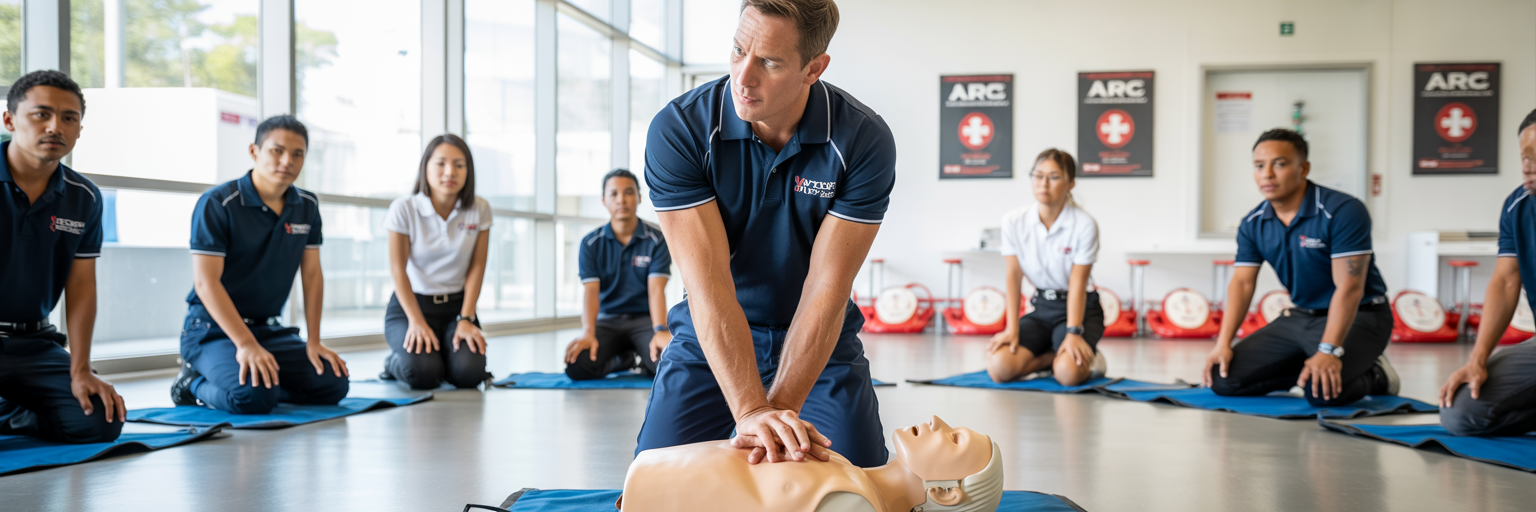
Is your CPR certificate about to expire? If you’re reading this on a Sunday evening frantically searching for renewal options, you’re not alone. Over 70% of Brisbane professionals renew their CPR certification within two weeks of expiry—and honestly, many of us are doing it with just days to spare.
Here’s the thing though – renewing your CPR certificate is actually way faster and simpler than when you did your original qualification. Most Brisbane renewal courses take just 2-3 hours (compared to that full day you had to sacrifice for initial certification), and you can walk out with a same-day digital certificate that’s ready to send to your boss immediately.
Whether you’re a personal trainer whose certificate expires this week, a teacher who needs documentation for HR by Monday, or an aged care worker who’s actually planning ahead for once, this guide covers everything you need to know about CPR renewal in Brisbane. You’ll learn exactly when to renew, how the process is different from that initial training session you sat through years ago, where to find next-available courses across Brisbane’s suburbs, and how to avoid the last-minute panic that affects thousands of professionals every year.
⚡Quick Answer: CPR certificates expire every 12 months in Australia. Renewal courses take 2-3 hours, and you'll receive a same-day digital certificate. Book 2-4 weeks before expiry for best availability.
How Often Do You Need to Renew Your CPR Certificate?
In Australia, you need to renew your CPR certificate every 12 months. Yeah, every single year. Unlike First Aid certificates which last for 3 years, CPR certification (that’s HLTAID009 Provide Cardiopulmonary Resuscitation if you want to get technical about it) expires annually and has to be renewed to stay valid.
Quick Renewal Timeline
When to Book Your Renewal:
- ✅ Ideal timing: 2-4 weeks before your expiry date (this is the sweet spot)
- ⚠️ Last-minute window: 1-2 weeks before expiry (still manageable, but you’re cutting it close)
- ❌ Expired: You can still attend a renewal course, but you’re technically unqualified until you’re recertified
Why Annual Renewal Actually Matters
CPR guidelines update regularly. The Australian Resuscitation Council reviews protocols annually, which means the compressions you learned two years ago might not match current best practice anymore.
Skills fade without practice. Studies show that compression quality drops by about 40% after 6 months without practice. That’s a big deal when someone’s life depends on you remembering the right depth and rhythm.
Employer compliance requirements. Most workplaces require valid, unexpired certification. Expired means invalid, which means you can’t legally work in roles that require CPR.
Insurance coverage gets messy. If your CPR certification has lapsed and something goes wrong, your professional indemnity insurance might be invalidated.
💡Pro Tip: Set a renewal reminder for 11 months after your course date. This simple step helps you avoid the last-minute scramble that catches 70% of Brisbane professionals off-guard every single year.
Understanding CPR Certificate Expiry in Australia
What Happens If Your CPR Certificate Expires
You can’t legally work in roles requiring CPR. Personal trainers, teachers, aged care workers, childcare educators – if CPR is part of your position requirements and your certificate has expired, you’re technically not qualified to be there. Some employers are strict about this (you’re stood down immediately), while others are more lenient (they give you a week to sort it out).
Your professional insurance might be worthless. If you’re working with an expired CPR certificate and something happens, your professional indemnity insurance can refuse to cover you. They’ll point to your expired certification and say you were operating outside your qualified scope.
You could lose income while you wait. Meet Sarah (not her real name, but this is a real story). She’s a personal trainer in Chermside who let her CPR certificate expire by three days. Her gym stood her down immediately – no training sessions, no income – until she got recertified. That’s two full weeks of lost income because she was three days late booking her renewal.
The good news? You can book a renewal course immediately even if you’re already expired. You’re just unqualified during the gap between expiry and recertification. Most Brisbane training providers run courses multiple times per week specifically because they know how many people are in this exact situation.
CPR vs First Aid Certificate Renewal Differences
| Certificate Type | Code | Renewal Frequency | What You Need to Know |
|---|---|---|---|
| CPR Only | HLTAID009 | Every 12 months | Annual renewal required, no exceptions |
| Provide First Aid | HLTAID011 | Every 3 years | Certificate lasts 3 years, BUT CPR component needs annual updates |
The CPR Renewal Process Explained
Step-by-Step: Booking Your CPR Renewal in Brisbane
- Check your current certificate expiry date. You need to know your exact expiry date so you can book before it lapses.
- Book 2-4 weeks in advance (or ASAP if you’re already expired). The earlier you book, the more course options you’ve got. Weekend spots fill up fastest, so weekday evening courses are often your best bet for urgent renewals.
- Bring your current certificate (or details) to the course. You’ll need to show proof of your previous certification.
- Complete the 2-hour practical training session. You’ll spend most of the session practicing compressions, doing rescue breaths, and running through different emergency scenarios.
- Pass the competency assessment. You just need to demonstrate that you can perform CPR to the current Australian Resuscitation Council standards.
- Receive your same-day digital certificate. Most Brisbane training providers email your new certificate within hours of course completion.
What to Bring to Your CPR Renewal Course
- Your current or expired CPR certificate
- Photo ID (driver’s license or passport)
- Comfortable clothing you can kneel in
- Your Unique Student Identifier (USI) number if you’ve got one
- Water bottle (CPR courses are physically tiring)
💡Pro tip: Wear clothing that's knee-friendly - you'll spend a solid chunk of time practicing compressions on the floor.
When to Book Your CPR Renewal Course
The Ideal Renewal Timeline
30-45 days before expiry: Optimal planning window with full course availability.
14-30 days before expiry: Still good timing, though popular weekend slots might be filling up.
7-14 days before expiry: Last-minute territory. Weekend courses are probably fully booked, so you’re looking at weekday evening sessions.
0-7 days before expiry: The panic zone. You’re at the mercy of whatever slots are left.
Already expired: Not ideal, but you can still book a renewal course. You’re just unqualified until recertified.
About 70% of Brisbane professionals book in that 7-14 day window. The stress of scrambling for available courses and limited location options is all avoidable if you just book a few weeks earlier.
Setting Up Renewal Reminders That Actually Work
Calendar reminder at 11 months after your course date. Not 12 months – 11 months. This gives you a full month buffer to find a course that suits your schedule.
Second reminder at 2 weeks before expiry. If you ignored the 11-month reminder, this one catches you before you’re in crisis mode.
Use your personal phone calendar, not your work calendar. When you change jobs, those reminders disappear.
Set them as recurring annual reminders. You’ll be doing this every year for your entire career.
What to Expect During Your CPR Renewal Course
Typical Course Structure
First 15-20 minutes: Welcome and guideline updates covering any changes to CPR protocols since you last trained.
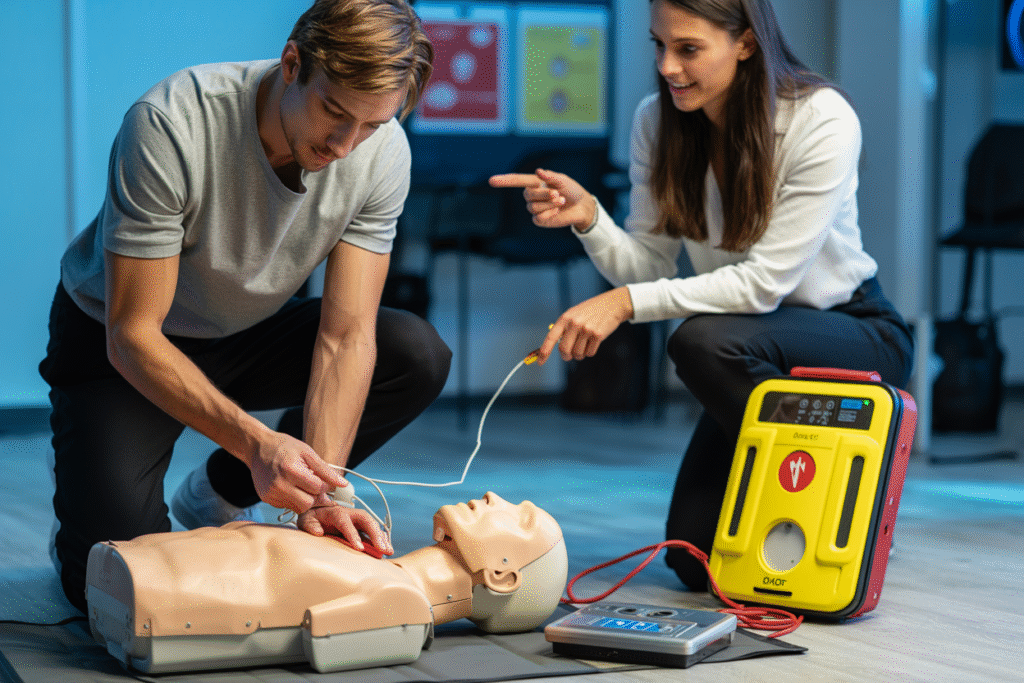
Next 60-90 minutes: Hands-on practice rotating through different stations – compressions, rescue breaths, using the AED, and running through complete CPR scenarios.
20-30 minutes: Assessment preparation where your instructor explains exactly what they’re looking for.
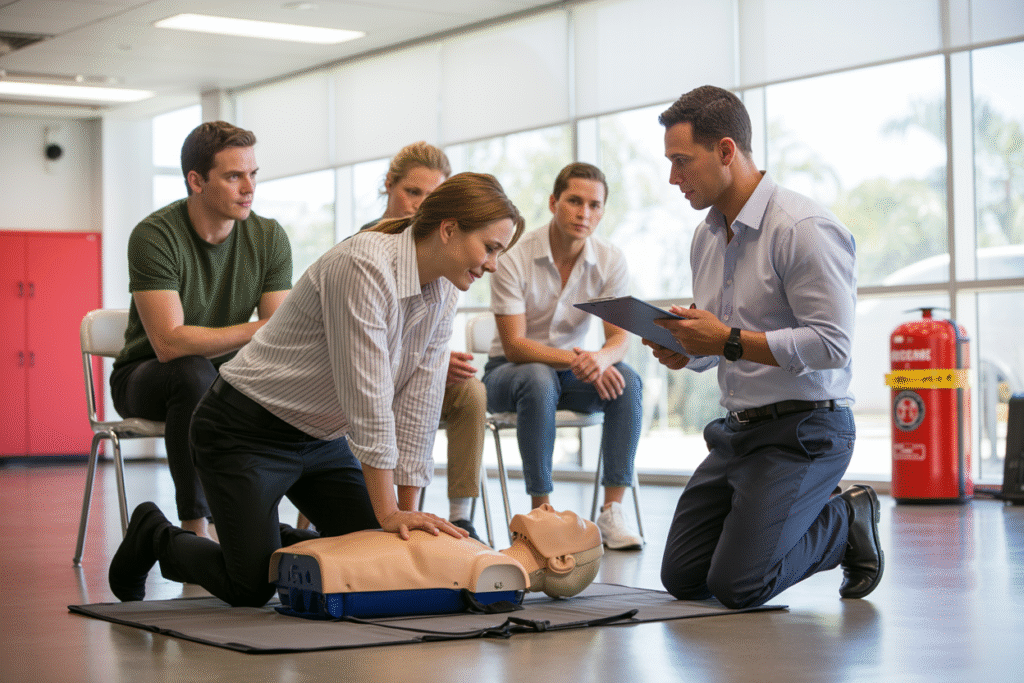
Final 20-30 minutes: Competency assessments demonstrating your CPR skills.
Last 5-10 minutes: Paperwork and certificates.
What You’ll Practice
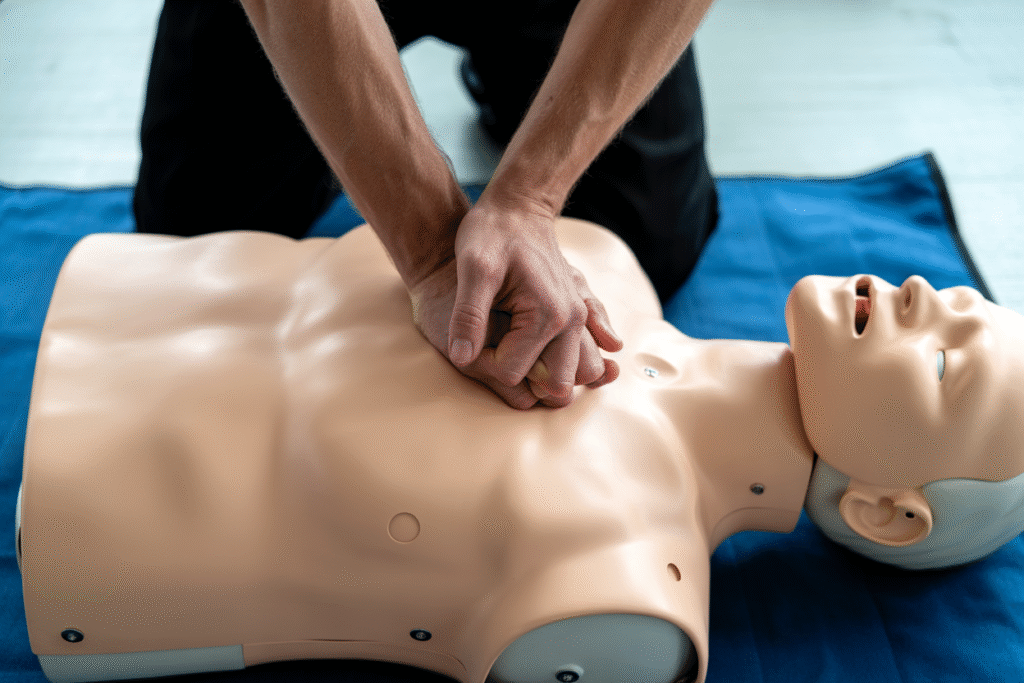
Chest compressions are the main event. You’ll practice correct hand placement, proper depth (5-6cm for adults), right speed (100-120 compressions per minute), and full chest recoil between compressions. Your arms will get tired – that’s normal.
Rescue breaths and airway management. You’ll practice opening airways properly and delivering effective rescue breaths.
Using an AED. You’ll practice turning it on, placing the pads correctly, and following the voice prompts.
DRSABCD action plan. The emergency response sequence: Danger, Response, Send for help, Airway, Breathing, CPR, Defibrillation.
Common Mistakes During CPR Renewal
Technical Errors People Make Most Often
Compression depth – too shallow is the #1 problem. You need to push down 5-6cm, and that’s deeper than most people think. If someone’s in cardiac arrest, they’re already dead. You can’t make it worse. Shallow compressions don’t circulate blood effectively.
Incorrect hand placement wastes your effort. Your hands need to be in the center of the chest, on the lower half of the sternum. The right spot is roughly between the nipples.
Rate problems. The target is 100-120 compressions per minute. The “Stayin’ Alive” trick genuinely works – that song is 103 beats per minute, right in the sweet spot.
Not allowing full chest recoil between compressions. You’re supposed to completely release pressure between compressions so the chest returns to normal position – that’s when blood flows back into the heart.
🚨Most Common Error: Compression depth too shallow (not pushing hard enough). You need 5-6cm depth - if someone's in cardiac arrest, they're already dead. You can't make it worse. Push harder than you think you need to.
Mental Blocks and Anxiety Management
Performance anxiety in front of the instructor. Remember your instructor wants you to pass. They’re not hoping to catch you out. A small mistake doesn’t fail you – stopping completely because you panicked is what causes problems.
Overthinking the process. Your body knows what to do even if your brain is spinning. Trust your muscle memory and just start doing compressions.
Practical anxiety management tips:
- Take deliberate deep breaths before your assessment
- Ask for a practice run-through right before assessment if you need it
- Talk yourself through it out loud during assessment
CPR Renewal for Different Industries
Personal Trainers and Fitness Instructors
Most fitness facilities require HLTAID009 (CPR) as the bare minimum, but many also require HLTAID011 (Provide First Aid). Most Brisbane gyms will stand you down the day your certificate expires – that’s direct loss of income until you’re recertified.
Teachers and Education Staff
Queensland schools need both CPR and Provide First Aid. School holidays are the obvious choice for renewal – December/January or June/July holidays see massive spikes in teacher renewals.
Aged Care and Disability Support Workers
HLTAID009 (CPR) is mandatory, with most facilities also requiring Provide First Aid. Your CPR skills might literally save someone’s life in this industry, which is why facilities are strict about keeping certifications current.
Childcare Educators
Every childcare educator needs HLTAID012 (Provide First Aid in an Education and Care Setting), which includes CPR plus asthma, anaphylaxis, and other child-specific emergencies. Make sure your renewal course covers infant CPR specifically – the technique for babies is completely different.
How to Book Your Brisbane CPR Renewal Course
Finding Accredited Training Providers
Check they’re a registered RTO. Their RTO number should be displayed on their website. If you can’t find one, that’s a red flag.
Verify their registration on the ASQA website. Go to asqa.gov.au and confirm they’re currently registered and allowed to deliver HLTAID009.
Look for Australian Resuscitation Council (ARC) alignment. Legitimate providers will mention that their courses follow ARC guidelines.
Warning signs of dodgy providers:
- Claiming you can get certified “100% online” without practical assessment
- No physical address or location details
- No contact phone number, only email
- Promising certification without attending a course
What Information You’ll Need to Provide
Your personal details:
- Full legal name
- Date of birth
- Email address (this is where your certificate gets sent)
- Phone number
- Physical address
Your previous CPR certification details:
- Certificate number (if you can find it)
- Date you completed previous training
- Training provider name
- Expiry date
Your CPR Renewal Checklist
Before Booking
□ Check your current certificate expiry date
□ Confirm what qualification you need (CPR only or First Aid combo)
□ Find your USI or create one
□ Research training providers in your area
What to Bring on Course Day
□ Current or expired CPR certificate
□ Photo ID
□ USI number
□ Water bottle
□ Comfortable clothing
After the Course
□ Check your email for digital certificate
□ Download and save your certificate to multiple locations
□ Forward certificate to your employer if needed
□ Add your new expiry date to your calendar
□ Set up renewal reminders for next year (11 months, 10 months, 2 weeks before)
Ready to Renew Your CPR Certificate?
CPR certificates expire every 12 months – no extensions, no grace periods. Book your renewal 2-4 weeks before expiry to give yourself options for dates and locations. The renewal course takes just 2-3 hours, and you’ll walk out with a same-day digital certificate that’s ready to send to your employer immediately.
Whether you’re a personal trainer who can’t miss shifts, a teacher with compliance deadlines, or an aged care worker who actually needs these skills for real emergencies – keeping your CPR current is non-negotiable. Set those reminders now, book early next time, and avoid the Sunday evening panic searches that 70% of Brisbane professionals do every year.
Your renewal course is mostly practical skills, not theory lectures. You’ll practice compressions until your arms are tired, get comfortable with the AED, and refresh the DRSABCD sequence. The assessment isn’t designed to trick you – your instructor wants you to pass and will coach you until you’re competent.
Set up those renewal reminders before you close this page. Future-you will thank you when you’re booking your renewal with a comfortable month of buffer time instead of frantically searching for same-day courses on a Sunday night.
Book Your First Aid Training Now
Fast, affordable, and nationally accredited training delivered by professionals who care
Frequently Asked Questions About CPR Renewal
Q.Can I renew my CPR certificate before it expires?
Yes, absolutely - you can renew anytime before your expiry date. Most Brisbane training providers are happy to take bookings from people whose certificates don't expire for another month or two. Your new certificate will be dated from when you complete the renewal course and will be valid for 12 months from that date. Just keep in mind that if you renew really early (like 6 months before expiry), you're essentially shortening your certification period since your old certificate expires on its original date regardless.
Q.What if I've completely forgotten everything from my last course?
Don't stress - this is way more common than you think. Most people who show up for CPR renewal have forgotten at least half of what they learned. That's exactly why renewal courses exist, and the instructor knows you're there to refresh forgotten skills, not demonstrate mastery. You'll get practice time, coaching, and gentle correction until your technique is back up to standard. If you're genuinely anxious, arrive a few minutes early and tell your instructor you're feeling rusty - they'll keep an extra eye on you during practice.
Q.Do I need to do the full First Aid course again or just CPR?
This depends on what certificates you currently hold and what your employer requires. If you only have HLTAID009 (CPR) and that's all your workplace needs, then you only need to renew CPR. If you have HLTAID011 (Provide First Aid), that certificate is valid for 3 years, but the CPR component within it still needs annual updates. Check what your employer actually requires before booking, because showing up with just CPR when you needed full First Aid is frustrating for everyone.
Q.How long does my renewed certificate last?
Your renewed CPR certificate (HLTAID009) is valid for 12 months from the date you complete the renewal course - not from when your old certificate expired, but from when you do the new course. So if you complete your renewal on November 15, 2025, your new certificate expires on November 15, 2026, and the date will be clearly printed on your certificate.
Q.What happens if I fail the assessment?
First off, failure rates for CPR renewal are very low because you've got recent practice and the instructor has been coaching you for 2 hours. But if there's a genuine safety issue with your technique, the instructor will give you specific feedback about what you need to improve, additional practice time and coaching, then reassess you - often on the same day. Instructors want you to pass and they're not trying to fail people. If you're genuinely trying and following their coaching, you'll get there.
Q.How do I verify my certificate is legitimate?
Your certificate will have an RTO logo and registration number on it, and employers can verify that RTO is legitimately registered with ASQA by checking the ASQA website at asqa.gov.au. Your certificate will also have a unique certificate number and a USI that are traceable through the national training database. Some employers might contact your training provider directly to confirm you completed the course, which is why it's helpful to keep the training provider's contact details along with your certificate.
Making first aid training more affordable for
every classroom
We believe every student deserves access to life-saving first aid knowledge. That’s why we offer specially reduced pricing for schools and educational groups. Whether you’re booking for a single class, a year group, or your entire school, our flexible packages make training more accessible and cost-effective — without compromising quality.
