
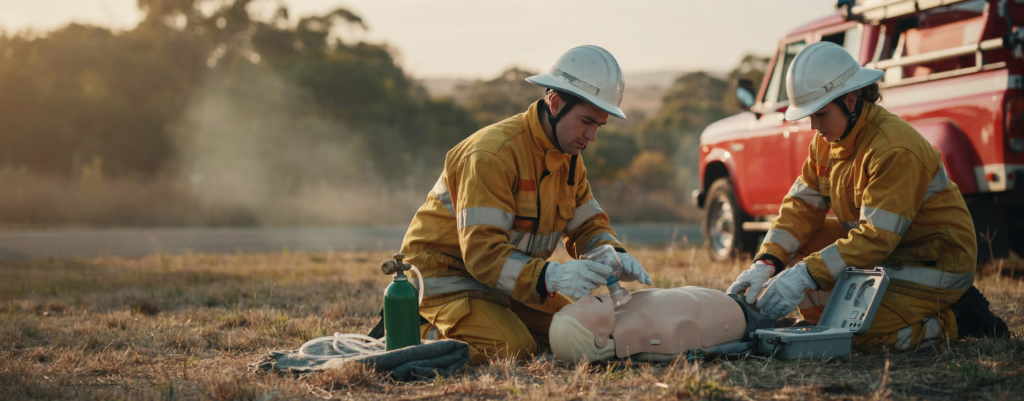
Queensland Ambulance Service crews attended 6,787 out-of-hospital cardiac arrests in 2023/24, and on a fireground, a rural road or an industrial site, the first person with an oxygen cylinder and an AED is often a firefighter. Resuscitation training for firefighters in Brisbane has to prepare you for that moment, not just tick a box.
That goes for Rural Fire Service Queensland volunteer brigades, industrial and site fire teams, airport and port precinct ERTs, and FIFO mine crews flying out of Brisbane between swings. Most of you have done CPR on a real person already. You don’t need the basics again.
What slips is the gear you barely touch. A regulator that felt simple in a training room gets fiddly fast with gloves on, heat building inside your PPE, smoke in the air and a long shift already in your legs. And it’s always the kit you need most that fades first.
HLTAID015 Provides Advanced Resuscitation and Oxygen Therapy goes straight at that gap. Real oxygen, airway, bag-valve-mask, suction and AED equipment. Scenario-based assessment. Onsite delivery for your whole crew.
Below is who books it, what the course covers, fire-specific scenarios, training an entire crew together, and how to pick a provider who’s worth booking.
What Does Resuscitation Training for Firefighters Cover?
Resuscitation training for firefighters in Queensland is usually delivered through HLTAID015 Provide Advanced Resuscitation and Oxygen Therapy. It builds on HLTAID011 Provide First Aid and covers:
- Emergency response: Checking the scene and the casualty when you're first on the job
- Advanced resuscitation: Single-rescuer and two-rescuer CPR using oxygen
- Oxygen therapy: Recognising when oxygen is needed, including with a pulse oximeter, and choosing the right delivery device
- Specialised equipment: Hands-on practice with the oxygen and resuscitation gear you'll use on the job
- Handover and reporting: Passing clear incident details to QAS paramedics
- Incident review: Debriefing and recognising the psychological impact on you and your crew
Training follows Australian Resuscitation Council guidelines. Courses for fire crews work best when the scenarios reflect the fireground: heat, PPE and limited space.
Who Books Resuscitation Training for Firefighters in Brisbane
Most people miss this part. Career Queensland Fire and Rescue firefighters do their medical training through the department. The people booking fire crew first aid training in Brisbane are pretty much everyone else who turns up when things are burning.
Rural Fire Service Queensland volunteer brigades
Fringe brigades are often first on scene, sometimes a long way from the nearest ambulance. On those jobs your crew is the medical response until QAS arrives. Rural brigades in Queensland have run advanced resus courses before and carried oxygen and AEDs on their appliances (Bundaberg Now, 2020). So the idea isn’t new. It just needs keeping sharp.
Industrial and site fire teams
Industrial and port fire teams usually work out of a first aid room that already has oxygen and an AED in it. If that gear’s on the wall, somebody on the team needs to be properly trained to use it. Usually that somebody is you.
Airport, port and precinct emergency crews
These crews get audited, and not just once. Contractors, principal clients and insurers all want proof that tickets are current, plus clean Statements of Attainment that upload to a contractor portal without endless back-and-forth emails.
FIFO mine site emergency crews
Plenty of mine emergency crews live in Brisbane and fly out to site. For them, HLTAID015 has to fit into a short break before the next swing, with nothing wasted on stuff they already know.
Whichever crew you’re on, the conditions you’ll resuscitate in look nothing like the training room.
🔥 Reality check: The training room is the easiest place you'll ever do CPR. Train for the harder version.
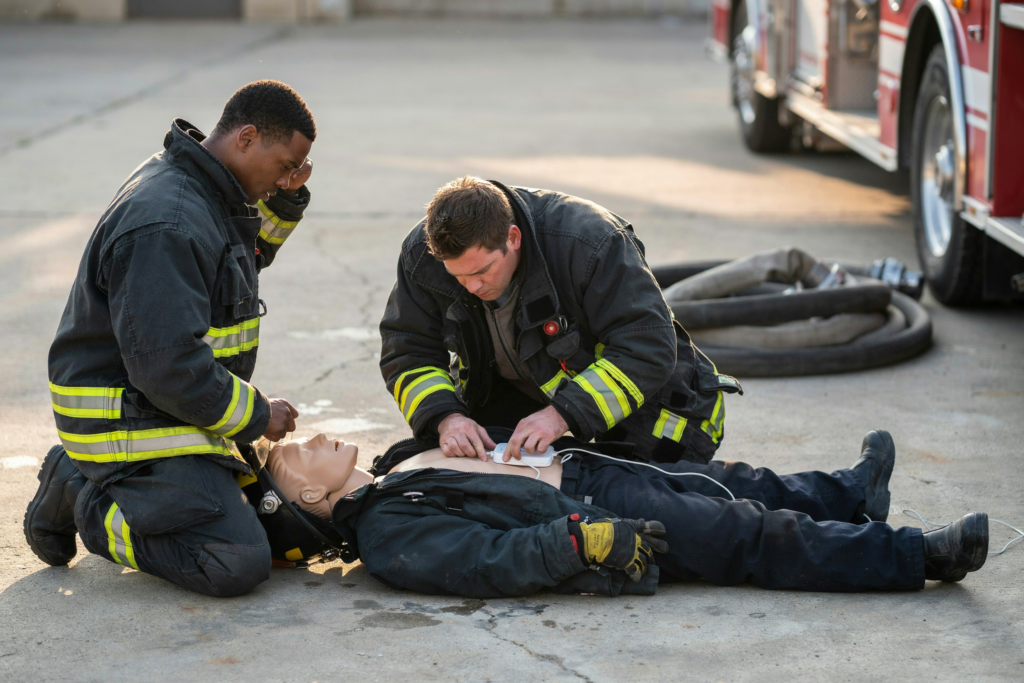
Why Resuscitation on the Fireground Is Different
A clean floor, good lighting and a manikin that doesn’t sweat make for a nice training room. The fireground gives you none of those. Advanced resuscitation for fire crews has to hold up when everything around you makes the job harder.
Heat, PPE and exertion
Sometimes the casualty is one of your own, in full turnout gear, after hard work. Before the pads go on and compressions start, the PPE has to come off, quickly and in the right order. Meanwhile the rest of the crew is already cooked from the same shift. Tired hands make sloppy CPR, so the drills need to be second nature.
Smoke, dust and a compromised scene
Scene safety comes first. It’s the first element of the unit, and on a fireground it can’t be skipped. Get the casualty into clean air before you start on oxygen. Oxygen makes things burn hotter and faster, so keep cylinders and delivery gear away from heat, flame and sparks, in line with Australian Resuscitation Council guidance on oxygen in emergencies.
🔥 Four-panel graphic Alt: Four ways fireground resuscitation differs: heat, smoke, access and distance.
Tight access and awkward positions
Real casualties don’t land in open space. They’re slumped in a vehicle, wedged in a plant room or lying on a narrow rural track beside a tanker. Two-rescuer technique matters here: who’s on compressions, who’s on the airway and oxygen, and where the kit sits so nobody kneels on the tubing.
Long waits before QAS arrives
On fringe and rural jobs, help can be a long way off. That means sustained casualty management: rotating compressors, watching the oxygen supply and keeping the casualty stable for longer than a city job would ask. Stamina and a plan count as much as technique.
That’s why the course has to put the equipment in your hands, not on a slide.
What You Will Do on an HLTAID015 Course
You’ve sat through enough slides. A good HLTAID015 Brisbane course gets you on the gear early and keeps you there. The HLTAID015 unit of competency article covers the element-by-element detail.
Oxygen therapy, hands on
This is where most crews feel the gap. You’ll practise oxygen therapy from start to finish: working out whether the casualty needs oxygen, using a pulse oximeter to help decide, picking the right delivery device and setting up the cylinder and regulator yourself. Not watching the trainer do it. You. That’s the difference between an oxygen therapy course Brisbane crews remember and one they forget by the car park. The five rights of oxygen administration piece goes deeper on the decision-making side.
Airway management and ventilation
You’ll work through airway management and ventilation on real equipment. The aim is simple. Pick it up, size it, use it, and repeat until your hands know the sequence without your head talking them through it.
Two-rescuer CPR with oxygen and an AED
Fire crews don’t work alone, so you won’t train alone either. You’ll practise two-rescuer CPR as a pair, bringing oxygen and the AED into the same sequence. Who’s on compressions, who’s on the airway, when you swap, and how you keep it smooth.
Handover to QAS
When the paramedics arrive, they need the story fast and clean. You’ll practise a structured incident handover: what happened, what you did, what’s changed. It’s the fourth element of the unit for a reason.
Debrief and crew wellbeing
The job doesn’t end when the ambulance leaves. You’ll cover reviewing the incident and recognising the psychological impact on yourself and the rest of the crew. Anyone who’s been on a bad job knows this bit matters.
Skills hold better when you’ve used them in a setting that feels like the real job.
🎯 Tip: Ask any provider how their scenarios reflect fire work before you book.
Fire-Specific Scenarios That Make the Training Stick
A manikin on a clean floor teaches you the steps. It doesn’t teach you to do them with a helmet still on and a tanker in the way. Scenario-based resuscitation training closes that gap, because your brain files the skill away with the conditions you practised it in. When comparing providers, ask whether they can run scenarios built around your work, like these three.
A crew member collapses in PPE
Example scenario: A crewmate goes down at the appliance after a stint on the hose line. The crew strips the PPE, starts CPR, gets the AED on and brings in oxygen, with somebody calling roles so nothing gets missed.
Skills used: PPE removal, two-rescuer CPR, AED, oxygen therapy, role allocation
A casualty in a vehicle or confined space
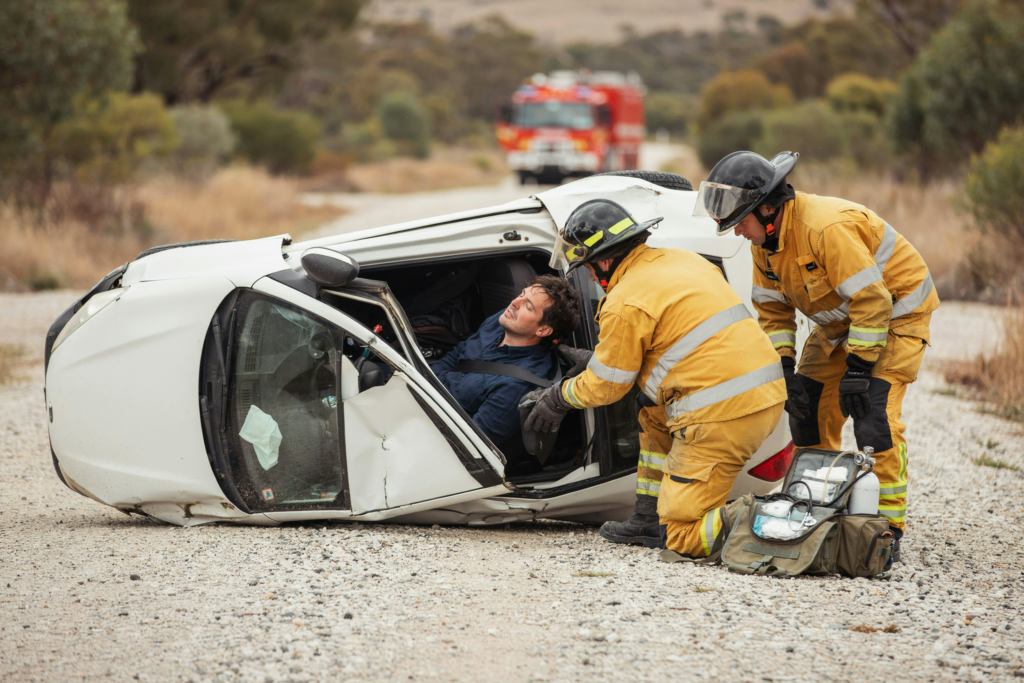
Example scenario: A driver is slumped behind the wheel after a rollover on a rural road. Is the scene safe? How do you get them out and positioned? And how do you run resus with barely enough room to kneel?
Skills used: scene safety, extraction, positioning, CPR in limited space
A remote fireground with no ambulance nearby
Example scenario: A casualty arrests on a fire trail well away from the nearest road. The crew settles in for sustained resus, rotating compressors, watching the oxygen supply and giving QAS a clear handover over the radio.
Skills used: sustained CPR, oxygen supply management, radio handover
None of this is about scaring anyone. It’s so the first time you face that setup isn’t the real thing.
Those scenarios work best when the whole crew trains together.
Training a Whole Brigade or Fire Team Onsite in Brisbane
A crew that trains together responds together. That’s the real argument for onsite advanced resuscitation training in Brisbane. Everyone learns the same sequence, the same calls and the same kit layout.
Training on your own equipment
Training on the cylinders, regulators and AED you actually carry takes the guesswork out. Nobody has to translate “the one at training” to “the one on our truck”.
Split sessions that keep cover
You can’t pull the whole brigade or site fire team offsite and leave the station empty. Split sessions fix that, so someone is always available to respond.
Group bookings
One booking for the whole crew is easier to organise and leaves one clean record for your training files.
Keeping a crew’s tickets current
Every crew leader knows this headache. One member’s HLTAID009 is coming due, someone else’s HLTAID011 has lapsed, and nobody can remember when the HLTAID015 tickets were done. Training as a group pulls everyone onto the same renewal date.
Crew Readiness Self-Check
Run through this at your next brigade or team meeting. Any “no” is worth fixing before the next call.
Check | Yes | No |
Every member can set up the oxygen regulator unaided | ☐ | ☐ |
Everyone’s HLTAID011 is current | ☐ | ☐ |
The crew has practised two-rescuer CPR with oxygen in PPE | ☐ | ☐ |
Everyone has trained on the same cylinders and AED you carry | ☐ | ☐ |
Everyone knows where the oxygen and AED are kept | ☐ | ☐ |
The crew has practised a structured handover to QAS | ☐ | ☐ |
The crew has a rotation plan for long resus on remote jobs | ☐ | ☐ |
You know every member’s HLTAID015 renewal date | ☐ | ☐ |
Enquire about onsite training for your crew
Before booking, check two things: that you hold HLTAID011, and when your current ticket runs out.
Entry Requirements and How Often to Renew
This part’s short. Before enrolling in HLTAID015, you need HLTAID011 Provide First Aid. That’s the official prerequisite listed on training.gov.au, and any decent provider will check it before your course. The HLTAID015 prerequisites article covers the finer detail.
Renewal is where people get caught out. There’s no single fixed legal period for HLTAID015, and these are exactly the skills that fade fastest. What decides your timing is whoever you answer to: your brigade, employer, insurer or principal contractor. Check with them, then book before your ticket lapses, not after.
HLTAID011 Provide First Aid | HLTAID015 | |
Scope | General first aid, including CPR | Advanced resuscitation, oxygen therapy, handover and incident review |
Oxygen | Not covered | Need for oxygen, pulse oximeter, delivery device |
Equipment | Standard first aid kit and AED | Oxygen and advanced resuscitation equipment |
Prerequisite | None | HLTAID011 Provide First Aid |
Then it comes down to a provider who takes the training as seriously as you do.
✅ Shortcut: A quick phone call tells you more about a provider than its homepage ever will.
Choosing a Brisbane Provider for Firefighter Resuscitation Training
Every provider says it runs the best advanced resuscitation course in Brisbane. That claim’s free to make. These seven points show you who can back it up.
Get Your Crew Ready Before the Next Call
The fireground doesn’t make allowances. Heat, PPE, smoke and long distances from help all work against you at once.
Your skills need to hold up when conditions are at their worst, not just on a clean training room floor.
Good resuscitation training for firefighters gets you there with real equipment, realistic scenarios and a whole crew trained the same way.
Start by checking if your HLTAID011 is current. Then book a public HLTAID015 date, or send through a crew enquiry and have the trainer come to you.
Grab the self-check while you’re at it and bring it to your next brigade or team meeting.
Book Your First Aid Training Now
Fast, affordable, and nationally accredited training delivered by professionals who care
Frequently Asked Questions
Q.Is HLTAID015 the same as a firefighter's department medical training?
No. HLTAID015 is a nationally recognised first aid unit delivered by registered training organisations, while department training for career firefighters is set by the department itself. Check with your service or employer if you're unsure whether one counts towards the other.
Q.Do I need HLTAID011 before HLTAID015?
Yes. HLTAID011 Provide First Aid is the prerequisite unit for HLTAID015, so have your Statement of Attainment ready when you book.
Q.How often should I renew HLTAID015?
There's no single fixed legal renewal period, so the answer depends on whoever sets your requirements, whether that's your brigade, employer, insurer or principal contractor.
Q.Can our whole crew train together?
Yes. Group training puts everyone through the same sequence and scenarios, helping bring the whole crew onto the same renewal date.
Q.Does the course cover setting up oxygen equipment?
Yes. You'll learn when oxygen is needed, how to use a pulse oximeter, how to choose a delivery device, and how to set up the cylinder and regulator yourself.
Q.Will the certificate work for contractor portals?
Yes. A Statement of Attainment shows the unit code, unit title and RTO number, which are details contractor portals and insurers commonly look for. Check the specific requirements of your contractor or insurer to confirm acceptance.
Making first aid training more affordable for
every classroom
We believe every student deserves access to life-saving first aid knowledge. That’s why we offer specially reduced pricing for schools and educational groups. Whether you’re booking for a single class, a year group, or your entire school, our flexible packages make training more accessible and cost-effective — without compromising quality.
