

It was a Tuesday morning in the toddler room. A four-year-old was playing on the mat when her body suddenly went rigid. Her arms stiffened. Her eyes rolled. She dropped to the floor.
The educator closest to her froze.
Not because she didn’t care. But because no one had ever shown her what a seizure in a four-year-old actually looks like. Her HLTAID012 certificate was sitting in the compliance folder, current and laminated. Seizure response was never covered – not in any way that stuck.
Epilepsy is one of the most common neurological conditions in childhood, and febrile convulsions affect somewhere between two and five percent of children under five. In a 75-place service, the probability that at least one child on your roll has a seizure condition is not a remote hypothetical. It’s a planning assumption.
So the question most Queensland directors are sitting with is this: does my team’s seizure management training childcare situation actually cover what it needs to? Is it inside HLTAID012 already – or does it need to be addressed separately? And what does Queensland childcare compliance actually require here?
The regulatory picture is genuinely ambiguous enough that even experienced directors get it wrong. This article gives you a clear answer – what seizure management training covers, what your NQF Quality Area 2 obligations mean in practice, and what you need to have in place.
What Does Seizure Management Training Cover for Childcare Educators?
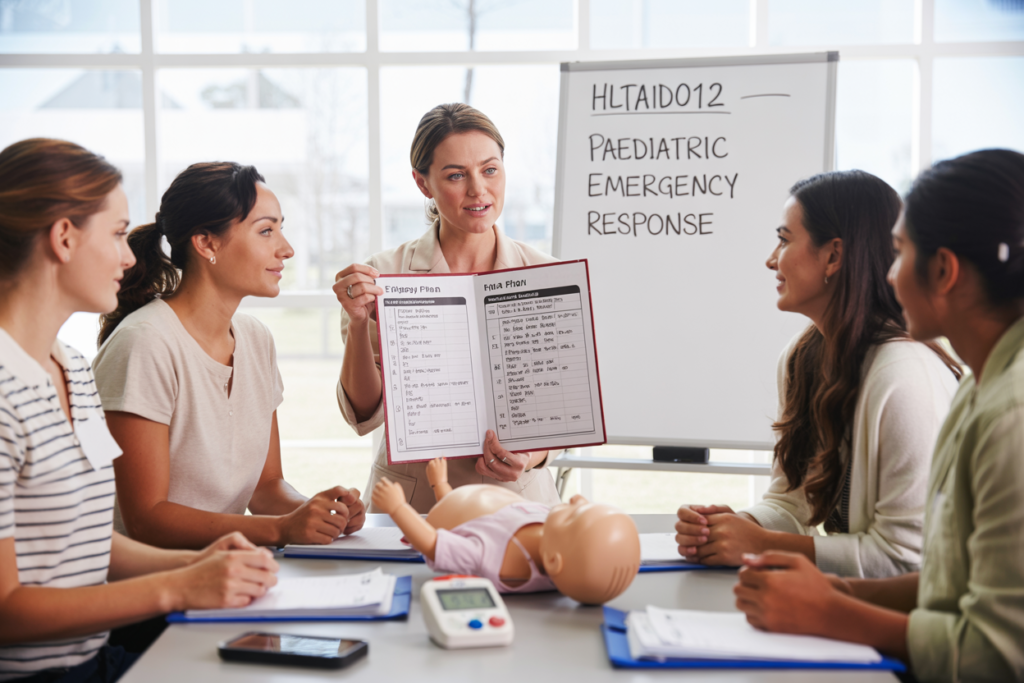
Seizure management training for childcare educators covers the recognition, safe response, and aftercare of seizure events in children including both febrile convulsions and epileptic seizures. A quality course delivered in an education and care context will typically include:
- Recognising the signs and types of seizures in infants and young children
- Safe positioning and environment management during a seizure
- Timing a seizure and knowing when to call 000
- Post-seizure recovery position and monitoring
- Understanding individual medical action plans for children with known seizure conditions
- When NOT to restrain or place objects in a child’s mouth
Is Seizure Management Training a Legal Requirement for Queensland Childcare Services?
There is no single regulation that says “all childcare educators must hold a seizure management certificate.” If you’ve gone looking for that specific line in the legislation, you won’t find it. But that does not mean seizure management training is optional – the regulatory web surrounding this issue makes it functionally mandatory for any service with an enrolled child who has a seizure condition, and strongly advisable for every service regardless.
What the National Regulations Say
Regulation 90 of the Education and Care Services National Regulations 2011 requires approved services to have a medical conditions policy covering children in their care. When a child with epilepsy is enrolled, that policy has to be implemented – which means educators have to be trained to implement it. It doesn’t just require paperwork. It requires your team to be capable of following an individualised epilepsy action plan in a real emergency.
Regulation 168 reinforces this by requiring health and safety policies that genuinely protect children. A service enrolling a child with a known seizure condition but without trained educators is sitting in a very uncomfortable position from a duty of care standpoint regardless of whether any incident has occurred.
⚠️ Regulatory reminder: For a child with epilepsy, compliance means trained staff who can respond - not just a laminated action plan on the wall.
How NQF Quality Area 2 Creates a Training Obligation
NQF Quality Area 2 – Children’s Health and Safety – is where seizure management training becomes impossible to sidestep at an assessment and rating visit. Element 2.1.1 requires that each child’s health is supported, and ACECQA’s guidance makes clear that services enrolling children with medical conditions must have individualised action plans in place and educators trained to follow them.
An assessor finding a documented epilepsy action plan but no seizure-specific training – that’s not a grey area. That’s a “Working Towards” finding. The NQF doesn’t grade you on your policies. It grades you on your practice.
What Happens If Educators Aren’t Trained
Serious incident reporting is triggered immediately when a child requires medical attention or an educator’s response may have contributed to harm. That report goes to the Queensland Department of Education and creates a record. Duty of care liability sits with the approved provider and the nominated supervisor – if a family can demonstrate a medical action plan was in place and the service hadn’t trained its educators, that’s a difficult position to defend. NQF assessment impact is real – a serious incident in a service that can’t demonstrate appropriate staff training goes directly to Quality Area 2 and can, in serious cases, put service approval at risk.
Knowing the regulatory obligation is one thing – understanding what your educators should actually be able to do is another.
Is Seizure Management Covered Inside HLTAID012?
The short answer is: yes – but it depends entirely on who’s delivering it. HLTAID012 includes content on altered consciousness and convulsions at the unit of competency level. But the gap between what the framework requires at a minimum and what a childcare educator actually needs in a real paediatric emergency is where a lot of providers fall short.
What HLTAID012 Covers and Where the Gap Is
The HLTAID012 unit of competency, as listed on training.gov.au, requires learners to recognise and respond to situations involving altered consciousness, with convulsions referenced in the performance evidence. What the framework does not prescribe is how that content is delivered or how specifically it is contextualised to childcare. That’s left to the RTO – which is exactly where quality differences between providers become visible.
A standard workplace first aid course with HLTAID012 attached is built around adult emergencies. The convulsions content is typically brief, scenarios involve adults, and the nuance specific to early childhood settings is either absent or superficial. What educators actually need goes well beyond the minimum – recognition of seizure types that present differently in young children, practical understanding of febrile convulsions, and hands-on familiarity with individual epilepsy action plans in a childcare scenario context.
💡 What to look for: Ask any provider directly: "Does your course cover absence seizures and febrile convulsions separately? Do educators practise with paediatric scenarios? Do you cover medical action plans?" The answers will tell you everything.
What Does a Seizure Look Like in a Young Child?
An educator cannot respond to a seizure they haven’t recognised – and recognising one in a young child is not as straightforward as most people assume. It doesn’t always look dramatic. Sometimes it looks like a child who just zoned out, stumbled, or went quiet.
Febrile Convulsions vs Epileptic Seizures
A febrile convulsion – is triggered by a rapid rise in body temperature, typically in children aged six months to five years. According to the Royal Children’s Hospital Melbourne, they affect approximately two to five percent of children in this age group, usually resolve without intervention, and are typically preceded by fever.
An epileptic seizure – is not triggered by fever it results from abnormal electrical activity in the brain and can occur without warning. In children with a diagnosed condition, the response is documented in their epilepsy action plan. In a child without a known diagnosis, it may be the first sign of a condition not yet identified.
💡 Key distinction: A febrile convulsion and an epileptic seizure can look almost identical in the moment. The response sequence is similar, but context and follow-up differ. Educators need to know both.
The Signs Educators Most Commonly Miss
Tonic-clonic seizures – are easiest to recognise the child loses consciousness, body stiffens, rhythmic jerking follows. Most educators will flag this as a medical emergency.
The ones that get missed are the subtle presentations. Focal awareness seizures leave a child partially conscious but confused or unresponsive to their name – easily mistaken for a behavioural episode in a busy room.
Absence seizures – are the most commonly missed of all. The child stops, stares blankly for five to thirty seconds, then resumes as if nothing happened – no falling, no convulsing. From across a childcare room, it looks exactly like daydreaming. According to Epilepsy Action Australia, some children experience dozens per day before a diagnosis is made, because episodes get attributed to inattention rather than neurological activity.
Recognition is only the first step – what matters equally is what happens in the sixty seconds after.
What Should an Educator Do During and After a Child’s Seizure?
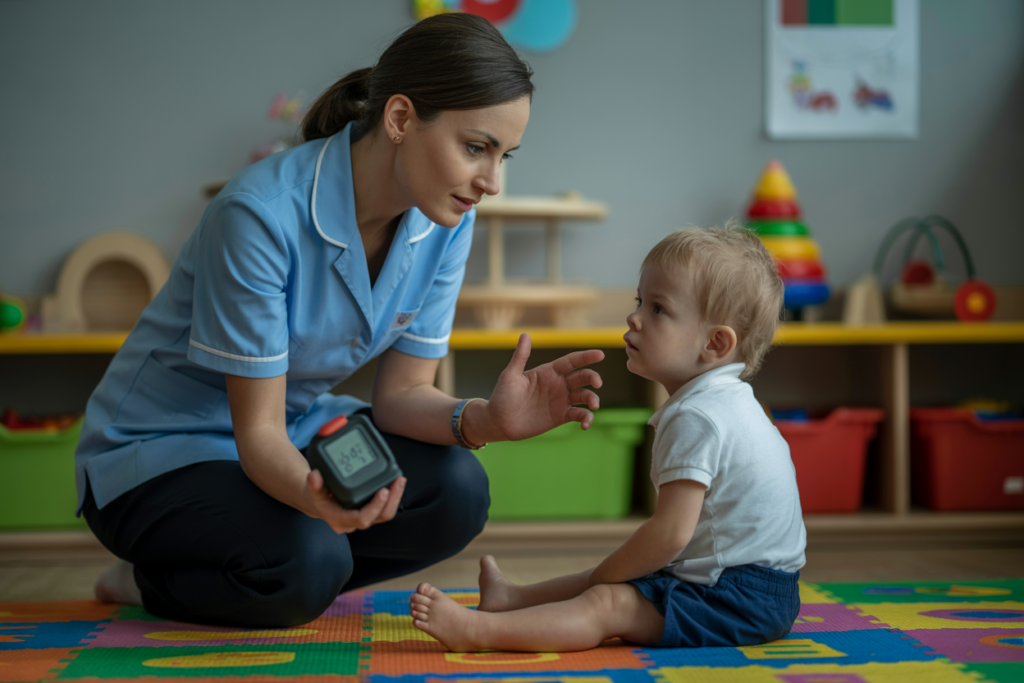
The response sequence below is what quality seizure management training builds into muscle memory a sequence an educator can execute under pressure with other children present, not just knowledge that lives in a folder.
The Step-by-Step Response Sequence
- Stay calm and stay with the child. Do not leave the child unattended. Send another educator for help – you stay.
- Note the time the seizure begins. Start timing immediately. Duration determines whether 000 needs to be called, and the treating team will need this information.
- Clear the surrounding environment. Move furniture and hard objects away. Do not move the child unless they’re in immediate danger.
- Do NOT restrain the child. Restraining during a seizure can cause injury. Let it run its course – your job is to protect the environment, not stop the movement.
- Do NOT put anything in the child’s mouth. Not a finger, not a spoon. A child cannot swallow their tongue during a seizure. Anything in their mouth creates a choking and bite injury risk.
- Position the child on their side if possible. If the child can be gently guided – without restraint – onto their side, do so. This reduces aspiration risk if vomiting occurs.
- Call 000 if any of the following apply:
- The seizure has lasted longer than five minutes
- The child does not regain consciousness after it stops
- The child is injured during the seizure
- It is the child’s first known seizure
- You are uncertain whether the child is recovering normally
- The child’s medical action plan instructs you to call 000
⚠️ When in doubt, call: A call that turns out to be unnecessary is not a problem. A call that should have been made earlier is.
- Follow the child’s individual medical action plan if one exists. That plan takes precedence – including thresholds for calling 000 and any medication instructions. Educators need to know where it’s kept and how to follow it under pressure.
Post-Seizure Care and Documentation
Place the child in the recovery position – on their side, airway clear, monitored until fully conscious. Do not leave them alone. Notify parents as soon as the immediate emergency is managed. Document the incident – start and end time, what the seizure looked like, actions taken, whether 000 was called, and parent notification details. If it meets the threshold for a serious incident, notify the Queensland Department of Education.
Knowing the right response sequence is critical – but it’s only as reliable as the training that built it.
What to Look for in a Provider
Most childcare directors have visited several provider websites before making a decision. They all say the same things – “quality training,” “experienced instructors,” “nationally recognised.” It starts to blur quickly.
Red Flags That a Provider Isn’t Genuinely Childcare-Focused
The course description reads like a workplace first aid page with a childcare code added at the bottom. No mention of paediatric scenarios, febrile convulsions, or NQF obligations – the code is there, the content is not.
Convulsions covered in a single paragraph. A genuinely paediatric-focused provider builds dedicated content around seizure types – not a checkbox.
No mention of medical action plans anywhere. If the provider hasn’t mentioned this, they haven’t built their course around the actual childcare context.
How Delivers Seizure Management Training
Advanced Resuscitation Training delivers seizure management as an integrated component of HLTAID012 – built around real paediatric emergencies, not adapted from a generic workplace template. The course covers febrile convulsions, tonic-clonic seizures, absence seizures, and focal presentations, with scenarios drawn from actual childcare settings. Educators practise following individual medical action plans so the skill is embedded, not just explained. ART is ASQA registered, with weekend courses and same-day digital certificates. Group bookings available.
Seizure management training childcare isn’t a compliance checkbox you tick once and forget. It’s the difference between an educator who freezes and an educator who acts – and in a paediatric seizure, the first sixty seconds are the ones that matter most.
Your HLTAID012 certificate is the foundation. But the quality of what’s built on that foundation depends entirely on who delivered it. A provider who covered convulsions in a slide and moved on has met a minimum. They have not prepared your educators for a four-year-old having an absence seizure on the mat, or the moment when someone has to open a child’s epilepsy action plan under pressure and actually follow it. That’s the standard worth holding your training to. Not the certificate – the capability behind it.
Book Your First Aid Training Now
Fast, affordable, and nationally accredited training delivered by professionals who care
Frequently Asked Questions
Q. Do I need a separate seizure management certificate, or is it covered in HLTAID012?
You don't need a separate standalone certificate - but whether your HLTAID012 training actually covers seizure management to the standard your service needs depends entirely on the provider. The unit of competency includes convulsions at a minimum level. A paediatric-focused provider will go significantly further, covering febrile convulsions, absence seizures, and medical action plan implementation as integrated content. Check with your provider before you assume it's covered.
Q. What should be in a child's epilepsy action plan at a childcare centre?
A child's epilepsy action plan should be prepared or approved by their treating physician - typically their paediatrician or neurologist - and updated regularly. At a minimum it should include a description of the child's typical seizure presentation, known triggers, the correct response sequence for that child specifically, thresholds for calling 000, whether any medication is to be administered and by whom, and emergency contact details. The plan should be accessible to all educators in the rooms that child attends - not just filed in the director's office.
Q. How often should childcare educators refresh their seizure management training?
HLTAID012 has a formal three-year renewal cycle, which sets the baseline. But three years is a long time - staff turn over, knowledge fades, and guidelines can change within that window. If your service enrols children with documented seizure conditions, building in an informal annual refresh - whether through a short scenario-based session or a team debrief after a near-miss - is a reasonable standard to hold your team to, even if the formal certificate hasn't yet expired.
Q. What's the difference between a febrile convulsion and an epileptic seizure?
A febrile convulsion is triggered by a rapid spike in body temperature and is most common in children aged six months to five years. An epileptic seizure is caused by abnormal electrical activity in the brain and can occur without fever or warning. Both can look similar in the moment, but the context, follow-up, and documentation requirements differ. Educators need to understand both - because febrile convulsions can happen to any child, not just those with a known seizure condition.
Making first aid training more affordable for
every classroom
We believe every student deserves access to life-saving first aid knowledge. That’s why we offer specially reduced pricing for schools and educational groups. Whether you’re booking for a single class, a year group, or your entire school, our flexible packages make training more accessible and cost-effective — without compromising quality.
