

Sarah found out her first aid certificate had lapsed the way most people do these days, an HR email flagging it during a routine audit, six weeks after the fact. Nobody warned her. And now there’s a course to book, except she works full-time, her weekdays are already spoken for, and the idea of losing an entire day to a classroom feels like more than the situation calls for.
This is exactly where self-paced online first aid theory comes in. It’s the first half of the HLTAID011 course, done on your own schedule, on your own device, before you ever set foot in a training room, followed by a short face-to-face practical session to finish things off.
For someone like Sarah, that means the theory gets done over a couple of quiet evenings, in short sittings, rather than eating a chunk of time she doesn’t have spare. She’s not trying to become an expert overnight, she just needs the certificate sorted before HR asks again, and a format that doesn’t require booking annual leave to make it happen.
Below, we’ll walk through how the modules actually work, what determines your pace through them, what still has to happen in person and why, and how the whole thing fits together from start to finish.
How Does Self-Paced Online First Aid Theory Work?
Self-paced online first aid theory is the first stage of HLTAID011, and you complete it independently, on any device, before you turn up for the face-to-face practical. There’s no fixed login time and no set schedule to work around, you log in when it suits, stop when you need to, and pick back up later.
The content itself is built around interactive modules, videos, scenario-based questions, and knowledge checks along the way, rather than one long block of reading. You can work through it in one sitting or spread it across several evenings, on your phone, laptop, whatever’s handy, and your progress saves as you go.
The one thing to keep in mind: it’s self-paced, not open-ended. It needs to be finished before your booked practical session, a face-to-face skills assessment where everything gets put into practice.
That distinction matters, because self-paced can sound like it means whenever you feel like it, no deadline at all. That’s not quite how it works here. Think of it more as flexible within a window, you choose when you sit down and do it, but there’s a practical date on the calendar and the theory needs to be behind you by the time that day comes around. For most people that’s not a problem at all, it’s easy enough to find a spare stretch across a week, it’s just worth knowing upfront rather than discovering it the night before your practical session.
📋 Quick take: Six short modules make up the online theory, each one designed to be finished in a single, easy sitting.

What Actually Happens in the Self-Paced Online Theory Component?
The theory covers everything you’d expect from a Provide First Aid course, just delivered as a sequence of short online modules instead of a lecture. Here’s the order it runs in:
- DRSABCD, the basic action plan for any emergency and the framework everything else in the course builds on
- CPR theory covering adults, children, and infants separately, since the technique changes depending on who you're dealing with
- AED operation, including how the device works, when to use it, and what it talks you through once switched on
- Medical emergencies, including asthma, anaphylaxis, seizures, heart attack, and other situations that can occur in an ordinary workplace
- Injury and bleeding management, covering the practical basics of controlling bleeding and treating common injuries before help arrives
- Legal and duty-of-care basics, including what you're required to do and what protections apply when you step in to help
Each of these plays out as its own short module rather than one long stream of content, so you’re never sitting through an unbroken stretch without a break. You move through video, answer a few scenario-based questions, do a quick knowledge check, then move to the next one. It’s built to keep you engaged rather than have you clicking through on autopilot.
How “Self-Paced” Actually Plays Out Day to Day
In practice, this usually looks like logging in on your phone during a break, getting through a module or two, then finishing the rest on the couch that evening. Or doing the whole thing in one go on a quiet afternoon, whatever fits. Your progress auto-saves as you move through it, so there’s no risk of losing your spot if you close the tab halfway through a module and come back to it a few days later.
There’s no software to download and no particular device you need. If you’ve got a phone with internet access, that’s enough to get through the entire theory component. Some people prefer a laptop for the video sections and switch to their phone for the quick knowledge checks between sittings, others just do the whole thing on whatever’s in front of them at the time. Neither way is more correct, it’s simply whatever fits into your week with the least friction.
If you’re weighing this up against a fully online theory option with no in-person component at all, our first aid online theory guide breaks down that broader comparison. Otherwise, you can see HLTAID011 course dates and book straight in once you’re ready to lock in a practical session.
⏱️ Quick take: Nobody moves through the modules at the same speed, and that's completely fine, there's no set pace to keep up with.
What Determines Your Pace
Realistically, the online component is built as short modules rather than one continuous slog, so it doesn’t feel like a long sitting the way a lecture might. Most people find it easier to break it into a few sittings than push through in one go, though there’s nothing stopping you doing it that way if you’d rather just get it done.
A few things affect how quickly you move through it:
- How much you already know, as previous first aid training can make some sections quicker to complete
- Whether you're skimming for the knowledge checks or reading through everything properly
- What device you're using, as moving through video content can be different on a phone compared with a laptop
Someone who’s done a first aid course in the past few years will often move through faster than someone coming to it fresh, since a lot of it is a refresher rather than brand new material. Someone coming to it for the first time might take a bit longer, particularly on the medical emergencies module where there’s more to take in. Either way, it’s not a race, and there’s no benefit to rushing through it just to tick a box, the knowledge checks are there to make sure it’s actually sinking in.
Combine the online theory with the practical session and the total commitment works out to roughly half of what a traditional full-day, one-sitting course asks of you. The difference isn’t just the total load either, it’s that most of it doesn’t have to come out of a single block of your week. The bulk of it fits around whatever else you’ve got on, and only the practical session needs a spot booked out on the calendar.
What You Still Have to Do Face-to-Face (and Why)
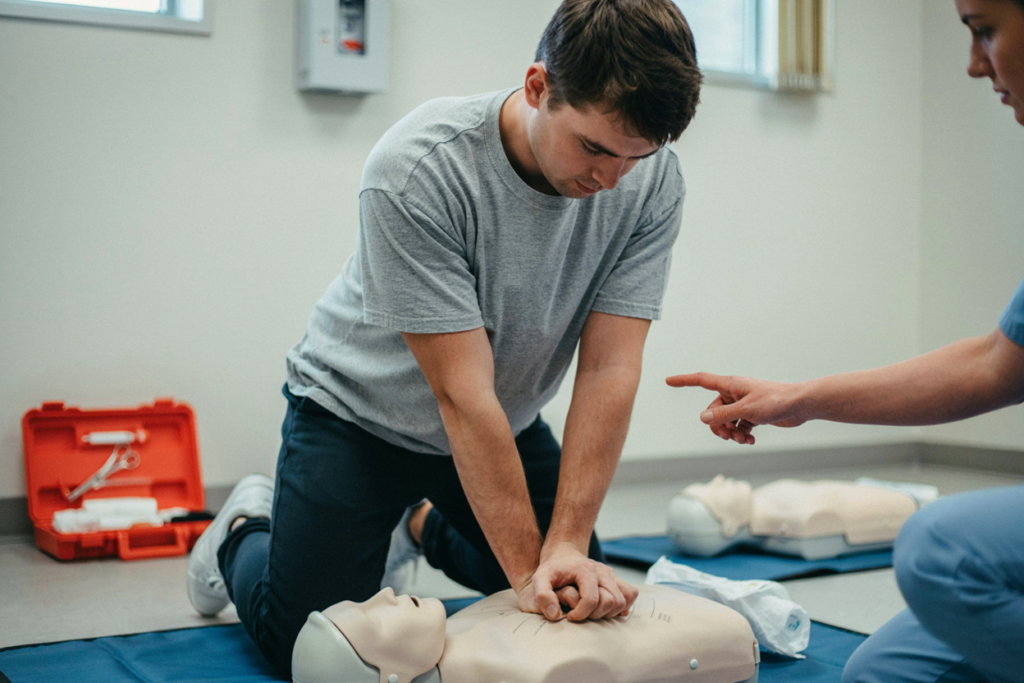
The online theory gets you through the knowledge side, but the practical session is where it actually becomes first aid rather than just information you’ve read. That session covers CPR on a manikin, using an AED, bandaging, putting someone in the recovery position, and working through scenario-based assessments where you’re asked to respond as if it were real. It’s led in person by Bill Hunter, who’s been training first aid for over 20 years, so you’re not working through this with a video on a screen, there’s someone there watching what you do and correcting it on the spot.
This part can’t move online, and that’s not First Aid Alive being cautious, it’s a regulatory requirement. Hands-on competency has to be assessed in person under ANZCOR guidelines, because knowing the steps to CPR and actually being able to do them under a bit of pressure are two different skills, and only one of those can be properly checked through a screen. Watching a video of someone doing chest compressions correctly doesn’t tell an assessor anything about whether you can do it yourself, at the right depth and rate, when it’s actually your hands on the manikin.
It also means the practical session isn’t a formality tacked onto the end. It’s where mistakes get caught and corrected before they matter, where you get to ask the question you didn’t think of during the online modules, and where the scenario-based assessments put everything from the theory together in a way that reading about it never quite does. Having Bill run that session in person, rather than it being a video walkthrough, means there’s someone actually watching your technique and telling you straight away if something needs adjusting.
The certificate you walk away with is identical either way though, whether you did the theory online or sat through it in a classroom, it carries the same validity and the same recognition. There’s no asterisk next to it, no note saying part of it was self-paced, and no reason to check with your employer beforehand, it’s a nationally recognised Statement of Attainment regardless of how the theory got done.
Once your theory’s done and your practical’s booked, that’s it: theory at your own pace, a short session with Bill in person, and you walk out with your certificate the same day. Book your HLTAID011 course here to get a practical date on the calendar.
Wrapping It Up
There’s a particular kind of relief in ticking something off a list you’ve been avoiding, and getting a first aid certificate sorted usually falls into that category more than people expect going in. It’s not the online theory that people dread, it’s the thought of losing a full day to it, and once that’s off the table, the whole thing stops feeling like a burden and starts feeling like something you just get done on a quiet night between dinner and whatever’s on the telly.
What matters most is that the flexibility doesn’t come at the cost of the certificate meaning anything less. Doing the theory on your phone during a break, or spread across a couple of evenings on the couch, produces exactly the same qualification as sitting in a room for a full day. Employers don’t ask how you got there, they just want to see the Statement of Attainment, and that document looks the same regardless of the path.
The practical session is where the format earns its keep, in a sense. It’s short, it’s focused, and because the theory’s already done, that time is spent entirely on the parts that actually need a person in the room watching you do them properly. No sitting through content you’ve already absorbed the night before, no wasted time.
For anyone who’s been putting this off because the idea of a full day away from work feels like too much to ask, the self-paced structure removes that excuse fairly cleanly. It’s built for people juggling a job, not for people with a free day to spare, and that distinction matters more than it might seem at first glance.
There’s also something to be said for finishing a course feeling like you actually took it in, rather than having sat through a long day half listening toward the end. Shorter sittings, spaced out, tend to land better than one long stretch, and a lot of people notice that difference once they’re through the practical and actually asked to demonstrate what they’ve learned.
Getting the certificate sorted is really just the start of the point, not the end of it. The actual value sits in knowing what to do if something happens, at work or anywhere else, and that’s true whichever way the theory got done. The format is just the part that makes it possible to fit in around everything else going on, so the thing that actually matters, being able to help someone when it counts, doesn’t get put off simply because a full day off was never really on the cards.
Book Your First Aid Training Now
Fast, affordable, and nationally accredited training delivered by professionals who care
Frequently Asked Questions
Q.Do I have to finish the online theory in one sitting?
No. You can stop and start as many times as you need to, and the progress tracking is there specifically so you're not forced into one long session just because you're worried about losing your place.
Q.What if I run out of time before my practical date?
Get in touch and we'll sort out rescheduling. It happens, life gets in the way, and it's a quick fix rather than something to stress about, far better to reach out than to turn up without having finished the theory.
Q.Will my employer accept a certificate from a blended, self-paced course?
Yes. It's a nationally recognised Statement of Attainment, and there's no distinction made based on how the theory was delivered, so there's nothing to check with HR beforehand, the certificate speaks for itself.
Making first aid training more affordable for
every classroom
We believe every student deserves access to life-saving first aid knowledge. That’s why we offer specially reduced pricing for schools and educational groups. Whether you’re booking for a single class, a year group, or your entire school, our flexible packages make training more accessible and cost-effective — without compromising quality.
