
Your first aid certificate expired two months ago, and you just found out there’s a workplace audit next week. You’re not alone—over 40% of Brisbane workers let their first aid certification lapse without realizing it, creating potential compliance issues and leaving them unprepared for workplace emergencies.
The standard first aid course in Australia (officially known as HLTAID011 Provide First Aid) has specific requirements that changed in 2022, and many workers remain confused about what they need, how long it takes, and which course actually meets their employer’s requirements.
Here’s the thing—you probably did your last first aid course years ago. Maybe it was called HLTAID003, or maybe you can’t even remember what the code was. You stuffed the certificate in a drawer, thinking you were good for “a few years,” and now here you are, stressed about compliance and not sure where to start.
This comprehensive guide cuts through the confusion. You’ll discover exactly what a standard first aid course covers, how it differs from CPR-only training, what the 2025 requirements are, and how to get certified quickly without sacrificing quality.
In this guide, you’ll learn:
- What qualifies as a “standard” first aid course in Australia
- HLTAID011 requirements and what’s covered
- Certification validity and renewal requirements
- How to choose the right provider and book quickly
What is a Standard First Aid Course?
A standard first aid course in Australia refers to HLTAID011 Provide First Aid, the nationally recognized qualification that teaches you to respond to emergency situations, injuries, and medical conditions. This is the most common first aid certification required by Australian employers across retail, hospitality, fitness, office, and community sectors.
Standard first aid course includes:
- CPR for adults, children, and infants
- AED (defibrillator) operation
- Managing bleeding, burns, and fractures
- Recognizing heart attacks, strokes, and anaphylaxis
- Treating shock and unconsciousness
- Wound care and bandaging techniques
- Emergency response procedures
The course involves both theory and hands-on practice, resulting in a nationally recognized certificate valid for three years. Unlike CPR-only courses (HLTAID009), standard first aid provides comprehensive emergency training that meets most workplace health and safety requirements.
💡 QUICK TIP: If your employer said "get your first aid certificate" without specifying a course code, they almost certainly mean HLTAID011. When in doubt, ask your HR department for the specific course code required.
Understanding HLTAID011: Australia’s Standard First Aid Course
What HLTAID011 Replaced
In 2022, Australian training standards updated first aid course codes. If you hold a certificate showing HLTAID003 Apply First Aid, this was the previous version—now replaced by HLTAID011 Provide First Aid.
The government loves changing these codes every few years, which is frustrating when you’re just trying to stay compliant. But the actual content? Pretty similar. They’ve just updated it to match current best practices.
Key Changes:
- Updated CPR guidelines (2021 Australian Resuscitation Council standards)
- Enhanced medical emergency content (stroke, heart attack, anaphylaxis)
- Refined practical assessment requirements
- Clearer industry-specific applications
If your certificate shows HLTAID003 and has expired, you’ll complete HLTAID011 to renew. The course content is similar but updated to current best practices. Your previous certification experience means you’ll likely find the renewal familiar—you’re not starting from scratch, you’re just refreshing what you already know with some updated techniques.
Who Needs HLTAID011 Provide First Aid?
HLTAID011 is the most common first aid requirement across Australian industries:
Industries Requiring Standard First Aid:
| Industry | Typical Roles | Why Required |
|---|---|---|
| Retail | Store managers, supervisors, team leaders | WHS compliance, customer safety |
| Fitness | Personal trainers, gym staff, yoga instructors | Fitness Australia requirement, client safety |
| Hospitality | Venue managers, bartenders, senior wait staff | Patron safety, liquor licensing in some states |
| Office/Corporate | First aid officers, floor wardens, managers | Safe Work Australia compliance |
| Community Services | Support workers, youth workers, event coordinators | Vulnerable population safety |
| Construction | Site supervisors, foremen | High-risk environment, WHS requirement |
According to Safe Work Australia’s First Aid in the Workplace Code of Practice (2023), businesses must ensure workers have adequate first aid training to respond to workplace incidents. HLTAID011 satisfies this requirement for most businesses.
What You’ll Learn in a Standard First Aid Course
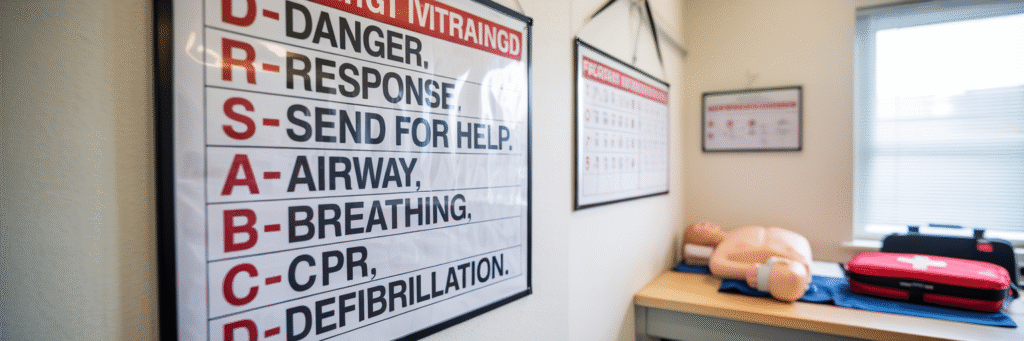
The DRSABCD Action Plan
The foundation of any emergency response is DRSABCD—an acronym that guides you through what to do when you encounter an emergency.
D – Danger: Check for danger to yourself, others, and the casualty
R – Response: Check if the person is responsive
S – Send for Help: Call 000 immediately
A – Airway: Open the person’s airway
B – Breathing: Check if they’re breathing normally
C – CPR: If not breathing, start CPR immediately
D – Defibrillation: Use an AED if available
This sequence becomes second nature after practicing it several times during the course.
CPR Skills You’ll Master
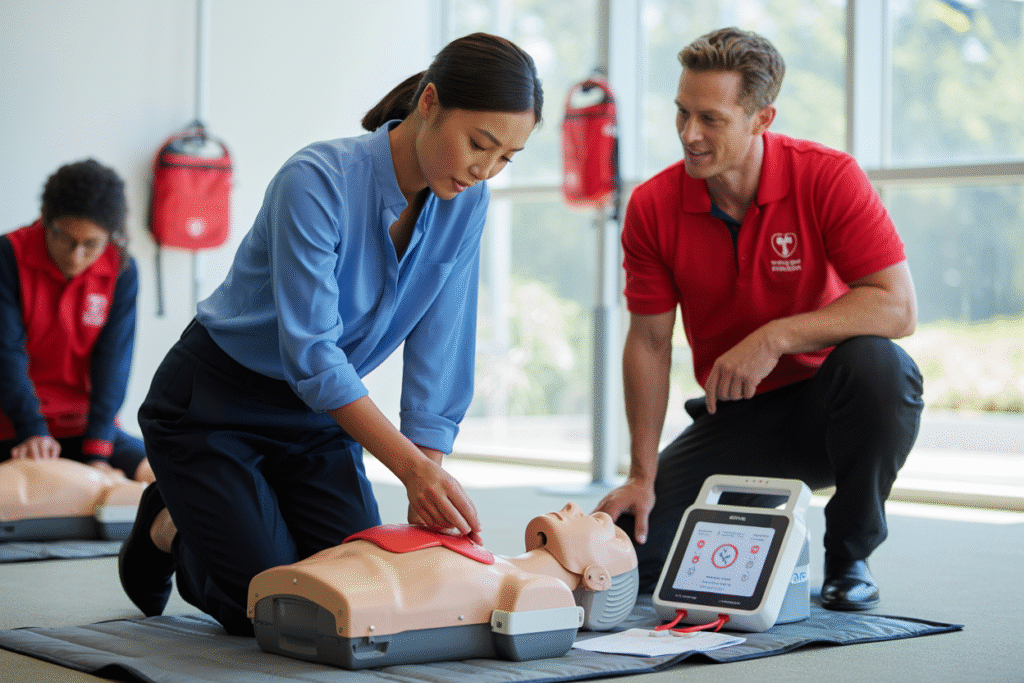
CPR (cardiopulmonary resuscitation) is the most important skill you’ll learn. You’ll practice on mannequins until the technique is automatic.
Key CPR Elements:
- Hand Placement: Center of the chest, one hand on top of the other
- Compression Depth: 5-6cm deep (feels harder than you expect)
- Compression Rate: 100-120 per minute (think “Stayin’ Alive” by the Bee Gees)
- Rescue Breaths: 30 compressions, then 2 breaths
You’ll learn CPR for adults, children (ages 1-8), and infants (under 1 year), with techniques modified for each age group. The course also covers hands-only CPR for situations where you’re uncomfortable giving rescue breaths.
Common Injuries and Medical Emergencies
Severe Bleeding:
- Apply direct pressure for at least 10 minutes
- Add padding without removing original cloth if blood soaks through
- Elevate the injured part above the heart
- Apply pressure bandage once bleeding slows
Burns:
- Cool under running water for 20 minutes
- Remove jewelry before swelling starts
- Cover with clean, non-stick dressing
- Call 000 for serious burns
Fractures and Sprains:
- Don’t move the injured limb
- Support it in the position you found it
- Apply splint if materials available
- Immobilize joints above and below the injury
Heart Attack Recognition:
- Chest pain or pressure
- Pain spreading to jaw, neck, or arms
- Shortness of breath, nausea, sweating
- Call 000, help them sit, give aspirin if available
Stroke Recognition (F.A.S.T.):
- Face: Does one side droop when smiling?
- Arms: Does one arm drift downward?
- Speech: Is speech slurred or strange?
- Time: Call 000 immediately if any signs present
Anaphylaxis:
- Difficulty breathing or swallowing
- Swelling of tongue or throat
- Call 000, help with EpiPen if available
- Lay flat unless breathing difficulty
Using an AED (Defibrillator)
You can’t hurt someone with an AED—it only shocks if needed. The device talks you through every step: turn it on, attach pads to bare chest, press analyze, follow prompts. You’ll practice with a training AED during the course.
📍 BRISBANE AED LOCATIONS: Westfield shopping centers, gyms, office buildings, Brisbane Airport, and many Brisbane City Council parks have public AEDs. The Brisbane City Council maintains an online AED registry showing locations near you.
Certification and Validity
How Long is Your Certificate Valid?
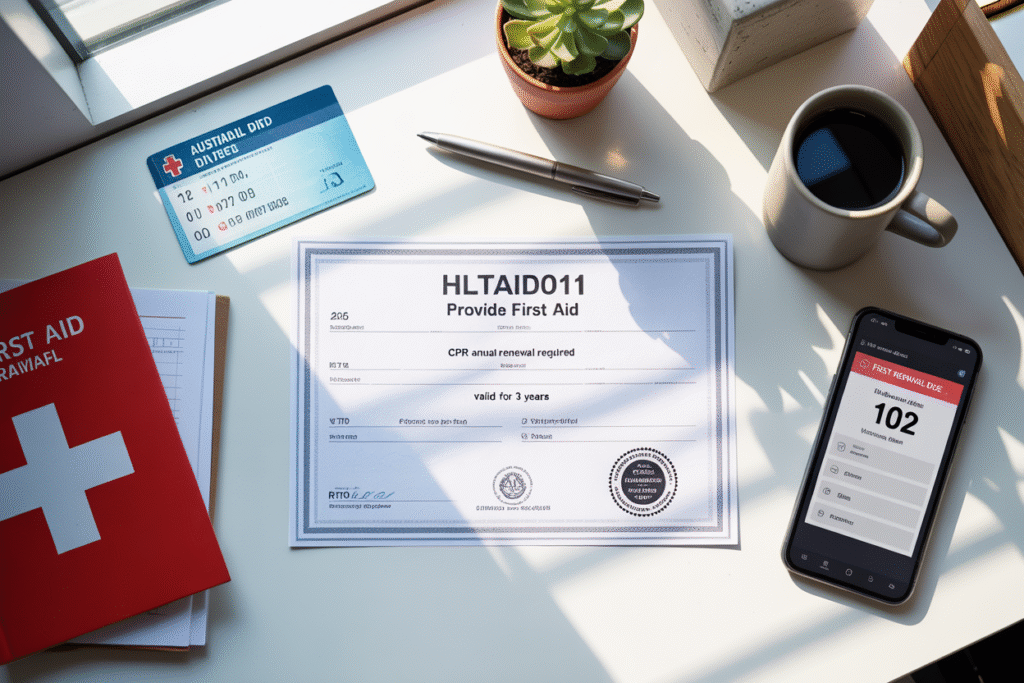
Your HLTAID011 Provide First Aid certificate is valid for three years from completion date. However, the CPR component needs renewal every 12 months.
Timeline Example:
- Year 1: Complete HLTAID011 (full first aid + CPR)
- Year 2: Complete HLTAID009 (CPR refresher only)
- Year 3: Complete HLTAID009 (CPR refresher only)
- Year 4: Complete HLTAID011 (full first aid + CPR again)
Some Brisbane employers are strict about this—if your CPR component is expired even by one day, they’ll consider you non-compliant.
What Your Certificate Looks Like
You’ll receive two versions:
Digital Certificate (Emailed Same Day): PDF sent within hours of completing the course, including your name, course code (HLTAID011), completion date, expiry date, and training provider’s RTO number. This is the version you submit to your employer.
Physical Certificate Card (Mailed Within a Week): Wallet-sized card you can carry. Same information as digital version, just more convenient for showing proof on the spot.
What Happens If You Let Your Certificate Lapse
Your certificate expires on the date shown—no grace period. If your employer checks and you’re expired, even by one day, you’re non-compliant.
Consequences:
- Can’t act as workplace first aid officer
- Employer may be in breach of WHS requirements
- For self-employed (personal trainers, contractors): insurance may be invalid
- Professional body registration may be suspended
Getting Recertified: Simply book another full HLTAID011 course. There’s no penalty or extra requirements—just complete the training again.
Setting Up Renewal Reminders
Don’t be like the 40% of Brisbane workers who let certificates lapse.
Set multiple reminders:
- 3 months before expiry: Start looking at course dates
- 1 month before: Book course NOW
- 2 weeks before: URGENT reminder
- Annual reminder for CPR renewal
Your qualification is recorded on the national USI (Unique Student Identifier) database, providing permanent verification even if you lose your certificate.
Course Requirements and Prerequisites
Who Can Take a Standard First Aid Course?
No medical background required. No previous first aid training needed. If you can follow instructions and practice physical skills, you can complete HLTAID011.
Age Requirements:
- Minimum age: 14 years old
- No maximum age
Physical Requirements:
- Ability to kneel on floor for CPR practice
- Ability to perform chest compressions
- Modifications available for physical limitations
Language Requirements:
- Sufficient English to understand verbal instructions
- Ability to read training materials and complete simple written assessment
What to Bring on Course Day
Required Items:
- Valid photo ID (driver’s license, passport, proof of age card)
- Pen and paper for notes
- Lunch and water
Everything else is provided—training manuals, practice equipment, morning tea, assessment materials.
What to Wear
Comfortable, practical clothing you can move in easily:
- Jeans or casual pants (not too tight)
- T-shirt or casual shirt
- Closed-toe shoes (required for safety)
Don’t wear:
- Short skirts or dresses (you’ll be kneeling on the floor)
- Tight restrictive clothing
- High heels or thongs
- Expensive clothes (you’ll be practicing on the floor)
Medical Conditions and Physical Limitations
If you have physical limitations or concerns about completing practical skills, tell your instructor at the start. Instructors can modify techniques, suggest alternative positioning, and work with you individually.
Common accommodations:
- CPR from standing position for those who can’t kneel
- Modified hand positions for wrist/hand injuries
- Extra support techniques for back problems
- Alternative positions for pregnancy
You still need to demonstrate competency, but most people with limitations can complete the course with appropriate accommodations.
Choosing the Right Training Provider
What Makes a Quality Provider
In a class of 12, the instructor can work with everyone individually. In a class of 25, you’re lucky to get 2 minutes of one-on-one attention.
Instructor Qualifications: Look for current or former paramedics with real emergency experience, not just minimum teaching qualifications. They can share real scenarios and answer questions from experience rather than textbooks.
Reviews and Ratings: Check Google Reviews for 4.5+ stars with 100+ reviews minimum. Read recent reviews mentioning “small class,” “patient instructor,” and “felt confident after course.”
Same-Day Certificate: Quality providers email digital certificates within hours. Waiting 5-7 days suggests outdated systems.
Accreditation: Every legitimate provider must be a Registered Training Organisation (RTO) with ASQA. Check their RTO number at training.gov.au before booking.
Red Flags to Avoid
Website Red Flags:
- No physical address listed
- No instructor information
- No reviews or only fake-looking reviews
- Unprofessional appearance
Communication Red Flags:
- Takes days to respond
- Vague answers to simple questions
- High-pressure sales tactics
Policy Red Flags:
- No rescheduling allowed
- No satisfaction guarantee
- Unclear cancellation policy
Standard First Aid vs Other First Aid Courses
HLTAID009: Provide CPR (Not Standard First Aid)
What It Covers: CPR skills only—no injury management, no medical emergencies, no bandaging.
Who Needs It:
- Annual CPR renewal for those holding HLTAID011
- Very specific workplace situations (rare)
Who Should NOT Book It: Pretty much everyone else. If your employer said “get your first aid certificate” without specifying CPR-only, they mean HLTAID011 (full first aid).
HLTAID011: Provide First Aid (Standard First Aid)
This is what 90% of Brisbane workers need. It includes everything in HLTAID009 (CPR) PLUS comprehensive first aid training.
Certificate Validity:
- Full first aid: 3 years
- CPR component: Annual renewal required
HLTAID012: Provide First Aid in Education and Care Setting
Who Needs It:
- Childcare educators and assistants
- Preschool teachers
- Outside School Hours Care (OSHC) workers
- Early childhood services
This is legally required for regulated childcare. HLTAID011 is not sufficient for these roles.
What’s Different: Includes everything in HLTAID011 plus extensive child-specific scenarios, detailed asthma management, and anaphylaxis management with EpiPen training.
HLTAID014: Provide Advanced First Aid
Who Needs It:
- FIFO (fly-in fly-out) workers
- Remote mining or construction sites
- Outdoor adventure guides working hours from medical facilities
For most Brisbane workers, HLTAID011 is sufficient.
Course Comparison Table
| Feature | HLTAID009 (CPR) | HLTAID011 (Standard) | HLTAID012 (Education) |
|---|---|---|---|
| CPR Skills | ✓ | ✓ | ✓ |
| Injury Management | ✗ | ✓ | ✓ |
| Medical Emergencies | ✗ | ✓ | ✓ |
| Child-Specific Content | ✗ | Basic | Extensive |
| Validity | 1 year | 3 years (CPR annual) | 3 years (CPR annual) |
| Meets Most Employer Requirements | ✗ | ✓ | Only for childcare |
💡 STILL UNSURE? Here's the simplest test: Ask your employer or professional registration body "Do I need HLTAID011 Provide First Aid?" If they say yes or don't know the specific code, that's your answer. HLTAID011 is the default standard first aid course for 90% of workers.
Ready to Get Certified?
You now know everything about standard first aid courses:
✓ HLTAID011 is the standard first aid course in Australia
✓ Certificate is valid for 3 years (CPR component needs annual renewal)
✓ You’re qualified to take this course (minimal prerequisites)
✓ How to choose a quality provider (small classes, paramedic instructors, same-day certificate)
✓ What to expect on course day
The only thing left: Book your course.
Don’t be like the 40% of Brisbane workers who let their certificates lapse. Don’t wait until there’s an audit next week or your insurance company asks for proof. Book now while you’re thinking about it.
Three months from now, you’ll be glad you did.
Certificate Expired Already?
Don’t stress. You can book and complete your renewal—providers train students in your situation every week. Nobody judges you for letting it lapse. Just get it sorted now.
Book Your First Aid Training Now
Fast, affordable, and nationally accredited training delivered by professionals who care
Frequently Asked Questions About Standard First Aid Courses
Q.Can I do a standard first aid course online?
No. Australian training standards require face-to-face practical assessment for CPR and first aid skills. Some providers offer "blended learning" with online theory, but the practical component is mandatory in person.
Q.How long does a standard first aid course take?
Most standard first aid courses run for one full day. You'll need to dedicate this time to complete both theory and practical components, though some providers offer two-evening formats that spread the training across multiple shorter sessions.
Q.What's the pass rate for standard first aid courses?
About 98% of students pass on first attempt. The course is designed for ordinary people to succeed, not to trick you or make you fail. Instructors provide extensive practice and won't assess you until they're confident you're ready.
Q.Is there a written exam?
Yes, but it's straightforward. Most written assessments are multiple choice and short answer format covering scenarios you've just practiced. It's more about demonstrating understanding than memorizing facts.
Q.What if I'm really nervous about the practical assessment?
You're not alone—most students feel nervous initially. By the time assessment happens, you'll have practiced each skill dozens of times with instructor feedback. The assessment is one-on-one with your instructor, not performed in front of the whole class.
Q.Can I renew my certificate early before it expires?
Yes, anytime. Common reasons include upcoming travel, busy periods ahead, or convenient course dates. Note that your new certificate starts from completion date, not from your old expiry date.
Q.What's the difference between renewal and taking the full course again?
For HLTAID011, there's no difference. You complete the same course covering all content. Skills degrade over 3 years, so the full course ensures you're properly trained, not just quickly refreshing vague memories.
Making first aid training more affordable for
every classroom
We believe every student deserves access to life-saving first aid knowledge. That’s why we offer specially reduced pricing for schools and educational groups. Whether you’re booking for a single class, a year group, or your entire school, our flexible packages make training more accessible and cost-effective — without compromising quality.
