

You’re standing next to a bed, the airway’s compromising fast, and someone’s already reaching for the suction unit. Not the moment for second guessing your technique. Yet plenty of clinicians end up there without having practised in a while, because suction device training tends to sit low on the priority list.
Suction competency slips quiet. Your CPR drills stay sharp, your defib checks stay sharp, and somehow rigid versus soft catheter technique just gets assumed. It won’t hold, not without practice. It’s part of what makes the rest of resuscitation actually work, not a footnote at the end.
This training sits inside Advanced Resuscitation Techniques (HLTAID015), built for clinicians who know the basics cold and need the airway piece drilled again, ANZCOR-aligned, hands on, run by instructors who’ve worked ICU or critical care, not a generalist reading off a slide deck.
Below, how often you need to renew this, what “current” looks like once you strip away the paperwork, and how it fits around a roster instead of fighting it.
How Often Is Suction Device Training Required?
Suction device training should be renewed roughly every 12 months, lined up with your broader resuscitation certification cycle. If your clinical role changes, your employer sets its own rule, or you’ve had time away from practice, that window can shrink.
A few things that tend to shorten it:
- ● A change in clinical role, moving into ICU, ED, retrieval, or somewhere else that's airway heavy.
- ● Your employer or credentialing committee running their own renewal timeframe, separate from the general 12 month guide.
- ● Extended leave from clinical practice, where hands-on time with the device has genuinely dropped off.
That’s the short version. Here’s what actually goes into keeping that competency sharp, not just current on a bit of paper somewhere.
🫁 Clinical Reality Check: A wrong suction technique doesn't just fail to help, it can actively delay airway clearance when seconds matter.
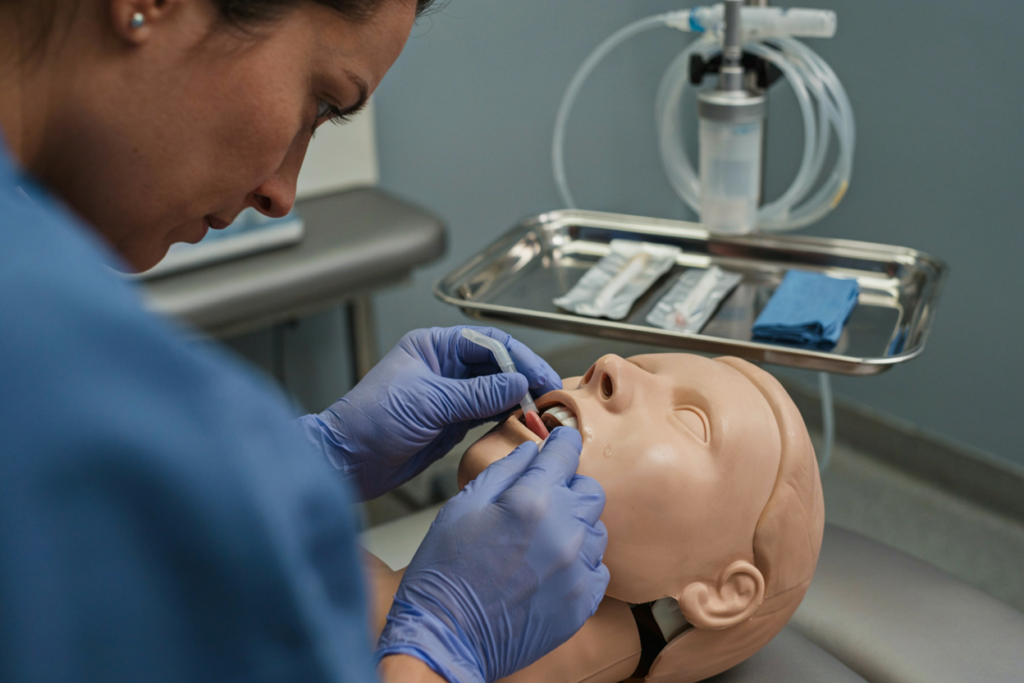
What Suction Device Training Covers at the Advanced Level
Most people picture suctioning as something you just do, catheter in, button pressed, done. Anyone who’s managed a compromised airway under real pressure knows it’s not that simple. Get it wrong and you’re moving the problem around, sometimes making it worse.
Airway assessment and when suction is clinically indicated. Before you suction anything you’re reading the airway first, secretions, blood, vomit, that gurgling sound telling you air isn’t moving cleanly. Those signals tell you suction is needed now, not in a minute. The real skill is the split second call on whether this patient needs it and how hard.
Device types and technique, rigid versus soft catheter. There’s an actual difference between a rigid Yankauer tip and a soft flexible catheter, not just preference.
Device | Best Used For | Key Technique Note |
Rigid Yankauer | Thick secretions, vomit, large volume | Wide bore, controlled sweep, visual guidance |
Soft catheter | Fine nasal or oral secretions, deeper reach | Gentler insertion, measured depth, lower trauma risk |
Grab the wrong one, or use it badly, and you’re either not clearing enough or causing trauma that wasn’t needed.
Common technique errors that delay effective airway clearance:
- ● Suctioning too long in one pass instead of short, controlled bursts.
- ● Going in without a clear line of sight, especially with the rigid tip.
- ● Applying suction on insertion instead of on withdrawal.
- ● Skipping the reassessment step after the first pass.
- ● Using the wrong catheter size for the patient in front of you.
None of these are complicated fixes. They’re habits that drift when your hands haven’t been on the kit in a while, and that’s the gap this training closes.
How This Fits Within Advanced Resuscitation Certification (HLTAID015)
Suction technique doesn’t live on its own. It sits inside the full resuscitation algorithm, the piece that gets skipped over more than any other.
Where suction sits in the ANZCOR resuscitation algorithm. Airway before breathing, before circulation, every clinician knows that cold. What’s talked about less is where suction fits inside that airway step. It’s not a side task ticked off once you’ve “handled” the airway, it’s often what decides whether your airway management works. Perfect head positioning and airway adjuncts mean little if fluid or secretions sit there unaddressed. This training puts suction back in its proper place, ANZCOR-aligned, not improvised in the moment.
Credentialing and CPD portfolio relevance. For a lot of you this isn’t just a refresher, it’s tied to something real. Hospital credentialing committees want this documented properly, and your CPD portfolio needs it filed right, not a generic certificate that doesn’t map to what you did in the room.
- ● Certification that lines up with what your credentialing committee actually asks for, not a vague "attended a course" line.
- ● CPD hours that slot cleanly into your existing portfolio structure.
- ● A paper trail that holds up if your registration or indemnity ever gets questioned on this specific competency.
If your currency lapses it’s rarely just an inconvenience. For a lot of clinicians it’s the difference between staying rostered on certain shifts or getting pulled off them until it’s sorted. Getting the documentation right the first time avoids that mess later.
👩⚕️ Not for Everyone, and That's the Point: This course is built for clinicians already working where airway compromise is real, not a general workplace refresher.
Who This Course Is For
This isn’t a course for someone who’s never touched a manikin. If you’re already working somewhere airway compromise is a real possibility, not a hypothetical on a slide, this one’s built for you.
ICU, ED, theatre recovery, retrieval and aeromedical clinicians. If you’re pulling shifts in ICU, ED, theatre recovery, or out doing retrieval work, you already know the stakes. You’re not signing up to learn what a suction device is, you’re signing up to get your technique properly drilled again, taught by people who’ve done this work themselves. A generalist reading off a slide deck won’t cut it here.
Nurse educators and unit based group bookings. A lot of people booking this aren’t booking for themselves. Nurse educators and unit managers often need a whole team together, ICU team, ED team, whoever’s rostered and due around the same time. That’s a different kind of booking, not nine people trickling in on nine schedules, one coordinated session that works for the unit.
If that’s you, this isn’t the generic first-aid funnel where you’re one of a hundred random bookings. It’s built with your group in mind.
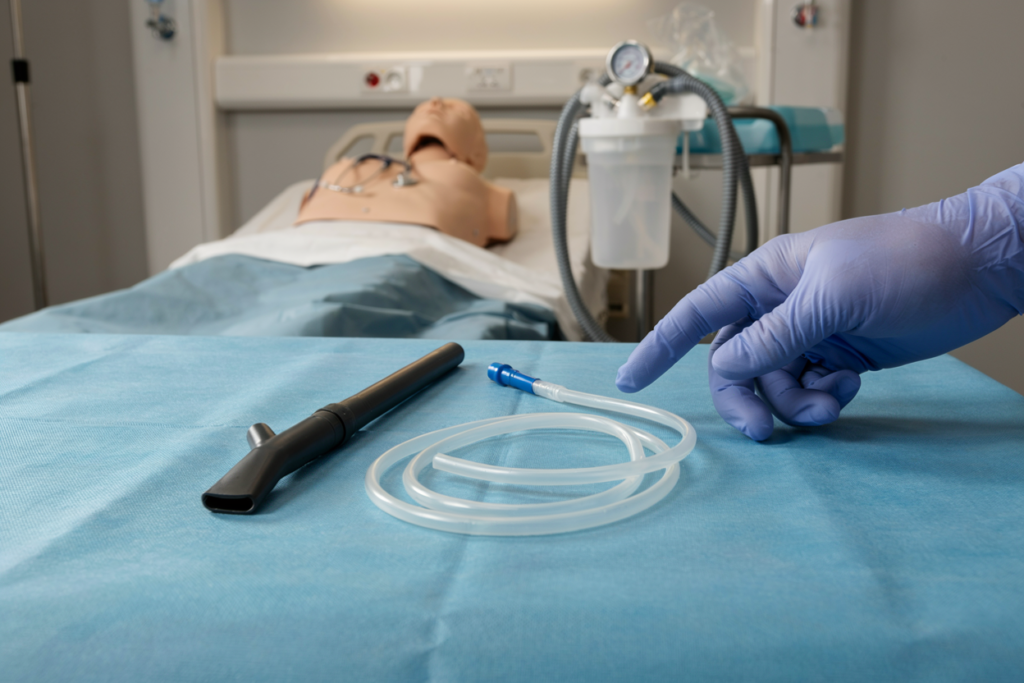
Course Format, Instructors and Group/Cohort Bookings
Booking a group session and having it fall short, not enough manikins, one instructor stretched too thin, that’s a specific dread if you organised it for your unit. This part makes sure that never happens.
Small groups and equipment for every participant. Vague promises of “small groups” don’t mean much on their own. What matters is whether there’s enough kit for everyone to get real hands on time.
- ● An instructor to participant setup that's stated plainly, not left to guesswork.
- ● A suction setup and manikin for every participant during practical sessions, not shared around.
- ● Enough time built in for repeated attempts, since one pass isn't enough to drill it in properly.
📅 Roster Reality: You're not "too busy," your available days are locked in months ahead, so a date-first booking approach actually matters here.
Dates, Renewal Timing and Roster Friendly Booking
Roster locked availability is a real constraint, not a scheduling preference, and generic “book any Saturday” calendars don’t solve it. If your days off are locked in months ahead, you need to check specific dates fast.
How to check current availability by specific date. The booking system filters by date first. Search your actual rostered day off, see what’s available against it, and book from there. No back and forth emails trying to find a slot that fits.
What happens if certification has already lapsed? If your suction competency has already lapsed that’s not the end of the world, but it needs sorting quickly, especially if it’s affecting your rostered shifts or scope of practice.
- 1. Book the next available date that fits your roster, even outside the usual renewal window.
- 2. Let your employer or credentialing committee know a renewal is booked, so there's a paper trail while you get sorted.
- 3. Bring any prior certification documentation along, it can help confirm your competency history.
Getting back on top of this doesn’t need to be complicated, it just needs to happen without more delay.
Conclusion
There’s a difference between knowing something and being drilled on it recently, and that gap is where suction technique likes to hide. Your algorithm knowledge stays sharp, your defib checks stay sharp, and somehow the piece that actually clears the airway gets treated like something you’ll just remember when it counts. It won’t, not without hands on repetition.
What separates a course that helps from one that wastes a rare day off comes down to who’s teaching it and how honest the content is about your level. A generalist trainer can talk you through a suction device in five minutes, but that’s not the same as someone who’s stood at a real bedside making that split second call.
Renewal timing, documentation, credentialing, none of that sits separate from the clinical skill. A certificate that doesn’t map cleanly to what a credentialing committee or CPD portfolio needs creates more work later, usually at a worse time. Getting the paperwork right the first time protects your scope of practice.
Group bookings carry their own weight too. Anyone who’s organised training for a unit knows the dread of one instructor stretched across too many people, or not enough manikins to go around. Being properly resourced, with real equipment for every participant, is the difference between a team walking out drilled and a team that just sat through a lecture.
None of this is really about ticking a box. It’s about the version of you standing at a bedside months from now, hand on a catheter, not hesitating because the technique is still fresh. That’s what recent, hands-on practice buys you.
Book Your First Aid Training Now
Fast, affordable, and nationally accredited training delivered by professionals who care
Frequently Asked Questions
Q. Is suction device training its own certificate or part of something bigger?
It sits inside Advanced Resuscitation Techniques (HLTAID015), so it's a skill module within your broader resuscitation currency rather than a separate standalone qualification.
Q. Do I need to already be a clinician to book this?
Yes, this course is built for people already working somewhere airway compromise is a real possibility, ICU, ED, theatre recovery, retrieval, or aeromedical work, not a general first-aid audience.
Q. What's the actual difference between a rigid and soft suction catheter?
A rigid Yankauer tip is generally suited to thick secretions or large-volume clearance with a wide bore and visual guidance, while a soft catheter suits finer secretions or deeper reach with a gentler, more measured insertion.
Q. Can I book this for my whole unit at once?
Yes, there's a dedicated group and cohort pathway for nurse educators and unit managers booking a team together, rather than everyone booking separately on different dates.
Q. What happens if my certification has already lapsed?
You can still book the next available date that fits your roster, let your employer or credentialing committee know a renewal is booked, and bring any prior certification documentation along to help confirm your competency history.
Making first aid training more affordable for
every classroom
We believe every student deserves access to life-saving first aid knowledge. That’s why we offer specially reduced pricing for schools and educational groups. Whether you’re booking for a single class, a year group, or your entire school, our flexible packages make training more accessible and cost-effective — without compromising quality.
