

Your 12-year-old comes home from school and hits you with this: “Mum, what would you do if someone collapsed and stopped breathing?”
It’s one of those questions that makes you stop mid-dinner prep, right? Because honestly, it’s confronting. And it also highlights something we don’t talk about enough—most Australian kids have zero idea what to do in a real emergency.
So what age for CPR training actually makes sense?
Here’s what the research says: kids as young as 10 years old can genuinely learn and perform CPR effectively. That’s according to the Australian Resuscitation Council and pretty much every international best practice guideline out there. And here’s the thing that should make every parent pay attention—early CPR training doesn’t just teach kids a skill, it increases the chances that someone will actually step in during a cardiac emergency. Which matters, because survival rates drop 10% for every minute someone’s not getting CPR.
Think about that for a second. Every minute counts. And we’re raising a generation of kids who mostly don’t know what to do.
Whether you’re a parent wondering if your child’s ready for CPR training, a teacher planning school safety programs, or a youth sports coach who’s responsible for young athletes every weekend, understanding the right age to start this education can literally be the difference between life and death.
What Age Can You Learn CPR?
Here’s the straight answer: children can start learning CPR from as young as 10 years old. That’s the official recommendation from the Australian Resuscitation Council and international resuscitation guidelines. But CPR education doesn’t have to be all-or-nothing—you can introduce it in stages based on what kids can actually handle at different ages.
Ages 5-9 Years:
At this age, kids aren’t physically strong enough to do full CPR, but they can learn the basics:
- How to recognize when someone needs help
- Calling 000 and what to say
- Basic compression-only CPR (simplified version)
- When to get an adult and when it’s actually an emergency
Ages 10-12 Years:
This is where it gets real. Kids at this age can do everything:
- Full CPR technique—compressions plus rescue breaths
- Proper hand placement and getting the compression depth right
- Using an AED (defibrillator) if there’s one nearby
- Getting nationally recognized certifications like HLTAID009
Ages 13+ Years:
By this age, they’re basically training at the same level as adults:
- Complete adult CPR training with no modifications
- All nationally recognized first aid certifications
- Same physical capability as adults for doing effective compressions
The Physical Requirements:
Here’s what kids actually need to pull this off: enough strength to compress an adult chest 5-6cm deep, and the stamina to maintain 100-120 compressions per minute. Most 10-year-olds can do this with proper training and technique. It’s not about being super strong—it’s about using the right body position and letting your weight do the work.
🏥 Official Position: The Australian Resuscitation Council doesn't set a minimum age for CPR training. Instead, they focus on physical capability—if a child can achieve proper compression depth and rate, they can learn effective CPR regardless of age.
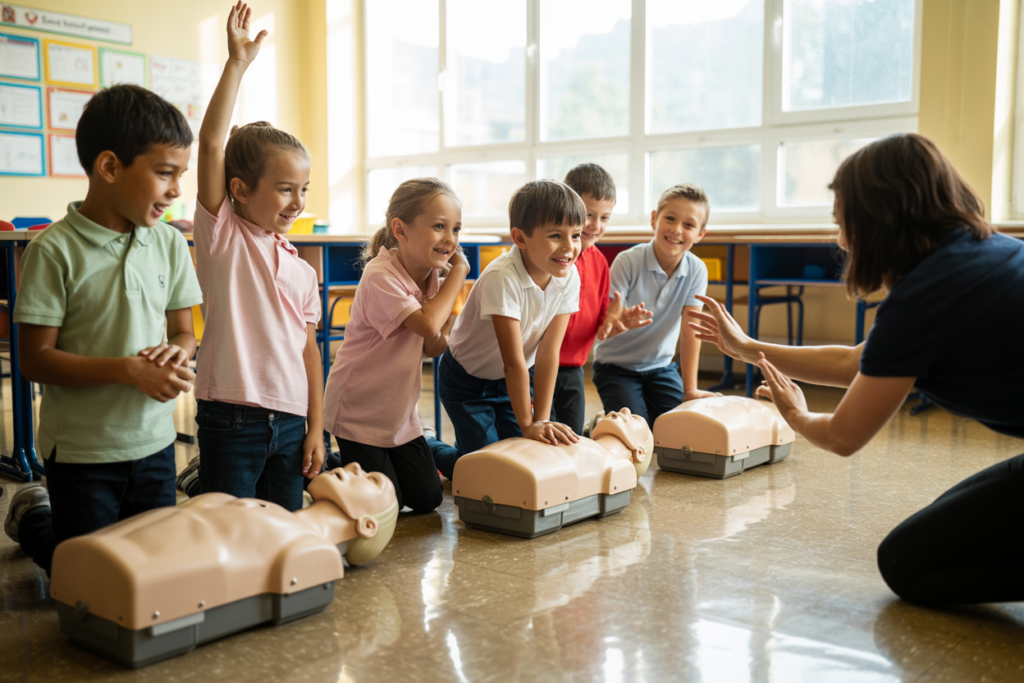
Australian Guidelines: Official Age Recommendations for CPR Training
What the Australian Resuscitation Council Says
The Australian Resuscitation Council publishes Guideline 8, which covers CPR for lay rescuers—basically anyone who’s not a paramedic or medical professional.
And here’s what’s interesting: they don’t actually set a hard minimum age for CPR education. None. Their position is that CPR training should be age-appropriate, which is a fancy way of saying “teach kids what they can actually handle at their developmental stage.”
The ARC aligns with international standards from the European Resuscitation Council and the American Heart Association, and they all basically agree on the same thing—start around 10 years old for full CPR certification, but you can introduce concepts earlier.
The ARC puts it pretty simply in their guidelines: if a child has the physical capability to compress a chest at the right depth (5-6cm) and can maintain the right rate (100-120 compressions per minute), they can learn effective CPR. Age is less important than capability.
And here’s the thing that matters for parents—this isn’t just theoretical. The guidelines are based on actual research showing that trained 10-year-olds can perform CPR at the same quality level as trained adults. The difference isn’t ability, it’s confidence. Kids who’ve practiced on mannequins don’t freeze when something real happens.
School CPR Programs Across Australia
Schools across Australia are finally catching on to this. More and more states are making CPR training part of the curriculum, and Queensland’s actually leading the pack here.
In Queensland, over 45,000 students get CPR training every year through school programs. That’s happening mostly in Years 7-10 as part of PDHPE—Personal Development, Health and Physical Education.
Here’s the data that should make every school administrator pay attention: states with mandatory school CPR training show 60% higher bystander intervention rates during cardiac emergencies. That’s huge. It means when someone collapses in public, there’s a much better chance someone nearby actually knows what to do.
Physical and Cognitive Development: What Kids Can Actually Do at Different Ages
| Development Stage | Physical Capability | Cognitive Ability | Realistic CPR Performance |
|---|---|---|---|
| Ages 5-7 | Insufficient strength | Can recognize emergencies | Can call 000 and get help |
| Ages 8-9 | 60-80% compression depth | Can follow simple sequences | Compression-only CPR |
| Ages 10-12 | Full compression capability | Multi-step processing | Complete CPR with certification |
| Ages 13+ | Adult-level strength | Full emergency reasoning | All advanced techniques |
Here’s the thing parents need to understand: CPR isn’t just about knowing the steps. It’s about having the physical strength to compress an adult chest deep enough, the stamina to keep going for several minutes, and the cognitive ability to remember a multi-step process while you’re panicking because someone’s unconscious in front of you.
Ages 5-7: Emergency Awareness Stage
At this age, don’t expect your kid to perform CPR. Their little bodies just aren’t there yet—they don’t have the arm strength, the body weight, or the hand size to do effective chest compressions on an adult.
But here’s what they CAN learn: understanding emergencies vs. non-emergencies, calling 000, getting adult help, and simple safety actions. The goal at this age isn’t CPR performance—it’s emergency awareness and getting help fast.
Ages 8-9: Compression-Only CPR Introduction
Eight and nine-year-olds are in this interesting middle ground where they’re strong enough to start learning compressions, but they’re not quite ready for the full CPR sequence yet.
Research shows that with proper training, 8-9 year olds can achieve 60-80% of the recommended compression depth. That’s not perfect, but it’s way better than nothing. And when you consider that hands-only CPR has about 90% of the effectiveness of full CPR in cardiac arrest cases, suddenly that 60-80% compression depth starts looking pretty valuable.
At this age, focus on simplified CPR—hands-only compressions, no rescue breaths yet. We’re building muscle memory and confidence.
Ages 10-12: Full CPR Certification Capability
This is the sweet spot. Ten to twelve-year-olds can do everything an adult can do in terms of CPR, and the research backs this up completely.
By age 10, most kids have sufficient strength and body weight to achieve the required 5-6cm compression depth on an adult chest. When they use proper technique—straight arms, locked elbows, using their body weight—they can compress just as effectively as adults.
Kids this age can handle multi-step procedures. They can remember: check for danger, check for response, call 000, start compressions, count to 30, give 2 breaths, repeat. That’s a complex sequence, and they can do it.
They can get HLTAID009 (Provide CPR) certification—the exact same qualification adults get. Same performance standards, same assessment criteria, same certification.
Here’s what surprises most parents: their 11-year-old is often better at this than they are. Kids this age are still flexible, they follow instructions precisely, and they haven’t developed the adult anxiety about “what if I do it wrong.” They just do it.
Ages 13+: Adult-Level CPR Training
By 13, there’s basically no difference between a teenager and an adult in terms of CPR capability. None.
They’ve got the physical strength, the cognitive development, the emotional maturity to handle emergency situations. In fact, studies show teenagers are often MORE willing to perform CPR than adults because they haven’t yet developed the bystander effect and the fear of legal liability that stops a lot of adults from acting.
Preparing Your Child for Their First CPR Course
So you’ve decided to get your child trained. Great. Here’s how to prepare them for the experience.
Having the Conversation: How to Talk to Kids About CPR
Be honest but not scary. Your child needs to understand what CPR is and why it matters, but you don’t need to traumatize them with graphic descriptions.
Try something like: “You know how sometimes people’s hearts stop working properly and they fall down? CPR is a way to keep their blood pumping until the ambulance gets there. It’s a really useful skill to have, like knowing how to swim or ride a bike.”
Address their specific concerns upfront:
“The instructors will teach you exactly how to do it properly. And here’s the thing—if someone needs CPR, they’re already in the worst situation possible. Anything you do to help is better than doing nothing. You can’t make it worse.”
“It’s totally normal to feel nervous about whether you’d actually do it in a real emergency. That’s why you practice on mannequins—so your hands remember what to do even if your brain is freaking out.”
What to Bring
Water bottle (CPR practice is physically tiring), snacks if it’s a longer session, comfortable clothing that allows them to kneel and move freely, and a hair tie if they have long hair. That’s basically it.
If your child has asthma, bring their inhaler. If they have allergies, bring their EpiPen. Tell the instructor at the start of the course if your child has any medical conditions.
Setting Expectations
Make sure your child understands that CPR is tiring—they’ll be doing compressions many times and their arms might be a bit sore afterward. That’s normal. It means they’re pushing hard enough.
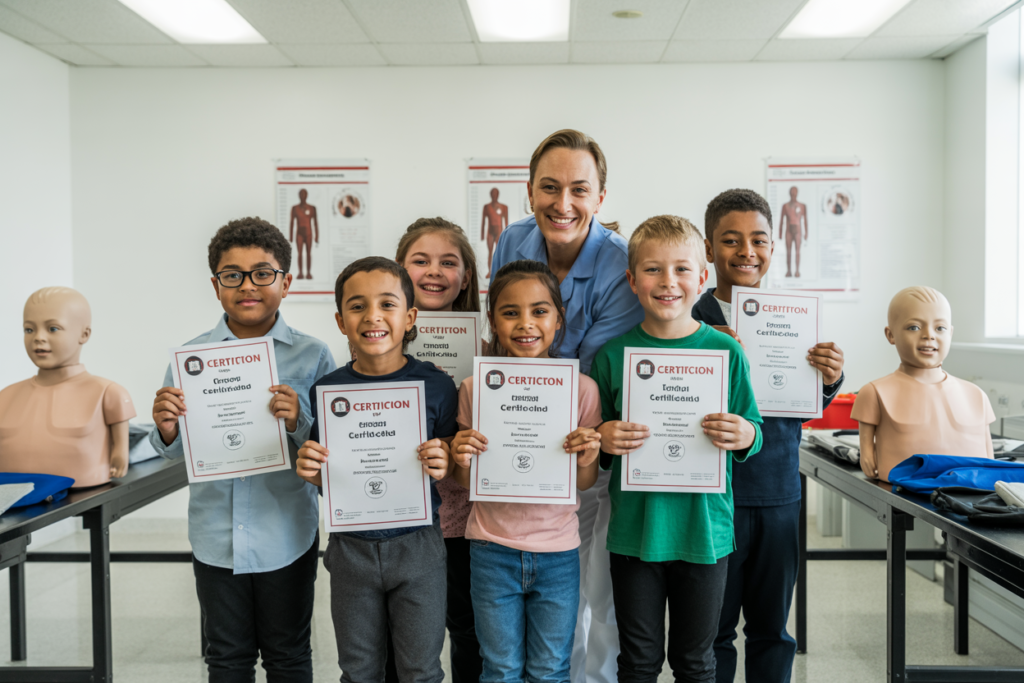
At the end of the course, they’ll need to demonstrate CPR to the instructor to get their certificate. This isn’t a scary test—it’s just the instructor watching them do what they’ve been practicing all day to make sure they’ve got it.
Frame it like this: “At the end, you’ll show the teacher you can do CPR properly, and then you get your certificate. It’s not a test where you pass or fail—the teacher’s there to help you get it right.”
Ready to Get Your Child CPR Certified?
It comes down to this: if someone collapsed in front of your child today, would they know what to do?
Not “would they figure it out” or “would they probably get help eventually.” Would they immediately recognize cardiac arrest, start effective CPR, and maintain compressions until paramedics arrived?
If the answer’s no, and your child’s 10 or older, that’s something you can change. Your child can be that person. The one who steps up. The one who acts instead of freezing. The one who potentially saves someone’s life.
Your child’s going to face emergencies in their lifetime. That’s not pessimistic, that’s just reality. Someone will collapse at their school. Someone will have a medical episode at a shopping center they’re in. A family member will have a health crisis.
When those moments come, do you want your child to be the helpless bystander who watched and wished they could help? Or do you want them to be the person who knew what to do and acted?
Book your child into a CPR course. Give them the skills that might save someone’s life. Give them the confidence that comes from knowing they can handle the worst moments.
Because somewhere down the line—maybe next month, maybe in five years, maybe in twenty years—there’s going to be a moment where your child’s CPR training matters. Someone’s going to need help. And your child’s going to be ready.
Book Your First Aid Training Now
Fast, affordable, and nationally accredited training delivered by professionals who care
Frequently Asked Questions About Youth CPR Training
Q.Can a 10-year-old really perform effective CPR on an adult?
Yes, absolutely. Research shows that trained 10-year-olds can achieve the required 5-6cm compression depth and maintain 100-120 compressions per minute when they use proper technique. It's not about raw strength—it's about body positioning, locked elbows, and using their body weight effectively. The Australian Resuscitation Council's guidelines are based on physical capability, not arbitrary age limits, and most 10-year-olds meet the performance standards when properly trained.
Q.Is CPR training scary or traumatic for children?
Not when it's taught properly. Good instructors use age-appropriate language, focus on the positive aspects of helping people, and create a practical rather than dramatic learning environment. Kids practice on plastic mannequins in a safe, controlled setting, which builds confidence without fear. The training emphasizes "you're learning a helpful skill" rather than dwelling on worst-case scenarios. Most children leave CPR courses feeling empowered and proud of their new capability, not frightened.
Q.What's the difference between HLTAID009 and HLTAID011 for kids?
HLTAID009 is CPR-only certification covering chest compressions, rescue breaths, and AED use—suitable for ages 10 and up. HLTAID011 is the comprehensive first aid course that includes CPR plus treatment for bleeding, burns, fractures, allergic reactions, and other emergencies—typically better suited for ages 12 and up due to the longer duration and greater information load. For most 10-11 year olds, starting with HLTAID009 builds a strong foundation before progressing to the full HLTAID011 course when they're older and can handle the extended training session.
Q.How long does CPR certification last for children?
CPR certification (HLTAID009) expires after 12 months for everyone, regardless of age. There's no difference between child and adult certification validity periods. This annual renewal requirement exists because CPR skills deteriorate quickly without practice—research shows most people lose 80% of their proficiency within 6 months. If your child needs ongoing certification for employment or volunteering, they'll need to recertify every year, just like adults do.
Q.What happens if my child can't pass the assessment?
This is extremely rare—over 95% of children who complete CPR training pass the practical assessment. If your child struggles during the assessment, the instructor provides immediate coaching and allows them to try again with feedback. Most children succeed on the second or third attempt. If additional practice is needed, instructors provide extra time until the child demonstrates competency. Many providers also offer free reassessment within 30 days if needed. The goal is genuine competency, not failing students—instructors work with each child until they can perform CPR effectively.
Making first aid training more affordable for
every classroom
We believe every student deserves access to life-saving first aid knowledge. That’s why we offer specially reduced pricing for schools and educational groups. Whether you’re booking for a single class, a year group, or your entire school, our flexible packages make training more accessible and cost-effective — without compromising quality.
