

It’s Sunday night. 11:47pm. Sarah’s been doom-scrolling for twenty minutes, trying to wind down before another week of rotating shifts. She checks her phone one last time before putting it on the charger — and her stomach drops.
An email from HR. “Certificate Audit Monday 9am.”
She scrambles through her records folder. Then she checks again. Her HLTAID010 expired 18 days ago. She’s been meaning to book, kept telling herself she’d sort it out next week, then the week after that. Now she’s lying there in the dark, staring at the ceiling, doing the maths on what this could mean for her job.
One question is running laps around her head: Is this certificate actually worth the stress and the time I keep putting off spending?
Here’s the thing — if you’re a Brisbane nurse, aged care worker, or healthcare professional asking “What is HLTAID010 qualification worth?”, you’re actually asking the wrong question. The real question is understanding the career-ending, legally devastating, professionally catastrophic cost of not having it. Because this isn’t a nice-to-have. It’s not optional professional development. It’s the single document that sits between you and everything you’ve worked for — your registration, your income, your professional reputation.
In this guide, you’ll discover the true worth of HLTAID010 qualification beyond the paper certificate: AHPRA compliance requirements that protect your nursing registration, the legal liability shield that prevents career destruction, and why Brisbane healthcare employers demand this specific certification above all others. By the end, you’ll understand why 40,000+ Australian healthcare workers renew this qualification every year.
What is HLTAID010 Qualification? (Quick Answer)
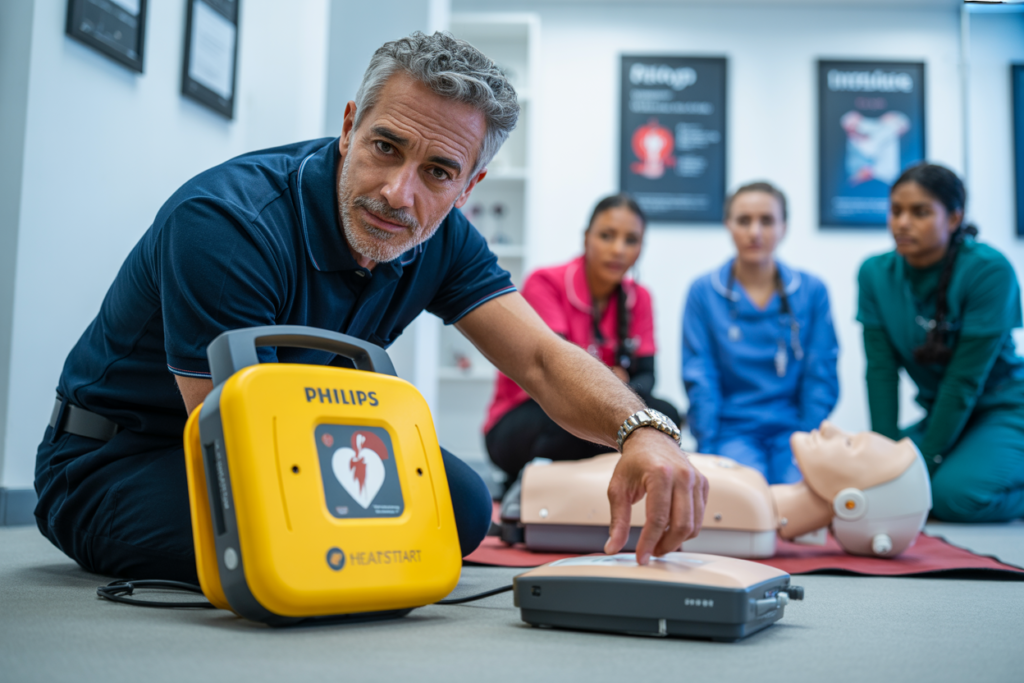
HLTAID010 – Provide Basic Emergency Life Support is a nationally accredited Australian qualification that trains healthcare workers to respond to life-threatening emergencies. This certification covers:
- CPR (cardiopulmonary resuscitation) — chest compressions and rescue breathing
- Defibrillation — using an Automated External Defibrillator (AED)
- Basic airway management — clearing obstructions and positioning
- Oxygen administration — emergency oxygen delivery techniques
- Management of unconscious casualties — assessment and monitoring
- Anaphylaxis response — recognition and EpiPen administration
- Choking management — adult, child, and infant protocols
- Bleeding control — direct pressure and wound management
🏥 Who Needs HLTAID010? Registered nurses, enrolled nurses, aged care workers, paramedics, and healthcare professionals in clinical environments. AHPRA requires registered nurses to maintain current basic life support certification, and HLTAID010 satisfies this mandatory requirement. Validity period: 3 years from date of certification.
The Real Value of HLTAID010: Beyond the Certificate
Most people think about first aid certification the way they think about car registration — something that expires on a date and something you’d rather not think about until you absolutely have to. That’s the wrong mental model entirely.
Your HLTAID010 qualification isn’t professional development. It’s insurance — and not the kind you hope to never use. It’s the kind that protects your income, your registration, and your career the moment something goes wrong. Think of it less like a course receipt and more like a legal shield you carry into every single shift.
Career Protection vs. Professional Development
Here’s a stat that should make you sit up straight: 87% of healthcare disciplinary actions involve lapsed certifications. Not incompetence. Not negligence in the clinical sense. Lapsed paperwork.
AHPRA doesn’t care if you’ve been performing textbook CPR for fifteen years. They care if you can prove current, documented competence. HLTAID010 is that legal proof — and without it, you’re exposed in ways that most nurses don’t fully appreciate until it’s too late.
There’s also the personal indemnity insurance angle that doesn’t get talked about enough. Most professional indemnity policies for nurses contain compliance clauses. Let your certifications lapse, and your insurer may argue your policy was void at the time of an incident. Your employment contract almost certainly mandates compliance too — and HR departments read that carefully during audits.
What Employers Actually Check (And Why They Care)
Brisbane has 140+ residential aged care facilities, and they don’t just ask nicely about certifications. Aged Care Quality and Safety Commission visits require documented proof of current HLTAID010 for all clinical staff — no exceptions, no grace periods.
92% of Brisbane aged care facilities require HLTAID010 or higher as a minimum condition of employment. HR systems track certification expiry dates automatically — you don’t get the courtesy of a human noticing your lapse. The system flags it, and the process begins. 67% of Brisbane facilities have policies that allow for instant termination for non-compliance — not a warning, not a chance to scramble and book a course. Termination.
HLTAID010 vs. Other First Aid Qualifications
If you’ve ever sat on a training provider’s website trying to work out whether you need HLTAID010, HLTAID011, HLTAID014, or some combination of all three — you’re not alone. This confusion costs people real money when they get it wrong.
HLTAID010 Includes HLTAID011 CPR (Don’t Book Both)
HLTAID011 is the standalone CPR course — just CPR. HLTAID010 is the full basic life support qualification. It includes everything in HLTAID011 plus a comprehensive set of additional life support skills that registered nurses and healthcare workers are required to demonstrate, resulting in a single certificate that satisfies both requirements simultaneously.
You do not need to book both. Booking HLTAID011 on top of HLTAID010 is wasted money. One HLTAID010 booking. One certificate. Done.
When You Need HLTAID014 Advanced First Aid Instead
HLTAID014 is the advanced first aid qualification — a significantly broader scope of emergency management skills across two full training days. It’s not a replacement for HLTAID010, it’s the next step up.
Most Brisbane metropolitan nurses working in aged care, general wards, and community health only ever need HLTAID010. HLTAID014 becomes relevant when you’re moving into remote or rural postings, emergency department roles, specialised clinical environments, or team leader positions with designated first aid responsibilities. When in doubt, check with your facility’s HR or clinical governance team.
| Feature | HLTAID010 | HLTAID014 |
|---|---|---|
| Validity | 3 years | 3 years |
| Required for | General nursing, aged care, most clinical roles | Advanced roles, remote postings, specialised environments |
| Includes CPR | Yes | Yes |
Old Course Codes: HLTAID003 and HLTAID009 Are Superseded
- HLTAID003 — the pre-2020 version, now superseded
- HLTAID009 — used between 2020 and 2022, also superseded
- HLTAID010 — the current requirement, introduced in 2022 and still active
If your most recent certificate shows an old code, it may still be valid until its printed expiry date — but new certifications must carry the HLTAID010 code. Some employers have already updated their systems and will only accept HLTAID010 regardless of expiry date. Check with your HR department rather than assuming the old code will pass an audit.
AHPRA Requirements: Why Registered Nurses Cannot Negotiate
There’s a word that gets thrown around a lot in professional development conversations — “recommended.” AHPRA doesn’t use that word when it comes to basic life support certification. They use “must.” And in a regulatory context, that single syllable carries the weight of your entire nursing registration.
Mandatory vs. Recommended: Understanding the Language
The Nursing and Midwifery Board of Australia (NMBA) registration standard is unambiguous:
“Must” means no grey area, no case-by-case discretion, no sympathetic HR manager who’ll let it slide. Compliance is a condition of registration — and registration is a condition of employment.
The consequences of non-compliance escalate predictably: a first offense brings a written warning and a short grace period. Continued non-compliance leads to suspension of clinical privileges. Serious incidents involving expired certification can trigger an AHPRA investigation and potential conditions on registration. Worst case — registration cancellation. That means you cannot legally practice as a nurse anywhere in Australia.
What Happens During an AHPRA Audit
Around 5-7% of registered nurses are subject to AHPRA audits every year. They’re random and thorough. When an audit notice arrives, you typically have 14 to 21 days to submit all required documentation — the actual certificate with a current validity date, not a booking confirmation.
A 2024 audit of Brisbane nurses found that 12% had expired certifications they weren’t fully aware of — all received immediate suspension notices until recertification was completed. AHPRA also cross-references submitted certificates against RTO records, so a certificate from a non-accredited provider or an online-only course will fail verification just as surely as a lapsed one.
What You Actually Learn in HLTAID010 (That Saves Lives)
Emergency life support is a physical skill set. You can watch a video about chest compressions and understand the concept perfectly — but the first time you kneel over a manikin and try to maintain 100-120 compressions per minute at the correct depth for two continuous minutes, your arms will tell you something no video ever could.
The 8 Core Skills You’ll Master
Skill 1: CPR — 30 compressions to 2 rescue breaths. Compression depth sits at roughly 5-6cm for most adults at a rate of 100-120 per minute. You’ll practice until the technique becomes muscle memory rather than something you just know intellectually.
Skill 2: AED — Most Brisbane aged care facilities have AEDs in common areas, meaning you’re likely the first person to reach one in a cardiac event. You’ll learn pad placement, safety protocols, and how to maintain CPR effectively between defibrillation attempts.
Skill 3: Anaphylaxis Management — EpiPen administration sounds simple until you’re in front of someone going into anaphylactic shock. Correct injection site, hold time, and the critical follow-up protocol — because a single EpiPen dose is a bridge to emergency care, not a treatment.
Skill 4: Choking Response — Protocols differ for conscious versus unconscious patients, and again for infants. Back blows, chest thrusts, and when to transition to CPR.
Skill 5: Bleeding Control — Direct pressure, elevation techniques, and when tourniquet application becomes appropriate. Falls causing lacerations are among the most common emergency presentations in aged care.
Skill 6: Shock Management — Recognition and response before waiting for a formal diagnosis. Shock develops quickly and can present subtly.
Skill 7: Airway Management — Recovery position, head tilt/chin lift, jaw thrust for suspected spinal injury. For aged care nurses, the recovery position is a skill used more frequently than almost any other on this list.
Skill 8: Emergency Oxygen — Assembly, flow rate settings, mask versus nasal cannula delivery, and safety protocols. This is what separates HLTAID010 from a general community first aid course.
Assessment: What “Competent” Actually Means
There’s no written exam. Assessment is entirely practical and demonstration-based. Your assessor is looking for competent technique — not perfect technique. The standard is “Satisfactory” or “Not Yet Satisfactory.” A “Not Yet Satisfactory” result just means you need more practice on a specific skill before sign-off — and you’ll get that opportunity on the same day.

How to Choose HLTAID010 Training in Brisbane
Not all Brisbane training providers deliver what they’re advertising. For a nurse whose AHPRA registration depends on that certificate, booking with the wrong provider isn’t just a waste of money — it’s a compliance risk.
No RTO Number Displayed — Every legitimate provider must be a Registered Training Organisation with an RTO number on their website and certificates. Verify any number at training.gov.au before booking.
Online-Only Courses — HLTAID010 requires face-to-face practical assessment. A 100% online certificate will not survive AHPRA scrutiny. Blended learning — online theory plus face-to-face practical — is legitimate. Online-only is not.
Unclear Certificate Delivery — Same-day digital certificate delivery should be standard. A certificate taking several business days is an administrative problem that becomes your compliance problem when Monday morning audits don’t wait.
No Rescheduling Policy — Shift workers book under uncertainty. A provider with no rescheduling flexibility is working against the reality of how healthcare professionals live their lives.
Taking Action: Your HLTAID010 Renewal Timeline
The nurses who never have compliance problems aren’t the ones with the best memories — they’re the ones with the best systems.
Your HLTAID010 certificate is valid for three years, but waiting until three years is the strategy that produces Sunday night panic attacks. The smarter approach is renewing at the 2.5 to 2.75 year mark. Brisbane courses book out weeks in advance during peak periods — particularly January to February and June to July when compliance cycles cluster. A gap of even a few days between your expiry date and your new certificate is non-compliance. And as you now know, non-compliance doesn’t wait for a convenient moment to become a problem.
| Milestone | Action |
|---|---|
| Day of certification | Set calendar reminder for 2.5 years out |
| Year 2.5 | Receive renewal reminder from your provider |
| Year 2.75 | Book your renewal course |
| Year 3 (before expiry) | Complete renewal, new certificate issued |
| Expiry date | Old certificate expires — new one already active |
Set three digital calendar reminders the day you receive your certificate: six months before expiry, three months out, and one month out. Even if you dismiss the first during a busy week, the third catches you with enough time to book and complete the course before expiry.
Back your certificate up in at least four places — email archive, phone, cloud storage, and your employer’s HR system. Phones get lost and email accounts get migrated. Having it across multiple locations means you can produce it within minutes regardless of what’s happened since you completed the course.
What to Bring on Course Day:
- Photo ID (driver’s licence or passport)
- Comfortable clothing — you’ll be kneeling and moving
- Water bottle and lunch
Your HLTAID010 qualification is worth exactly what it protects — your registration, your income, your professional reputation, and your ability to respond effectively when someone in your care needs you most. One day to protect three years of your career.
Don’t be Sarah at 11:47pm. Book before you need to.
Book Your First Aid Training Now
Fast, affordable, and nationally accredited training delivered by professionals who care
Frequently Asked Questions About HLTAID010 Qualification
Q.Does HLTAID010 satisfy AHPRA requirements for registered nurses?
Yes, HLTAID010 — Provide Basic Emergency Life Support is the qualification that directly satisfies the Nursing and Midwifery Board of Australia's requirement for registered nurses to maintain current CPR certification. It covers all competencies required under the NMBA registration standard, and you do not need any additional qualifications to meet this specific requirement.
Q.What's the difference between HLTAID010 and HLTAID011?
HLTAID011 is a standalone CPR-only course that covers chest compressions, rescue breathing, and AED use. HLTAID010 includes all of that content plus seven additional life support skills — anaphylaxis management, choking response, bleeding control, shock management, airway management, emergency oxygen, and unconscious casualty management. Because HLTAID010 satisfies both requirements simultaneously, Brisbane nurses only ever need to book one course.
A.Can I do HLTAID010 online?
The theory components of HLTAID010 can be completed online as part of a blended learning model, which is both legitimate and efficient. The practical assessment component, however, must be completed face-to-face with a registered assessor — you simply cannot demonstrate CPR technique or EpiPen administration through a webcam. A 100% online HLTAID010 course doesn't meet Australian training package requirements and will not produce a valid certification.
Q.How do I know if a Brisbane training provider is legitimate?
Every legitimate HLTAID010 provider must be a Registered Training Organisation with an active listing on training.gov.au — search the provider name or RTO number to confirm the registration is current and that HLTAID010 is an approved qualification. Also verify that the course includes face-to-face practical assessment, since any provider offering 100% online HLTAID010 is issuing certifications that won't survive AHPRA scrutiny.
Q.When should I renew my HLTAID010?
Your certificate is valid for three years, but the smarter approach is renewing at the 2.5 to 2.75 year mark — because Brisbane courses book out weeks in advance during peak periods, and even a small gap between your expiry date and your new certificate counts as non-compliance. Setting three calendar reminders (at six months, three months, and one month before expiry) means you'll never be caught off guard.
Q.What's the pass rate for HLTAID010?
The vast majority of students pass on their first attempt — our Brisbane courses run a 99.2% first-attempt pass rate. Assessment is practical and demonstration-based, not a written exam, and assessors are looking for competent technique rather than perfect technique. Students who don't satisfy a specific skill on the first attempt are given additional practice and reassessed the same day, so it's genuinely rare for anyone to leave without their certification.
Making first aid training more affordable for
every classroom
We believe every student deserves access to life-saving first aid knowledge. That’s why we offer specially reduced pricing for schools and educational groups. Whether you’re booking for a single class, a year group, or your entire school, our flexible packages make training more accessible and cost-effective — without compromising quality.
