

Your coordinator has emailed to say your BELS is due, and the only clue is a code that looks more like a Wi-Fi password than a course name: HLTAID010. HLTAID010 is the national unit code for Provide Basic Emergency Life Support. It’s a standard training requirement for a lot of disability support, aged care and community workers across Brisbane, yet hardly anyone explains it. Most people who need it have never heard of it. Not until someone asks them to book it.
Good news though. HLTAID010 is a short, practical course. It teaches you what to do when someone collapses, stops breathing, chokes or is bleeding heavily, and it keeps your compliance up to date so you stay on the roster. And once you know what’s actually in it, checking you’re booking the right course gets a whole lot easier.
This guide explains what HLTAID010 means in plain English, the skills you’ll learn in each part of the course, how you’re assessed, how it compares with HLTAID009 and HLTAID011, and how to book a session near you in Brisbane.
What Is HLTAID010?
HLTAID010 is the national unit code for Provide Basic Emergency Life Support (BELS). It’s a nationally recognised course that teaches you how to respond to a life-threatening emergency and give first aid until an ambulance arrives. It covers more than a CPR course, but less than full first aid (HLTAID011).
What you’ll learn in HLTAID010:
- 1. Using the DRSABCD action plan and calling Triple Zero (000)
- 2. CPR for adults, children and infants
- 3. Using an automated external defibrillator (AED)
- 4. Caring for an unconscious person, including the recovery position
- 5. Controlling severe bleeding and recognising shock
- 6. Helping someone who is choking
- 7. Responding to asthma, anaphylaxis and severe allergic reactions
🧠 Good to know: Every skill below is something you could genuinely need on a normal shift, not just in theory.
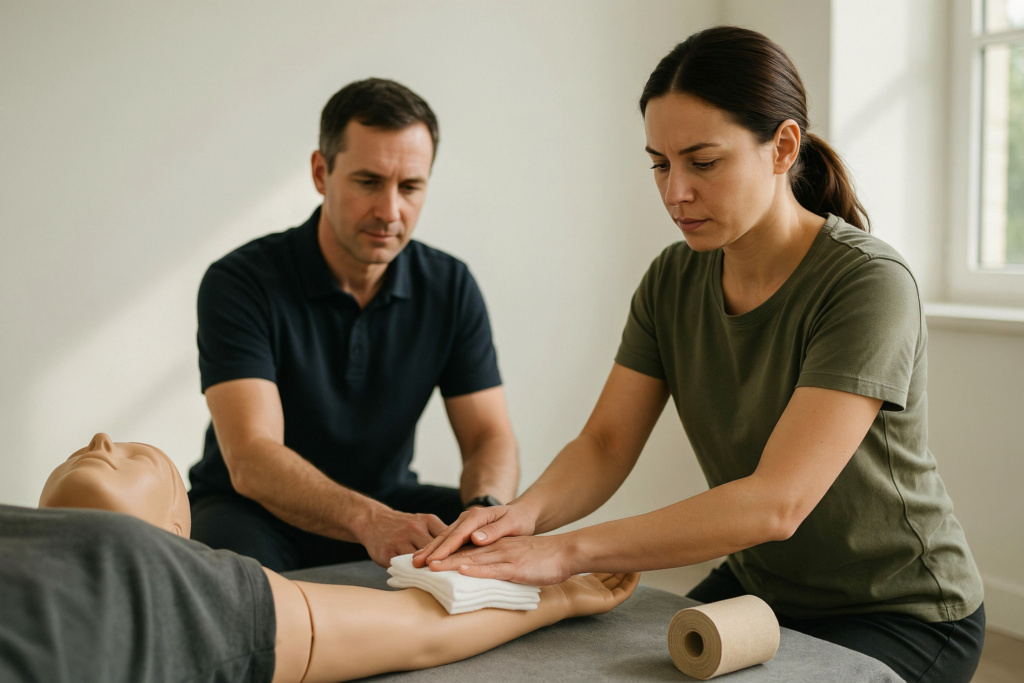
What You’ll Learn in HLTAID010: The Skills, One by One
That’s the short version. Here’s what each of those skills looks like in a real shift.
Imagine it’s lunchtime and a client you support starts coughing, then goes quiet with their hands at their throat. By the end of HLTAID010, you won’t freeze. You’ll know what’s happening and what to do next, and that’s pretty much the whole point of basic emergency life support.
Recognising an emergency and DRSABCD
Everything in BELS hangs off one action plan: DRSABCD. It stands for Danger, Response, Send for help, Airway, Breathing, CPR and Defibrillation, and it comes straight from the ANZCOR guidelines. You learn to check for danger first, see if the person responds, and get Triple Zero (000) on the phone early.
Say you’re on an SIL overnight and you find a client on the floor at 3am. Your heart’s racing, you’re half asleep. A plan you’ve actually practised gives your brain something to hold onto.
CPR for adults, children and infants
You’ll learn CPR for all three age groups. That covers hand position, how deep and how fast to push, and how to give rescue breaths. Infants are a different ball game. Smaller body, gentler technique, and the course walks you through the differences so they don’t catch you off guard.
Why does that matter for care work? Because you might support adults on shift and have little ones at home. Clients of all ages need someone who knows what they’re doing. If you want the clinical steps in more detail, our BELS protocols guide has them.
Using a defibrillator (AED)
Plenty of people are nervous about defibrillators. Fair enough, it’s a machine that shocks a heart. But an automated external defibrillator is built for untrained users. You’ll practise sticking the pads on and following the voice prompts, which talk you through every step out loud.
You’ll often spot an AED on the wall in day programs and aged care facilities. After the course, you’ll know exactly what it’s for, and you won’t hesitate to grab it.
Caring for an unconscious person
Someone who’s breathing but won’t wake up still needs you. You’ll learn how to keep their airway clear, how to roll them into the recovery position, and how to keep monitoring them until the ambulance gets there.
For support workers this one comes up more than you’d expect. A client has a seizure, it stops, but they don’t come round. Knowing how to protect their airway in those few minutes makes a real difference.
Severe bleeding and shock
This part covers how to control heavy bleeding with direct pressure, how to recognise the signs of shock, and why keeping the person warm still matters so much.
It’s not just a workplace injury thing. A client slips in the bathroom and cuts their head on the vanity. A knife slips during a cooking skills session. Blood looks scary, and a lot of it looks scarier. Having a clear plan stops the panic taking over.
Choking
Mealtimes are a huge part of the job, and choking is a real risk, especially for clients with swallowing difficulties. You’ll learn to tell the difference between mild and severe choking, and when to use back blows and chest thrusts, which are the techniques ANZCOR recommends.
Our choking guide goes further if you want to read up before your course.
🍽️ If you support clients at mealtimes, especially anyone with swallowing difficulties, the choking section is the one to pay extra attention to.
Asthma, anaphylaxis and allergic reactions
You’ll learn the signs of a severe allergic reaction and an asthma attack, how a reliever puffer is used, how an adrenaline autoinjector works, and why you call 000 straight away. The guidance lines up with ASCIA and the National Asthma Council Australia.
Imagine you’re on a community outing and a client with a known allergy grabs the wrong snack. You won’t have time to Google it.
Other emergencies
The course also covers recognising a stroke using F.A.S.T. (Face, Arms, Speech, Time), which comes from the Stroke Foundation.
Say a client you’ve known for months sits down to breakfast and one side of their face has dropped. Spotting it fast, and calling 000 fast, gives them the best shot.
Reporting and handover
When the paramedics arrive, they’ll want to know what happened, when it started and what you’ve done so far. You’ll learn what to tell them and how to hand over clearly without rambling.
Then there’s the paperwork. Your provider will have its own incident reporting procedures, and the course helps you understand why good records matter once the emergency is over.
🖥️ Heads up: Finish your online learning before the day, or you may not be able to complete the practical.
How an HLTAID010 Course Works
Now you know what’s taught, here’s how the course itself is set up.
Most HLTAID010 courses in Brisbane run in two parts. There’s an online component you do at home first, then a hands-on session with a trainer.
Online learning before the course
The theory side of BELS is done online before your course day. It covers the knowledge behind the skills, so on the day you can spend your time practising instead of sitting through slides.
It has to be finished before you turn up. If it’s not done, you may not be able to complete the practical. Try not to leave it until the night before after a long shift. It goes a lot smoother on a computer or tablet than squinting at your phone.
💻 Tip: Do your online learning on a computer or tablet, not your phone. If the login email hasn't shown up, check your spam or junk folder before you panic.
The face-to-face practical session
This is where you actually get your hands on the manikins and the AED. Wear comfortable clothes you can kneel and move around in. Think gym gear, not work uniform.
What to bring:
- Photo ID
- Your USI (Unique Student Identifier)
That’s the basics. If you want to know more about how the online and face-to-face parts fit together, have a read of our blended learning guide. If it’s your first time doing any kind of first aid training, our BELS for beginners guide walks you through the day itself.
How You’re Assessed in HLTAID010
The part most people worry about is the assessment, so let’s clear that up.
The HLTAID010 assessment isn’t a trick, and it’s not a race. Your trainer is there to coach you through it, not to catch you out. If something’s not quite right, they’ll show you how to fix it and you’ll have another go.
The practical assessment
The HLTAID010 practical is where you show you can actually do the skills. You’ll perform adult CPR on the floor, then infant CPR on an infant manikin. You’ll also use a training AED and work through a simulated emergency scenario, the kind of thing you could genuinely face on shift.
It sounds like a lot when it’s written down. On the day, it feels more like practice with someone watching over your shoulder.
Questions and knowledge checks
There are questions in your online learning and a few more on the day. They’re about understanding what you’re doing and why, not memorizing a textbook.
Worried about kneeling?
This one’s real for a lot of care workers. Years of lifting and bending take a toll on your knees and back. CPR on the floor is a requirement of the unit, so it can’t be skipped, because in a real emergency that’s usually where the person will be.
If you’ve got an injury or a condition that makes kneeling hard, give us a call before you book and have a chat about it. Our BELS for beginners guide has more on what to expect physically.
HLTAID010 vs HLTAID009 vs HLTAID011: Where It Fits
If you’re still wondering whether HLTAID010 is the right code for you, this is where it sits in the range.
Think of the three courses like nesting boxes. CPR sits inside BELS, and BELS sits inside full first aid.
HLTAID009 | HLTAID010 | HLTAID011 | |
Name | Provide cardiopulmonary resuscitation (CPR) | Provide basic emergency life support (BELS) | Provide first aid |
What it covers | CPR and using an AED | CPR, AED, plus choking, severe bleeding, unconsciousness, asthma and anaphylaxis | Everything in BELS, plus a wider range of injuries and illnesses |
Typical roles | Roles that only ask for CPR, plus yearly CPR refreshers | Disability support, aged care, security, swim and aquatic staff | Team leaders and roles that ask for full first aid |
Includes the others? | No | Includes the CPR content of HLTAID009 | Yes, includes HLTAID010 and HLTAID009 |
The main thing to take away from the HLTAID010 vs HLTAID011 question is that HLTAID011 includes BELS. So if you already hold a current HLTAID011, you may not need HLTAID010 separately. Check with your employer before you book, just to be sure.
For a closer look, read HLTAID010 or HLTAID011 or our guide to BELS units.
Who Needs HLTAID010 in Brisbane?
So who actually gets asked for it?
Most of the people booking HLTAID010 in Brisbane are there because an employer, an agency or a placement coordinator put the code in an email. It’s commonly asked for by employers and agencies in jobs where you could be the first person on the scene when something goes wrong.
That usually includes:
- Disability and NDIS support workers
- Aged care and home care workers
- Community, youth and personal care workers
- Security officers
- Swim and aquatic staff
- Students heading out on placement
If you’re looking into first aid requirements for NDIS workers, you’ll find there’s no single rule that names HLTAID010 for everyone. It comes down to your provider’s own policy. Some ask for BELS, some ask for full first aid, and some want both CPR and first aid kept current. The same goes for HLTAID010 in aged care. Your employer’s policy is the one that counts, so check it before you book. Our guide to BELS as a minimum qualification explains this in more detail.
It’s the kind of training you hope you never use but feel better for having. Especially when you’re the only one on shift.
How Long Does HLTAID010 Last?
Once you’ve got it, the next question is how long it lasts.
Your Statement of Attainment doesn’t actually have an expiry date printed on it. How often you renew is set by industry guidance and your employer’s policy. The common expectation is a CPR refresher every 12 months and the full BELS renewal every 3 years. That’s in line with Safe Work Australia’s First aid in the workplace Code of Practice and Australian Resuscitation Council guidance.
Life gets busy, and renewals slip through the cracks. We can send you a free SMS reminder at 11 months so you’re not caught off guard next time.
Our Statement of Attainment guide has more on what your certificate shows.
📞 Not sure which course you need? Give us a call and we'll confirm in two minutes.
Book HLTAID010 With First Aid Alive in Brisbane
If your BELS is due, here’s how to get it sorted this week. First Aid Alive runs HLTAID010 courses across Brisbane with free parking, plus weekend and early morning sessions. So you can pick a date that works around your roster, not the other way round.
You can book straight from your phone. Once you’re in, you’ll get a link to your online learning. Knock that over first, on a computer or tablet if you can, so the day itself is all hands-on practice.
On the day, nobody’s there to catch you out. If you’ve got sore knees or a bad back, give us a call beforehand and we’ll talk it through, so you walk in knowing what to expect.
Your Statement of Attainment is nationally recognised through RTO 31106, and it’s emailed the same day you finish. You can upload it to your employer’s system before your next client-facing shift and get back on the roster without the stress.
Ready to lock in a date? Book your HLTAID010 course online. Not sure it’s the right course? Give us a call and we’ll confirm in two minutes.
👉 Your next step: If your employer has asked for HLTAID010, pick a date that fits your roster and book online, or call us first if you'd like us to double-check it's the right course. Either way, you'll leave knowing what to do in an emergency, with your certificate in your inbox the same day.
Book Your First Aid Training Now
Fast, affordable, and nationally accredited training delivered by professionals who care
HLTAID010 FAQs
Q.What is HLTAID010?
HLTAID010 is the national unit code for Provide Basic Emergency Life Support (BELS). It's a nationally recognized course that teaches you how to respond to a life-threatening emergency and give first aid until an ambulance arrives, covering more than CPR but less than full first aid (HLTAID011).
Q.Is HLTAID010 the same as first aid?
Not quite. HLTAID010 covers CPR and life-threatening emergencies, while full first aid (HLTAID011) covers those plus a wider range of injuries and illnesses, so a current HLTAID011 usually meets a BELS requirement. Check with your employer to be sure.
Q.Does HLTAID010 include CPR?
Yes. CPR for adults, children and infants is taught and assessed in HLTAID010.
Q.Can I do HLTAID010 fully online?
No. You can do the theory online before the course, but CPR and the other practical skills have to be assessed face-to-face by a trainer.
Q.What does BELS stand for?
BELS stands for Basic Emergency Life Support. It's the short name for the unit HLTAID010 Provide basic emergency life support.
Q.How long does HLTAID010 last?
Your certificate has no expiry date printed on it, but most employers expect a CPR refresher every 12 months and full BELS renewal every 3 years. Your employer's policy has the final say.
Q.What if kneeling is hard for me?
CPR on the floor is a requirement of the unit, so it can't be skipped. Give us a call before you book if you've got an injury or condition and we'll talk it through.
Making first aid training more affordable for
every classroom
We believe every student deserves access to life-saving first aid knowledge. That’s why we offer specially reduced pricing for schools and educational groups. Whether you’re booking for a single class, a year group, or your entire school, our flexible packages make training more accessible and cost-effective — without compromising quality.
