

You’ve booked your CPR course. Good on you. But somewhere between clicking confirm and falling asleep that night, a familiar thought creeps in. Did I pack everything? Will I show up and look completely unprepared?
It’s a completely normal feeling. Most people heading to their first or even their third CPR course in Australia spend more mental energy on the logistics than the learning. Your trainer will guide you through everything on the day, but arriving organised means you walk in calm, focused, and ready to absorb the skills that actually matter.
This guide covers exactly what to bring to a CPR course Australia-wide, what to wear, what to expect on arrival, and a few things most people forget until they’re standing in the car park wishing they hadn’t. Whether you’re completing HLTAID009 for the first time, renewing an expired certificate, or ticking off a workplace compliance requirement, this is your pre-course checklist.
Quick Answer: What Do You Need to Bring to a CPR Course?
Most Australian CPR courses require very little, but a few essentials will make your day run smoothly:
- ●Photo ID: Required for identity verification and certificate issuing.
- ●Proof of enrolment: Your booking confirmation email (digital is fine).
- ●Comfortable clothing: You'll be kneeling and moving; loose-fitting clothes and flat shoes are strongly recommended.
- ●Water bottle: Practical sessions are physical; staying hydrated matters.
- ●Snacks or lunch: Most half-day courses don't include catering.
- ●Reading glasses: If you need them for paperwork or assessment materials.
- ●Any relevant medical information: Let your trainer know of any physical limitations before the session begins.
Your RTO will confirm any venue-specific requirements in your booking confirmation. When in doubt, check your pre-course email.
The Essential Checklist: What to Bring to a CPR Course in Australia
Photo ID and Your Enrolment Confirmation
Your photo ID is the one thing you genuinely cannot turn up without. RTOs are required by ASQA to verify your identity before issuing a nationally recognized certificate. The certificate is tied to you, and without identity verification, it can’t be issued in your name.
Accepted ID types include a driver’s licence, passport, or Medicare card. If you’re not sure what your provider accepts, your booking confirmation email will spell it out.
Bring that confirmation email too. A digital copy on your phone is completely fine. Having it accessible means registration takes 30 seconds instead of five minutes of inbox scrolling while a queue forms behind you.
What to Wear to a CPR Course
This one catches people off guard more than anything else on this list.
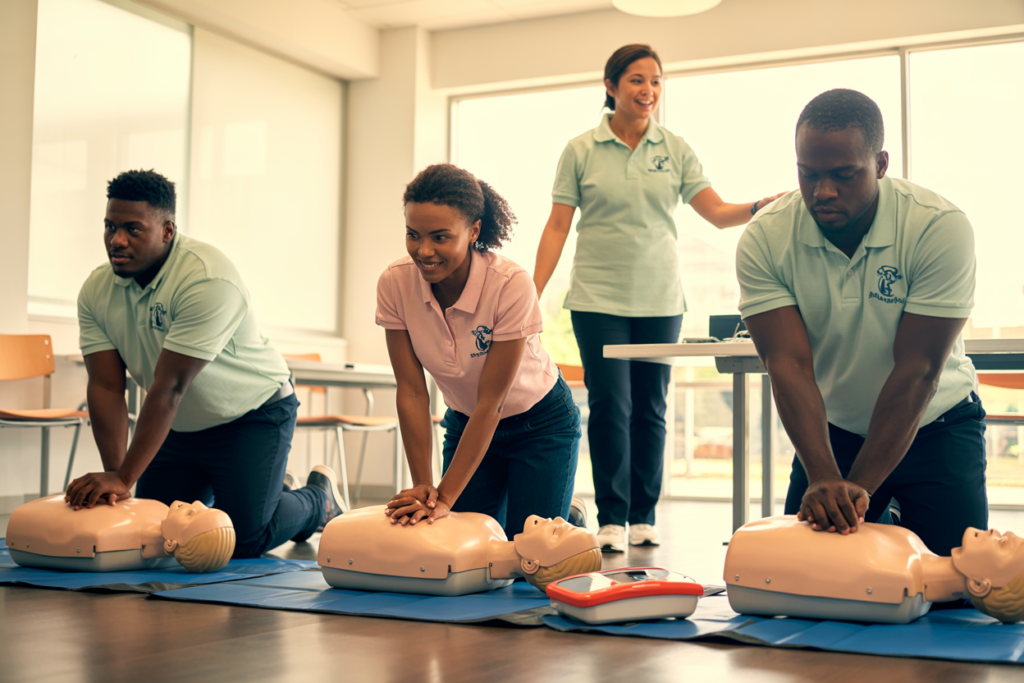
CPR is a physical skill. The practical component involves getting down on the floor, kneeling beside a manikin, and performing chest compressions at the correct depth and rate, repeatedly. Arriving in a fitted pencil skirt, tight jeans, or dress shoes means spending the whole practical session uncomfortable rather than focused on technique.
Loose, flexible clothing is the move. Think activewear, casual pants, or anything you’d wear to a gym class. Flat, closed-toe shoes are strongly recommended. No thongs, no heels. If you’ve got long hair, tie it back.
👕 Wear This: Activewear or casual pants, flat closed-toe shoes, loose t-shirt or polo, hair tied back.
🚫 Not This: Tight jeans, skirts, heels, thongs, formal office wear, or anything you'd be nervous to kneel in.
In our experience, students who turn up in business attire spend the practical session uncomfortable, and that discomfort genuinely affects skill retention.
Food, Water, and Physical Comfort
Bring a water bottle. A CPR practical session is more physical than most people expect, and doing real compressions in a warm training room means your hydration needs are higher than a standard classroom session. Most CPR courses in Australia don’t include catering, so pack a snack or light lunch. Don’t count on finding a café nearby or having time to duck out.
Personal Items and Medical Considerations
Bring your reading glasses if you need them. There’s pre-course paperwork including a medical declaration and consent form, and squinting through it in the room is an avoidable frustration.
If you carry regular medication, bring it. That includes a Ventolin inhaler if you have asthma. If you have a physical limitation including a knee injury, a back condition, or pregnancy, let your trainer know privately before the session begins. Trainers work with students at every physical capacity and will offer modifications. No one is expected to perform beyond what their body allows.
Now that you know what to pack, here’s what you can leave at home.
What You Don’t Need to Bring
No Prior Knowledge Required
You do not need to study before your CPR course. No textbooks, no pre-reading, no YouTube rabbit holes the night before. Unless your RTO has specifically advised otherwise, you can walk in completely fresh and that’s exactly how it’s meant to work.
Your trainer covers everything from the beginning. The theory, the sequence, the technique, all of it. And here’s something worth saying plainly: the room will be full of people at exactly the same starting point as you. Some are doing this for the first time. Some are renewing a lapsed certificate and privately worried they’ve forgotten everything. Your trainer has seen every level of experience walk through that door. You are exactly where you’re supposed to be.
No Equipment to Purchase
The RTO provides everything required for the practical component including manikins, AED trainers, and face shields. There’s no gear list and nothing to source beforehand. Some graduates choose to purchase a personal face shield after the course, but that’s a post-course decision. Turn up empty-handed on the equipment front and you’ll be perfectly set.
No Formal Documentation Beyond ID
For most standard HLTAID009 enrolments, your photo ID and booking confirmation are the only documents you need. If you’re completing the course for workplace compliance, check with your HR team beforehand whether a specific post-course form is required or whether your certificate needs to go directly to a compliance register.
Knowing what not to bring is half the battle. Here’s what the morning itself will actually look like.
What to Expect When You Arrive
Registration and Sign-In
Aim to arrive 10 to 15 minutes before your session starts. It gives you time to find the venue, grab a seat, and settle in before the trainer begins. At the registration desk, you’ll show your ID and complete a short medical declaration and consent form. It takes maybe five minutes.
The name you give at registration is the name that goes on your certificate. Bring it exactly as you want it to appear, full legal name if your workplace requires it. Corrections after issuing can slow things down, so get it right on arrival.
The Classroom Component
Theory comes first. Your trainer will walk the group through the chain of survival, how to recognize a cardiac arrest, the correct sequence of response, and when and how to call for help. At a quality RTO, this isn’t a lecture. It’s interactive, conversational, and built around real scenarios. The content reflects the same protocols that emergency services and hospitals follow, which matters for renewal buyers especially since guidelines do get updated.
The Practical Component
This is the part people are most nervous about before they arrive, and the part they talk about most when they leave.
The hands-on component puts you at your own manikin and walks you through the full CPR sequence. Chest compressions at the correct depth and rate, rescue breaths if included, AED (defibrillator) operation, and two-person CPR scenarios. You’ll practice until you’re confident, not just until time is up.
The question we get asked most on arrival is whether students have to perform in front of the group. The answer is no. Everyone practices at their own manikin with the trainer moving through the room to give individual feedback. There’s no spotlight, no moment where the whole class is watching you.
Everyone compresses too shallow on their first attempt. That’s not a failure. That’s what the manikin is there for.
The experience looks slightly different depending on why you’re there. Here’s what to keep in mind for your situation.
Specific Considerations for Different Buyer Types
Parents and Caregivers
If you’ve got a baby or toddler at home, mention it to your trainer before the session starts. HLTAID009 covers infant CPR as well as adult and child resuscitation, and a good trainer will tailor scenario examples to your situation. For a parent that means cot-side scenarios, pool-edge responses, and what to do when you’re the only adult present.
Write down your child-specific questions the night before. The practical component is the best possible time to ask them. Queensland consistently records some of Australia’s highest drowning rates involving children, and the combination of backyard pools and a long warm season means this skill is genuinely more likely to be needed here. Don’t wait until your kids are already in the water every afternoon.
Workplace and Compliance Buyers
Check with your HR team before course day whether your certificate needs to go directly to a compliance register. Most RTOs issue certificates digitally and can send them wherever you need, but it’s easier to set that up in advance.
Also confirm before you book whether your workplace requires HLTAID011 (Provide First Aid) rather than HLTAID009, which covers CPR only. Roles with higher duty-of-care obligations often require the full first aid qualification. Check before the course, not after.
Renewal Buyers
You don’t need to bring your old certificate. It won’t be asked for. What’s worth bringing is an open mind about relearning the technique. Guidelines are updated periodically and the compression depth, rate, and sequencing recommendations have shifted since many renewal buyers first trained. Arrive ready to recalibrate. Frame it as an upgrade, not a repeat.
Fitness and Active Community Professionals
Check your industry body’s requirements before booking HLTAID009. Some fitness industry registration bodies require HLTAID011 rather than HLTAID009 for membership compliance. Turning up to a CPR-only course when your insurer needs the full first aid unit means doing it twice. If your industry body requires CPD records, bring your registration number.
Buyer Type | Key Action Before Course Day |
Parents / caregivers | Note child-specific questions; don’t delay booking into swimming season |
Workplace / compliance | Confirm with HR whether HLTAID011 is required; check certificate delivery needs |
Renewal buyers | No old certificate needed; arrive open to updated technique |
Fitness professionals | Confirm whether HLTAID009 or HLTAID011 satisfies your industry body |
A Few Things Most People Forget
These won’t be in your booking confirmation. Nobody will remind you on the day. But they’re the things people wish they’d thought of when they’re standing in the car park five minutes before the session starts.
- 1.The name for your certificate: Exactly as you want it to appear. Full legal name, professional name, whatever your workplace needs. Corrections after issuing can delay delivery.
- 2.A phone charger or power bank: Will pull up your confirmation email and show your enrollment screen. Battery matters more than you'd think.
- 3.Cash or card for parking: Venue-dependent, but worth checking your booking confirmation the night before.
- 4.A light jacket: Air-conditioned venues can get cold during the theory component, especially if you've dressed for a warm day outside.
- 5.Your questions: Write them down the night before. Anything about CPR technique, AED use, infant scenarios, or what to do if you're alone. Your trainer wants to answer them.
- 6.An open mind about getting it wrong in practice: Everyone compresses too shallow the first time. Every single person. That's what the manikin is there for.
Your Pre-Course Checklist
Bring:
- ●Photo ID (driver's licence, passport, or Medicare card)
- ●Booking confirmation email (digital is fine)
- ●Water bottle
- ●Snacks or light lunch
- ●Reading glasses if needed
- ●Any required medications
- ●The exact name for your certificate
- ●A light jacket
- ●Phone charger or power bank
- ●Cash or card for parking
- ●Your questions, written down
Wear:
- ●Loose, comfortable clothing
- ●Flat, closed-toe shoes
- ●Hair tied back if long
Leave at home:
- ●Textbooks or pre-reading materials
- ●Your own equipment, everything is provided
- ●Anxiety about getting it wrong, that's what practice is for
Wrapping Up
Showing up to a CPR course prepared isn’t about being the most organised person in the room. It’s about removing every small friction point that might get between you and actually learning the skill. When you’re not distracted by the wrong shoes or a dead phone battery, you’re free to focus on what actually matters.
And what actually matters is leaving with a skill you’d genuinely use. Not just a certificate in your inbox. Not just a compliance box ticked. The ability to recognise a cardiac arrest, start compressions without hesitating, and keep going until help arrives.
The logistics are simple once you know them. Photo ID, comfortable clothes, a water bottle, your questions written down. Everything else is provided and covered on the day.
Queensland’s outdoor lifestyle, its long swimming season, its backyard pools and open water access, they’re part of what makes this skill particularly worth having here. The scenarios aren’t hypothetical for most families and workers in this state. They’re the Saturday afternoon at the pool, the sporting field, the workplace kitchen. Knowing what to do in those moments is the real reason people book.
So pack your bag the night before and walk in knowing you’ve done the preparation. The rest happens in the room.
Book Your First Aid Training Now
Fast, affordable, and nationally accredited training delivered by professionals who care
Frequently Asked Questions
Q.Do I need to study before a CPR course?
No prior study is required. Your trainer covers all theory and practical components on the day from the very beginning, so you can walk in completely fresh. Just bring your ID, your confirmation email, and an open mind.
Q.What should I wear to a CPR course?
Wear loose, comfortable clothing you can move and kneel in freely. Activewear or casual pants work well. Flat, closed-toe shoes are recommended and long hair is best tied back. Avoid restrictive jeans, skirts, heels, or anything you'd be uncomfortable getting down to floor level in.
Q.Can I do a CPR course if I have a physical limitation?
Yes. Let your trainer know privately before the session begins and they'll offer appropriate modifications where needed. No one is expected to perform beyond their physical capacity, and quality trainers accommodate every student regardless of their starting point.
Q.Do I need to bring my old CPR certificate if I'm renewing?
No. Your old certificate won't be asked for and it has no bearing on your enrolment. Just bring your photo ID and your booking confirmation and you're set.
Q.When does a CPR certificate expire in Australia?
HLTAID009 certificates are valid for 12 months from the date of issue, in line with Australian Resuscitation Council recommendations. It pays to track your expiry date yourself, particularly if workplace compliance is involved, and not rely solely on a reminder from your provider.
Making first aid training more affordable for
every classroom
We believe every student deserves access to life-saving first aid knowledge. That’s why we offer specially reduced pricing for schools and educational groups. Whether you’re booking for a single class, a year group, or your entire school, our flexible packages make training more accessible and cost-effective — without compromising quality.
