

You’ve booked your HLTAID012 course. Good on you. Then that little voice kicks in the night before, the one that asks what do I actually bring to this thing? Do I need a bag full of notes? Should I wear my nice clothes in case there’s photos? Is there going to be a test I haven’t studied for?
Honestly, most people rock up more prepared than they need to be, and a few people rock up in heels wondering why their feet are killing them by lunch. Neither is ideal. We’ve watched people arrive with folders full of printouts they didn’t need, and we’ve watched people arrive in office clothes who spent the whole practical session trying not to get chalk dust on a blazer. Both are avoidable with about five minutes of planning the night before.
Here’s the thing about what to bring to your HLTAID012 course. It’s a shorter list than you’d think, and most of it isn’t paperwork at all, it’s just common sense stuff like the right shoes. HLTAID012 isn’t your average, run of the mill first aid ticket either. It’s built specifically for people working in education and care settings, so the practical side of the day matters more than it might for a generic course, which is exactly why what you wear ends up on this checklist right alongside your ID.
Below, you’ll find exactly what to bring, what to wear, what’s already sorted for you so you don’t overpack, and a few extra notes if you’re a centre director organising this for your whole team. Read it once, tick off what you need, and you can stop thinking about it until the morning of your session.
What Do I Need to Bring to a HLTAID012 Course?
If you only read one part of this before your session, make it this bit. Here’s the short answer, then we’ll go into the details further down.
Bring the following on the day:
- Photo ID: Driver licence, passport, or a proof-of-age card all work
- Your USI: Unique Student Identifier, you'll need this, no way around it
- Proof of completed online theory: If your course has an online component
- Comfortable, casual clothing: You'll be on the floor
- Closed-in shoes: No thongs, no sandals, no heels
- A water bottle: Bring lunch or snacks if your session runs across a meal break
Here’s the same list broken down by why each item matters, so it’s clear what you’re packing and why.
Item | Why you need it |
Photo ID | Verifies attendance and identity against the qualification |
USI | Mandatory for any nationally recognised training in Australia |
Proof of online theory | Confirms you’ve completed the pre-course component, if applicable |
Comfortable clothing | You’ll be kneeling and moving on the floor for CPR practice |
Closed-in shoes | Safety and comfort during floor-based practical work |
Water bottle | Practical sessions are more physical than a classroom day |
Everything else, manikins, AED trainers, the practice gear, is supplied by the provider. You genuinely don’t need to bring a first aid kit to a first aid course, as funny as that sounds when you say it out loud.
One thing worth being upfront about: exact catering arrangements can vary depending on your session, so if you’re not sure whether lunch is provided, it’s worth a quick check when you book rather than guessing and turning up hungry. Nobody wants to be doing chest compression drills on an empty stomach at 2pm.
A lot of people also stress about whether they need to memorise anything before the day. You don’t. This isn’t a course where you need to have flashcards ready. Bring the documents on the list, wear the right clothes, and the actual first aid knowledge gets built during the session itself. That’s the whole point of it being hands-on.
👟 Quick answer: Comfortable, casual clothing and closed-in shoes. Think gym gear, not office wear, you'll be on the floor for a good chunk of the day.
What to Wear to Your HLTAID012 Course
Why comfortable clothing matters
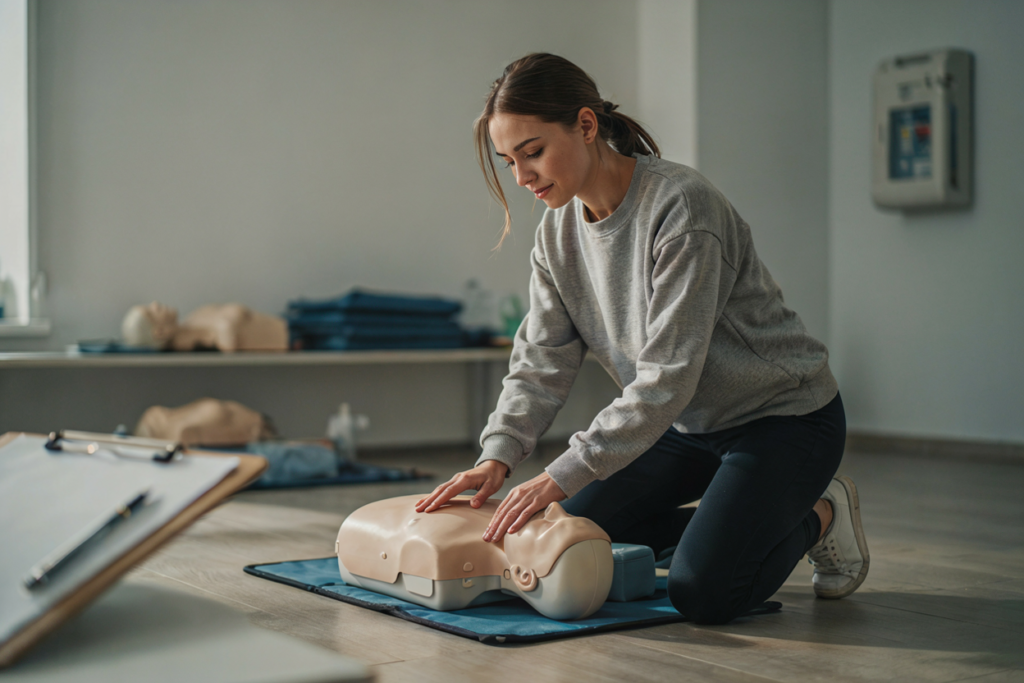
This one trips people up more than any other item on the list, and it’s the one that actually affects your day the most. HLTAID012 is hands-on. You’ll be down on the floor practicing CPR, kneeling next to a manikin, getting back up, doing it again. It’s not a sit-and-listen kind of course, and if you’ve never done first aid training before, that might genuinely surprise you.
So if you rock up in your work uniform, or something tight, or a skirt you can’t kneel in comfortably, you’re going to notice it by the second hour. Think gym clothes or something you’d wear to do the gardening. That’s the vibe. Layers are a good idea too, training rooms can run warm once everyone’s moving around, or cool if the air con is cranked, so something you can peel off or put back on makes the day more comfortable.
A few educators have told us they’ve come straight from a shift and just brought a spare t-shirt and leggings to change into before the practical component started. That’s a perfectly sensible approach if your work clothes aren’t floor-friendly.
Footwear
Closed-in shoes are a must. Sneakers, work boots, anything with a solid sole and covered toes. Leave the thongs, sandals, and heels at home, you’ll be moving around on the floor and you don’t want bare toes anywhere near that environment. It’s not about looking a certain way, it’s purely practical. You’ll be up and down off the floor repeatedly through the day, and proper shoes make that a lot less awkward.
A small comfort tip
If you’ve got a dodgy knee, a bad back, or you just know floor work isn’t your favourite thing, bring a small cushion or a knee pad along. Nobody’s going to bat an eye at it, and trainers see it all the time. Your instructor would honestly rather you be comfortable and paying attention than quietly gritting your teeth through the practical bits. It’s a small thing to pack and it can make a real difference to how much you actually take in during the session, because it’s hard to focus on technique when you’re distracted by discomfort.
Documents You Must Bring
This is the paperwork side of things, and it’s shorter than most people expect.
Photo ID
Bring something with your photo on it, a driver licence, passport, or a proof-of-age card will all do the job. This is standard for any nationally recognised training, not just HLTAID012, so don’t read anything sinister into it. It’s simply how your attendance and completion get verified against the qualification.
Your USI
Your USI, or Unique Student Identifier, is a requirement for anyone doing nationally recognized training in Australia. If you don’t already have one, or you’ve forgotten it, you can look it up at usi.gov.au before your course date. It only takes a couple of minutes, but it’s not something you want to be scrambling for on the morning of your session, so sort it out ahead of time. If you’ve done any other nationally recognized training before, whether that’s a first aid course, a certificate, or a diploma, chances are you already have one and just need to look it up rather than create a new one.
Proof of completed online theory
If your course has an online theory component you’re meant to finish beforehand, bring proof you’ve done it. A screenshot of the completion page or the confirmation email is plenty, nobody’s expecting a printed certificate. Just make sure it’s something you can pull up quickly on your phone or have saved somewhere easy to find, rather than digging through old emails while everyone else is settling in.
If you’re renewing
If this is a renewal rather than your first time doing HLTAID012, it’s worth bringing your previous certificate or Statement of Attainment along. It’s not mandatory everywhere, but it can save a bit of back-and-forth if your trainer needs to confirm anything about your last qualification, particularly if there’s any question about currency or whether your last course covered everything the current unit requires.
🧰 Quick answer: All training equipment and course materials are supplied. You don't need to bring anything beyond your ID, USI, and comfortable clothes.
What’s Already Provided, So You Don’t Overpack
A lot of people turn up braced to bring half a training room with them. You don’t need to, and honestly, most of what you’d think to bring is either unnecessary or already sitting in the room waiting for you.
Training equipment
Manikins, AED trainers, and the practice devices used for asthma and anaphylaxis scenarios are all supplied on the day. This gear gets used constantly and needs to be looked after properly, so it’s not something participants bring themselves, it’s all set up and ready before you walk in. You won’t be asked to source your own CPR manikin or defibrillator trainer, and if anyone ever tells you that you need to, that’s a red flag worth asking questions about.
Course materials
Whatever workbooks, handouts, or reference materials you need for the day are provided as part of the course itself. You don’t need to bring your own notebook, though plenty of people like to jot things down as they go, so if that’s you, a small notepad and pen certainly won’t hurt.
The reassurance bit
There’s no big pile of pre-reading or textbooks to work through before you arrive. HLTAID012 is built to be practical and hands-on rather than something you need to cram for the night before, so if you haven’t opened a book yet, you’re not behind. The learning happens in the room, through demonstration and repetition, not through memorising a textbook the week prior.
💧 Quick answer: Bring a water bottle, and pack a snack or lunch just in case your session runs across a meal break.
Food, Drink & Session Logistics
Water bottle
Bring one. You’ll be moving around more than you’d expect for a “sit in a classroom” type day, so having water on hand is just a good idea. Practical sessions can be more physically tiring than people expect, especially the CPR components, so staying hydrated genuinely helps you get through the day feeling fresh rather than flagging by the afternoon.
Lunch and snacks
If your session runs across a meal break, it’s worth packing something to eat or a snack to keep you going, just in case catering isn’t part of your particular session. Best to check this when you book so you’re not caught out either way. A muesli bar or piece of fruit in your bag is cheap insurance against a rumbling stomach halfway through an afternoon practical block. Even if you’re not usually someone who snacks during the day, practical training tends to burn more energy than people expect, so having something on hand is worth it.
Packing it all the night before
A good habit is laying everything out the night before rather than scrambling in the morning. ID, USI details, comfortable clothes, closed-in shoes, water bottle, and a snack if you need one. Once it’s all sitting by the door, the morning of your course becomes a non-event instead of a scramble, and you can walk in focused on the training rather than mentally running through a checklist while everyone else is already settling into their seats.

A Note for Centre Directors Briefing Staff
If you’re a centre director or nominated supervisor organising HLTAID012 for your team rather than just yourself, a couple of things will make your life easier, and honestly, this section exists because we know your booking experience looks different to someone booking for themselves.
Forward this checklist to your staff
Send this along to whoever’s booked in before their session. It’s one less thing you have to chase up individually, and it means nobody turns up in the wrong shoes or without their USI while you’re trying to run a centre at the same time. It saves you fielding the same “what do I bring?” question five separate times in the group chat too.
Booking multiple staff together
When you’re booking a group rather than an individual, it helps to have one point of contact managing the logistics and one consolidated invoice rather than everyone booking separately and you trying to track it all after the fact. It keeps your compliance paperwork tidier too, which matters when an assessor comes asking, and it means you’re not chasing five separate confirmation emails when you need to prove your whole roster is covered.
A quick reminder on the qualification itself
HLTAID012 is specific to education and care settings, it’s not the same as a generic first aid course, and it’s worth double-checking that any staff member who says they’ve “already done first aid somewhere else” actually holds the right qualification rather than a course that won’t satisfy your regulatory requirements. This mix-up happens more often than you’d think, particularly with newer staff who did a general workplace first aid course in a previous job and assume it transfers across.
Ready to book your team in?
If you’ve got multiple staff needing HLTAID012, get in touch about group pricing and we’ll sort the logistics with you directly, from scheduling around your roster to making sure everyone’s certificate lands in your compliance file at the same time. Book Multiple Staff – Get Group Pricing
Ready to Book Your HLTAID012 Course?
That’s genuinely the whole list. Bring your ID, your USI, comfortable clothes and closed-in shoes, and you’re set. Everything else is taken care of for you on the day.
If you haven’t booked in yet, get your spot sorted now, and if you’re organising this for your whole centre, reach out about group pricing so we can work through the scheduling together.
Wrapping It All Up
So that’s the full list, and if you read this the night before your course wondering whether you needed to pack half your house, hopefully you’re feeling a bit lighter now. Photo ID, your USI, comfortable clothes, closed-in shoes. That’s genuinely most of it. Everything else on that list, the water bottle, the snacks, the knee pad, is just there to make your day a bit easier, not because you’ll get turned away without it.
What trips people up isn’t the paperwork side, it’s usually the clothing. People forget this is a hands-on day, not a sit-in-a-chair-and-listen day, and they turn up in work clothes or shoes that aren’t built for kneeling on the floor. If there’s one thing worth double checking before you walk out the door, it’s your footwear. Everything else on this list is easy to sort in five minutes the morning of.
On the paperwork front, your USI is the one piece worth handling early rather than leaving until the last minute. It only takes a couple of minutes to look up if you don’t already have it saved somewhere, but it’s not something you want to be hunting for while everyone else is already checked in and settled. The same goes for any proof of completed online theory, save it somewhere you can find it fast rather than relying on memory the morning of.
If you’re a centre director booking this for your team rather than just yourself, the same rules apply, just multiplied across however many staff you’ve got coming through. Forward the checklist, sort the group logistics ahead of time, and you’ll save yourself a fair bit of chasing people up on the day. And a quick check that whoever’s booked in actually needs HLTAID012, not a generic first aid course, will save everyone a headache down the track too.
At the end of the day, this course isn’t designed to catch anyone out. Turn up with your ID, your USI, comfortable clothes, and closed-in shoes, and you’ve done everything you need to do. The rest is just showing up and getting stuck into the practical side of it, which is really what the day’s about anyway.
Book Your First Aid Training Now
Fast, affordable, and nationally accredited training delivered by professionals who care
Frequently Asked Questions
Q.Do I need to bring my own manikin or first aid equipment?
No. All training equipment, including manikins, AED trainers, and asthma and anaphylaxis practice devices, is supplied on the day. You only need to bring your ID, USI, comfortable clothing, and closed-in shoes.
Q.What if I don't know my USI?
You can look it up in a couple of minutes at usi.gov.au before your course date. It's best to sort this out ahead of time rather than trying to find it on the morning of your session.
Q.Can I wear my work uniform to the course?
You can, but it's not ideal. HLTAID012 involves floor-based CPR practice, so anything tight, restrictive, or not suited to kneeling and moving around will make the day less comfortable. Gym clothes or casual wear work best.
Q.Do I need to study anything before I arrive?
No extensive pre-study or textbook reading is required. HLTAID012 is a practical, hands-on course, and the learning happens through demonstration and repetition on the day itself.
Q.What if I'm renewing my HLTAID012 rather than doing it for the first time?
Bring your previous certificate or Statement of Attainment along if you have it. It's not mandatory everywhere, but it can help your trainer confirm details of your last qualification quickly.
Q.Is HLTAID012 the same as a general first aid course?
No. HLTAID012 is specific to education and care settings and isn't interchangeable with a generic workplace first aid certificate. If a staff member has done a different first aid course elsewhere, it's worth checking whether it actually satisfies your regulatory requirements before assuming it transfers across.
Making first aid training more affordable for
every classroom
We believe every student deserves access to life-saving first aid knowledge. That’s why we offer specially reduced pricing for schools and educational groups. Whether you’re booking for a single class, a year group, or your entire school, our flexible packages make training more accessible and cost-effective — without compromising quality.
