

You’ve probably already tried it. Sat there with your laptop open, typed something like “first aid course fully online” into Google, and got a list of results that all look promising until you actually click through. Some sites make it sound like you can finish the whole thing from your couch, tick a few boxes, print a certificate, done. And then somewhere in the fine print, or sometimes not until you’re halfway through checkout, you find out that’s not quite the full story.
Here’s the short version. A genuine HLTAID011 certificate can’t be done entirely online, and there’s a solid regulatory reason for that, not just providers being difficult. But the online part does most of the heavy lifting, so the in-person bit is shorter than most people expect.
In this one we’ll get into what actually has to be assessed face to face, why that practical session is shorter than people assume, and how to spot a provider who’s cutting corners on the online-only promise before you hand over your money. If you’ve felt a bit annoyed at the whole search process already, that’s a pretty normal reaction. Nobody enjoys hunting through five different provider websites just to find out one basic fact.
🔍 The honest answer, up front: the theory can be done online. The physical skills can't. That's the whole distinction, and everything below is really just explaining why that split exists and what it means for you.
Why Can’t First Aid Courses Be Done Fully Online?
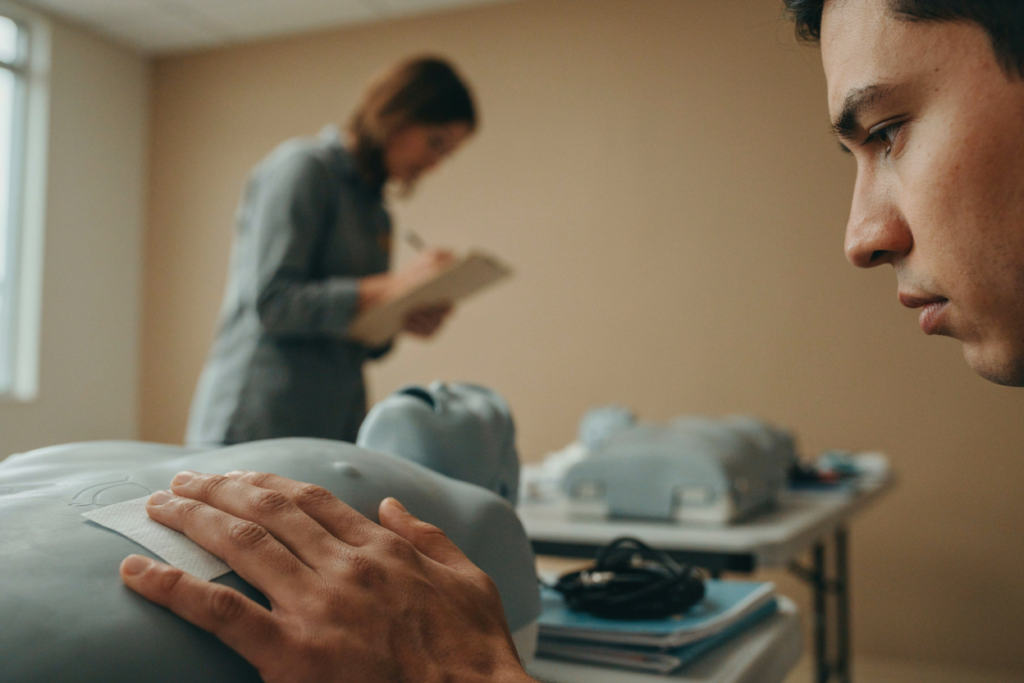
A first aid course can’t be run fully online because a registered training organisation has to watch you actually perform the physical skills before they can sign off on your competency, not just tick that you’ve read the material.
That means an assessor needs to see you:
- Perform CPR chest compressions at the correct rate and depth
- Use an AED correctly, including pad placement
- Respond to a choking casualty and place someone in the recovery position
Once that’s done, the training organisation can issue a nationally recognised Statement of Attainment, which is what your employer or industry body actually needs to see.
It’s worth sitting with why this matters, rather than just accepting it as a rule someone made up. Knowing the steps to CPR in theory and being able to actually do it under a bit of pressure are two different skills entirely. Plenty of people could recite the compression ratio from memory and still freeze, or get the depth wrong, or forget to check the airway first, the first time they’re actually kneeling next to someone. An assessor watching you do it in person is the only way anyone can honestly say you’d be able to do it again, for real, if you ever needed to.
There’s also a fairness angle to this that doesn’t get talked about much. If certificates could be earned by watching a video and clicking through a quiz, the whole qualification would mean very little, because there’d be no way to tell the difference between someone who genuinely practised the skill and someone who just clicked next a few times while doing something else. The in-person requirement is really what protects the value of the certificate for everyone who’s actually done the work properly.
The Legal Reason: What Australian Training Standards Actually Require
This part doesn’t come down to opinion or one provider being stricter than another. It’s set by the national training standards, and every RTO delivering HLTAID011 has to work within them.
📋 Worth knowing: this isn't one provider being stricter than another. It's the same requirement across every RTO in the country.
Why a qualified assessor has to watch you do it
Skills like CPR aren’t something you can tick off by watching a video and answering a quiz. The training standards require a qualified assessor to directly observe you performing the physical skill, in person, before they can confirm you’re actually competent at it. Bill Hunter of First Aid Alive (RTO 31106) puts it simply: an assessor needs to see your hands doing the work, not just hear you describe it.
This is really the same logic that applies to a driving test. You could pass every written road rules quiz going, and that still wouldn’t tell anyone whether you can actually parallel park or merge safely in traffic. Someone has to watch you do the actual thing. First aid works the same way, except the stakes when it counts are a fair bit higher than a parking bay.
The specific skills that must be demonstrated in person
A handful of skills sit at the centre of this, and they’re the same ones that come up on the HLTAID011 course page if you want the full breakdown:
- CPR chest compressions, at the right rate and depth
- AED use, including correct pad placement
- Choking response, following current ANZCOR guidance
- Recovery position
None of these can be assessed from a webcam angle or a written answer. They’re physical, hands-on skills, and the Australian Resuscitation Council’s ANZCOR guidelines are what every RTO trains and assesses against, which is also why you won’t hear us using older terms like the Heimlich manoeuvre. Australian guidelines moved away from that language a while back, and a provider still teaching outdated terminology is usually a sign their content hasn’t been reviewed in a long time either.
How to Spot a “Fully Online” Course That Won’t Be Accepted
Now, this is the bit that actually matters if you’re trying not to waste your time and some money on the wrong booking. Because there are providers out there who market themselves as fully online, and some of them aren’t upfront about what that actually means until you’re already signed up.
🚩 Pattern worth noticing: the providers vaguest about the in-person requirement are usually the ones least likely to meet it properly.
Red flags in provider marketing
A few things worth watching for before you book anything:
- No RTO number listed anywhere on the site
- Certificates issued from overseas, rather than through an Australian RTO
- No mention of a practical or in-person session at any point in the booking process
If a site is vague about any of these, that’s usually not an accident. A marketing copy that leans hard on words like “instant” and “fully online” while staying quiet on the practical component isn’t necessarily lying outright, it’s just letting you assume something that isn’t true and hoping you don’t ask too many questions before you pay.
The one question to ask before booking
If you’re not sure, there’s one question that cuts through most of it: “Is there a face-to-face component, and how is it delivered?” A legitimate provider will answer that clearly and quickly. One that dodges the question, or buries it in a FAQ you have to go hunting for, is telling you something too.
Here’s a quick way to compare what you’re looking at:
Compliant provider | Non-compliant provider | |
RTO number | Listed clearly | Missing or vague |
Practical session | Stated upfront | Not mentioned, or unclear |
Certificate issued by | Australian RTO | Overseas or unclear body |
Assessor observation | Required and explained | Not mentioned |
Getting this wrong is exactly how people end up booking a course, finishing it, and then having HR knock it back because it doesn’t actually meet the requirement. Better to catch that before you book than after, because redoing the whole process a second time is a far bigger hassle than spending two minutes checking a provider’s credentials up front.
What Blended Training Actually Looks Like
“Blended” is the actual term for how these courses run, and once you see how it’s structured, the online-plus-in-person split makes a lot more sense.
⏱️ The short version: theory happens on your own device, in your own time. The hands-on part happens in person, and it's leaner than most people picture.
Online theory component
You do this part first, in your own time, on your own device. You can break it up however suits you, over a lunch break, in the evening, whatever works. This is where you cover the knowledge side of things, the why behind what you’ll be doing physically later. Covering the theory before you show up also means you’re not sitting through a slideshow in person while everyone else in the room is quietly checking the time.
Practical session
This is the part where you turn up in person, and it’s shorter than most people picture. People sometimes assume it’ll eat a full day, and that’s actually one of the reasons some providers get away with implying it’s basically online, because the in-person chunk really is small. But small doesn’t mean skippable. This is where the assessor watches you do the CPR, the AED use, the choking response, and confirms you can actually do it, not just describe it.
The flow looks like this: online theory, done in your own time, then a practical session, done in person, then the certificate is issued.
That structure is deliberate. Doing the theory first means you walk into the practical session already knowing what you’re doing, which is part of why it doesn’t need to be a full day. It also means the in-person time gets spent on the part that actually matters most, doing the skill under supervision, rather than sitting through content you could just as easily read at home. Check current session availability before you book.

Will Your Employer Actually Accept the Certificate?
This is usually the real question underneath all of it. Nobody’s doing this course out of pure curiosity, most people are doing it because work needs it, and the thing they actually care about is whether what they end up with will satisfy that requirement.
✅ The short answer: yes, as long as it's an RTO-delivered, properly assessed certificate. The delivery format doesn't change that.
What “nationally recognised” means versus delivery format
Here’s where a bit of confusion tends to creep in. People sometimes assume “online theory” means “not quite the real thing,” as if doing part of it on a laptop somehow makes the certificate less valid. It doesn’t work that way. What matters for national recognition isn’t how the course was delivered, it’s whether it was delivered by a registered training organisation and assessed properly, including that in-person component. A blended HLTAID011 course through an RTO is just as nationally recognised as one run entirely in a classroom.
It helps to think of it less as “online course” versus “in-person course” and more as one course, delivered across two settings, both of which are required for the certificate to mean anything. The online part isn’t a shortcut version, and the in-person part isn’t an optional extra tacked on for compliance’s sake, they’re two halves of the same requirement.
Statement of Attainment as proof
What you actually get at the end is a Statement of Attainment. That’s the document to forward to HR, not a screenshot of a quiz result or a completion email. It’s the formal, nationally recognised proof that you’ve met the unit requirements, and it’s what employers are expecting to see.
If employer acceptance is the thing that’s actually been sitting at the back of your mind through all of this, that’s the document that puts it to rest. Once it’s in HR’s hands, this whole thing becomes something you genuinely don’t have to think about again for a good while.
Ready to get it sorted? Book your HLTAID011 course today.
Booking Around a Full-Time Job Without Losing a Full Day
If work is the reason you’re doing this in the first place, the last thing you want is for the course itself to eat into more of your time than it needs to.
📅 Good to know: the blended structure exists partly so this doesn't have to swallow a whole day off work.
Why online theory first shortens in-person time
This comes back to the structure we covered earlier. Because the theory’s already done before you arrive, the practical session stays short instead of blowing out into a full day. That’s the whole point of doing it this way, less time away from work, without cutting any corners on what actually gets assessed. It’s a genuinely sensible trade-off once you see how it’s built, rather than a compromise anyone’s making to cut corners.
For most people, the actual friction isn’t the course content, it’s finding a slot that doesn’t clash with work. Evening and weekend availability solves the bulk of that, and because the in-person portion is already lean, you’re not choosing between a full weekend day and putting this off for another few weeks. That’s usually the difference between people who sort this out straight away and people who keep meaning to and don’t.
Conclusion
So that’s the real answer to why a first aid course can’t be done fully online, and it’s not because anyone’s trying to make things harder than they need to be. A qualified assessor has to physically watch you perform CPR, use an AED, and respond to a choking casualty before your competency can actually be signed off. That’s not red tape for its own sake, it’s the whole point of the certificate meaning something when it matters.
The good news is that this in-person requirement is a lot smaller than most people assume going in. Theory online, done whenever suits you, followed by a shorter practical session for the hands-on side. That’s the entire face-to-face commitment, not a full day pulled out of your week.
If you’re still weighing up providers, the checklist is worth keeping in the back of your mind. An RTO number listed clearly, a certificate issued by an Australian training organisation, and an upfront answer about when and how the practical session happens. Providers that are vague on any of those points are usually vague for a reason, and it’s much easier to notice that before you book than after you’ve already paid.
What actually lands in your inbox at the end is a Statement of Attainment, and that’s the document your employer needs to see. It doesn’t matter that part of the course happened on your laptop, what matters is that it was delivered and assessed properly by a registered provider. That’s the part that puts the employer-acceptance question to bed.
None of this needs to turn into a bigger project than it is. Book a session that fits around your work week, do the online theory in your own time, turn up for the practical, and you’ll walk out with a certificate that actually holds up. That’s really all there is to it.
Book Your First Aid Training Now
Fast, affordable, and nationally accredited training delivered by professionals who care
Frequently Asked Questions
Q.Can I do my first aid certificate completely online?
No. The theory component can be worked through online, but a qualified assessor has to watch you demonstrate skills like CPR and AED use in person before a Statement of Attainment can be issued.
Q.Is a blended course less recognized than a fully in-person one?
No. What determines national recognition is that the course is delivered and assessed by a registered training organisation, not how the theory portion happens to be delivered.
Q.What should I actually give my employer as proof?
A Statement of Attainment. That's the formal, nationally recognized document that confirms you've met the unit requirements, and it's what HR is expecting to see, not a quiz result or a confirmation email.
Q.How can I tell if a "fully online" provider isn't legitimate?
Check for a listed RTO number, confirm the certificate is issued by an Australian RTO, and look for a clearly stated in-person component. If a provider is vague on any of those, ask directly before you book.
Q.Does the online theory need to be done in one sitting?
No. It's self-paced, so you can work through it in stages, whenever it suits your schedule, rather than needing to block out one long session.
Making first aid training more affordable for
every classroom
We believe every student deserves access to life-saving first aid knowledge. That’s why we offer specially reduced pricing for schools and educational groups. Whether you’re booking for a single class, a year group, or your entire school, our flexible packages make training more accessible and cost-effective — without compromising quality.
