
Approximately 30,000 Australians suffer a cardiac arrest outside hospital every year. Survival rates drop by around 10% for every minute that passes without CPR, yet fewer than one in five bystanders feel confident enough to step in. That gap between knowing something matters and feeling prepared to act is exactly why this question deserves a straight answer.
Maybe your employer told you to sort it out. Maybe you had a near-miss with a family member and the feeling hasn’t quite gone away. Whatever brought you here, you’re not alone.
What follows isn’t a sales pitch. It’s an honest breakdown of the real reasons Australians get first aid certified, from legal obligations and workplace compliance to the personal moments that make training genuinely worth it.
Whether you’re after HLTAID011 Brisbane sessions, HLTAID011 Gold Coast options, or just trying to figure out which certificate your situation calls for, this article covers all of it.
Why Get First Aid Certified? The Short Answer
First aid certification gives you the skills and confidence to respond effectively in a medical emergency before ambulance services arrive. In Australia, the first few minutes of a cardiac arrest, choking incident, or severe allergic reaction are the most critical. A certified first aider can mean the difference between a full recovery and a fatality.
The core reasons Australians get first aid certified:
- Legal obligation — Queensland workplaces must maintain trained first aiders under the WHS Act and Safe Work Australia Code of Practice
- Regulatory compliance — childcare services, schools, and NDIS providers must meet specific first aid ratio requirements
- Workplace safety — reduces the risk of serious harm or death following a workplace incident
- Personal preparedness — confidence to act in a home, community, or outdoor emergency
- Professional requirement — AHPRA-registered practitioners and many industry sectors require current certification
- Community responsibility — bystander CPR significantly improves cardiac arrest survival rates
The Legal Reason: What Queensland Law Actually Requires
What the WHS Act Says About First Aid
Workplace first aid isn’t optional, and it never has been. Under section 19 of the Queensland Work Health and Safety Act 2011, every person conducting a business or undertaking has a primary duty of care to maintain a safe work environment. First aid is explicitly part of that obligation. The Safe Work Australia First Aid in the Workplace Code of Practice (2021) makes it concrete, specifying that workplaces must have an adequate number of trained first aiders, appropriate equipment, and access to facilities.
If you employ people, you’re almost certainly required to have trained first aiders on staff. The question is how many.
How Many First Aiders Does Your Business Actually Need?
Safe Work Australia’s guidance ties the required number of first aiders to two factors, your workforce size and your workplace hazard level.
Business Size | Risk Level | Ratio Guidance |
Fewer than 25 workers | Low risk (office, retail) | At least 1 trained first aider |
25–50 workers | Low risk | At least 1 trained first aider |
Fewer than 25 workers | High risk (construction, manufacturing) | At least 1 trained first aider |
25–50 workers | High risk | At least 1 trained first aider per 25 workers |
More than 50 workers | Low or high risk | Proportional, consult the Code of Practice |
These are guidance figures, not hard statutory minimums, but they’re what a WorkSafe Queensland inspector will reference when they walk through your door.
Fines, Liability, and Audit Risk
WorkSafe Queensland inspections are commonly triggered by a notifiable incident, a worker complaint, or an industry-wide compliance campaign. When they show up, lapsed first aid certificates are exactly the kind of gap that gets documented. Breaches of the Queensland WHS Act can attract significant fines for corporations and personal liability for officers and managers. If a worker is injured on your premises and your designated first aider’s certificate was expired at the time, that lapsed certificate becomes evidence in any negligence claim that follows.
🟡 Queensland Compliance Check: Not sure if your business meets Safe Work Australia's first aid ratio requirements? Read our plain-English guide: How many first aiders does your Queensland business legally need?

The Compliance Reason: Industries Where Certification Is Mandatory
For a significant portion of the Queensland workforce, first aid certification is a hard requirement tied to licensing, registration, or service approval. Lose the certificate, lose the ability to operate.
Childcare and Early Childhood Services (ACECQA / NQF)
Childcare services must meet specific first aid ratio requirements under the National Quality Framework. ACECQA expects a sufficient number of educators to hold current first aid qualifications at all times the service is operating. Fail to maintain those ratios, and you’re looking at compliance notices, conditions on your approval, or service suspension.
The unit code confusion in this sector centres on HLTAID011 vs HLTAID012. HLTAID012 is ACECQA’s preferred unit for childcare workers because it includes enhanced paediatric content. HLTAID011 satisfies the broader first aid obligation, and many educators hold both. More information is available directly from ACECQA.
Schools and Educational Institutions (Queensland DET)
Queensland state schools must have trained first aid staff present during school hours and on excursions. The obligation extends to independent and Catholic schools, TAFE campuses, and university settings. Staff turnover creates ongoing compliance gaps, a teacher leaves mid-term, the ratio drops, and the gap needs to be closed before the next school day.
Healthcare and Aged Care (AHPRA, NDIS Practice Standards)
AHPRA-registered practitioners must maintain currency of practice as part of their CPD obligations, which commonly includes annual CPR recertification and triennial first aid renewal. Some clinical roles require HLTAID015 rather than HLTAID011. NDIS support workers also have a mandatory first aid obligation under the NDIS Practice Standards. More on AHPRA obligations at AHPRA.
Construction and Trades (Safe Work Australia, Site Inductions)
Your foreman needs to see a current certificate before you set foot on site. No certificate, no start. There’s no workaround.
Sporting Clubs and Community Organisations
Community sporting clubs across Queensland are increasingly expected to have trained first aiders present at games and training. The outdoor Queensland lifestyle makes this particularly relevant: weekend sport, beach activities, summer heat, and the ever-present risk of cardiac arrest on the sideline of a suburban oval. First aid training and AED operator familiarity go hand in hand, and the community setting is where that combination most often saves a life.
Industry | Regulatory Body | Certificate Required | Renewal Frequency |
Childcare / Early Childhood | ACECQA / NQF | HLTAID011 or HLTAID012 | Every 3 years (CPR annually) |
Schools / Education | Queensland DET | HLTAID011 | Every 3 years (CPR annually) |
Healthcare / Aged Care | AHPRA / Employer | HLTAID011 or HLTAID015 | CPR annually; First Aid 3 years |
NDIS Support Workers | NDIS Practice Standards | HLTAID011 | Every 3 years (CPR annually) |
Construction / Trades | Safe Work Australia / Site | HLTAID011 | Every 3 years (CPR annually) |
Sporting Clubs / Community | Club governance / WHS | HLTAID011 | Every 3 years (CPR annually) |
❤️ The human side: Compliance gets people through the door. But the reason most people are glad they did it is personal — because one day, the training is all that stands between someone they love and a very different outcome.
The Personal Reason: What Happens in the Minutes Before the Ambulance Arrives
Why Bystander Action Changes Everything
Queensland Ambulance Service metro response times average around 8 minutes in ideal conditions. The Australian Resuscitation Council is clear on what happens during that wait: survival rates drop by roughly 10% for every minute that passes without CPR. Bystander CPR, started early, can double or even triple survival rates. Fewer than one in five bystanders feel confident enough to act. The gap isn’t knowledge. It’s training.
Real Scenarios Where First Aid Training Makes a Difference
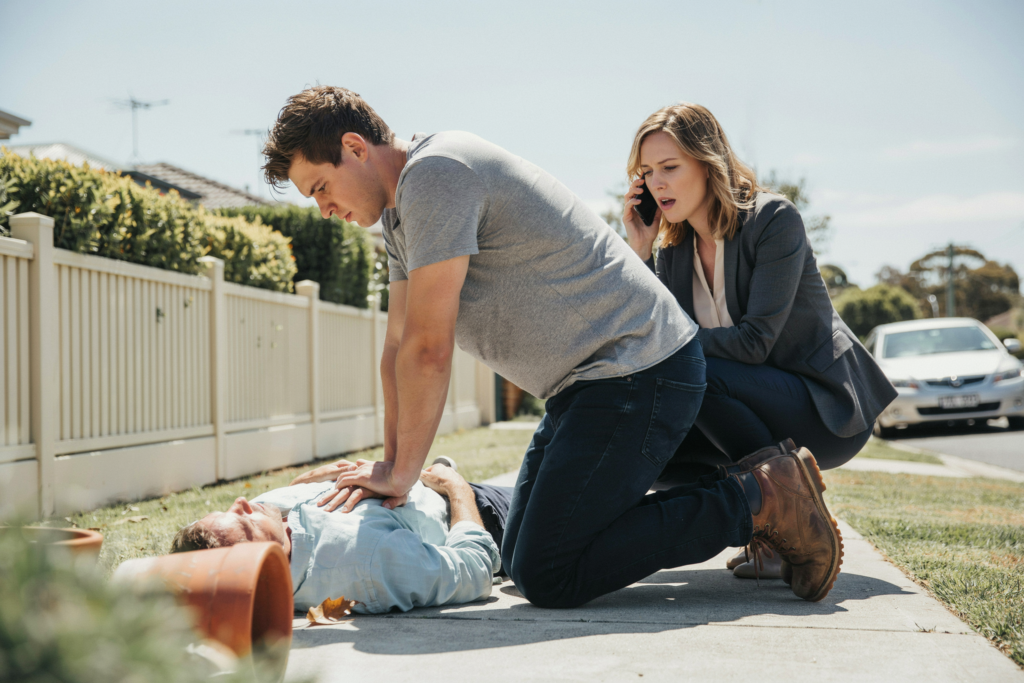
Cardiac arrest at home. The person most likely to be present when someone’s heart stops is a family member. A trained bystander who starts CPR immediately buys the time an ambulance response alone cannot.
A child choking. The parents who’ve practised back blows and chest thrusts on a training manikin don’t freeze in that moment. The ones who haven’t usually do.
Anaphylaxis at a sporting event. A teenager has an unknown allergy. Someone has an EpiPen. The question is whether anyone present knows when and how to use it, and what to do while waiting for the ambulance.
A workplace laceration. A deep cut managed quickly and correctly stays a manageable injury. Managed poorly, it becomes a much more serious situation.
Why Most People Freeze (and How Training Fixes It)
Freezing in an emergency isn’t a character flaw. It’s a physiological response, the brain, flooded with stress hormones and confronted with a situation it has no practiced response for, stalls. What training does at a practical level is give your brain a pathway to follow when panic hits. You’ve done the compression sequence on a manikin. You’ve run the scenario. So when the real thing happens, there’s something to fall back on other than blind instinct.
The Professional Reason: Career, Credentialing, and CPD
For many workers, getting first aid certified isn’t really a decision at all, it’s a condition of employment. Site inductions routinely list a current HLTAID011 as non-negotiable. The certificate is nationally recognised across all states and territories, so it travels with workers who move interstate.
For AHPRA-registered practitioners, CPD is a registration standard. HLTAID011 is valid for three years, but the embedded CPR component, HLTAID009, is recommended for annual renewal in line with Australian Resuscitation Council guidelines. In aged care, allied health, community sport, and fitness, a current certificate is often the difference between getting a role and being told to come back once credentials are sorted. For NDIS support workers, arriving with current certification makes you immediately deployable in an industry where participant safety is under increasing scrutiny.
Which Certificate Do You Actually Need?
Unit Code | What It Covers | Who Needs It | Valid For |
HLTAID009 | CPR, AED, unconscious casualty | Annual CPR renewal; CPR-only compliance | 1 year (recommended) |
HLTAID011 | Full first aid, CPR, AED, bleeding, burns, shock, fractures, anaphylaxis awareness | Most workplaces, community organisations, industry obligations | 3 years |
HLTAID012 | HLTAID011 content plus enhanced paediatric scenarios | Childcare and early childhood educators | 3 years |
HLTAID015 | Advanced resuscitation, airway management, oxygen therapy | Clinical roles, nurses, paramedics, some allied health | 3 years |
HLTAID009 – is for CPR-only compliance or annual refreshes supplementing an existing first aid certificate.
HLTAID011 – is what most people need. It satisfies the vast majority of workplace, community, and industry obligations across Queensland and nationally.
HLTAID012 – is the childcare-specific unit with enhanced paediatric content. ACECQA considers it the preferred unit for educators in care settings. Many hold both HLTAID011 and HLTAID012.
HLTAID015 – is a clinical-level qualification for healthcare workers. If you’re a registered nurse, paramedic, or other clinical worker, check your employer’s credentialing requirements before booking.
What the Training Actually Involves
A lot of people picture something closer to a university lecture than an actual skills session. It’s not that.
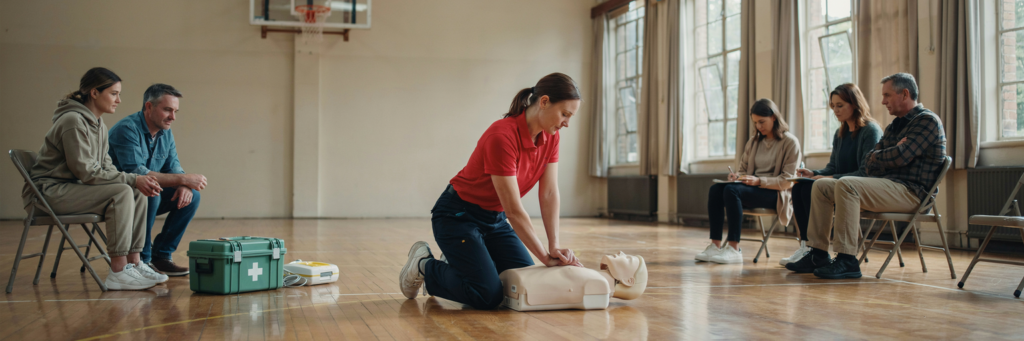
You’ll spend time on a manikin practising CPR compressions and rescue breaths until the technique feels natural rather than theoretical. You’ll use an AED trainer unit so that if you ever face a real defibrillator, you’re not reading the instructions for the first time under pressure. You’ll also practice bandaging, the recovery position, and scenario-based exercises working through realistic emergencies as a group.
How to Book First Aid Training in Brisbane and the Gold Coast
Public courses are open to individuals and small teams. Sessions run on weekdays and weekends across both Brisbane and the Gold Coast. You book your place online, show up on the day, and walk away certified.
On-site group training is the option for teams. RTO NAME sends a qualified trainer directly to your workplace, school, childcare centre, or venue. Your staff don’t lose time to travel, and the logistics, room setup, equipment, and assessment, are handled entirely by the trainer.
Here’s how to get certified:
- 1 Choose your course — HLTAID009 (CPR) or HLTAID011 (First Aid), or call us if you're not sure.
- 2 Pick a date — public sessions run weekdays and weekends across Brisbane and the Gold Coast. Group and on-site bookings are also available.
- 3 Show up and get certified — your nationally recognised certificate will be issued within [TURNAROUND_TIME] of completing your assessment.
Ready to Get Certified? Book Your First Aid Course in Brisbane or the Gold Coast
Getting first aid certified isn’t a complicated decision when you strip it back to what actually matters. Someone near you, a workmate, a family member, a stranger at a sporting event, will one day need help in the minutes before an ambulance arrives. The question isn’t whether that moment will come. It’s whether you’ll be ready for it when it does.
The legal and compliance reasons are real, and they matter. Queensland workplaces have genuine obligations under the WHS Act. Childcare services risk their approval status without the right ratios. Construction workers can’t start on site without a current certificate. Those obligations exist for a reason, because the alternative, a workplace or community where nobody knows what to do in an emergency, carries consequences that no fine schedule can fully capture.
But the personal reason sits underneath all of it. The parent who froze when their child choked. The partner who stood helpless while someone they loved collapsed. The bystander who watched a situation deteriorate because they didn’t know what to do and didn’t feel confident enough to try. First aid training doesn’t eliminate emergencies, nothing does. What it does is replace paralysis with action, and in a cardiac arrest or a choking emergency, action is the only thing that changes the outcome.
The certificate itself is straightforward. A practical skills session, not a lecture. A nationally recognised qualification accepted by every employer, regulator, and site supervisor in the country. The course isn’t hard. The commitment isn’t large. What you walk away with, the genuine ability to help someone in the worst moment of their life, is worth considerably more than the time it costs.
If you’ve been sitting on the fence about getting certified, this is the honest answer to why it’s worth doing. Not because a regulation says so, though many do. Not because your employer is asking, though they might be. But because the gap between knowing something matters and actually being prepared to act is a gap that closes in a single day, and once it’s closed, it stays closed.
Book Your First Aid Training Now
Fast, affordable, and nationally accredited training delivered by professionals who care
Frequently Asked Questions
Q.Why should I get first aid certified?
In Australia, cardiac arrest survival rates drop by roughly 10% for every minute without CPR, which means a trained bystander can directly change whether someone lives or dies. Beyond personal readiness, first aid certification also satisfies legal obligations for Queensland employers under the WHS Act, meets regulatory requirements across childcare, healthcare, construction, and education, and is a mandatory credential for many workers in NDIS, aged care, and site-based industries.
Q.Is first aid certification a legal requirement in Queensland workplaces?
Yes. Under the Queensland Work Health and Safety Act 2011 and the Safe Work Australia First Aid in the Workplace Code of Practice (2021), employers are required to maintain an adequate number of trained first aiders based on their workforce size and hazard level. Failing to meet the guidance figures puts businesses at risk during WorkSafe Queensland inspections and creates potential civil liability exposure if an incident occurs with lapsed certificates on file.
Q.What is the difference between HLTAID009 and HLTAID011?
HLTAID009 covers CPR, AED use, and management of an unconscious casualty only, with annual renewal recommended in line with Australian Resuscitation Council guidelines. HLTAID011 is the full first aid qualification — covering CPR, AED use, choking, bleeding, burns, shock, fractures, and anaphylaxis awareness — and is valid for three years. HLTAID011 includes HLTAID009 as an embedded component, so completing the full first aid course satisfies both obligations. Most Queensland workplace, industry, and community requirements call for HLTAID011.
Q.How long is a first aid certificate valid in Queensland?
HLTAID011 is valid for three years from the date of issue. However, the embedded CPR component (HLTAID009) is recommended for annual renewal in line with Australian Resuscitation Council guidelines, and many employers and regulators require it annually regardless of when the full certificate was last completed. AHPRA-registered practitioners should check their specific registration standard, as CPD renewal obligations may require more frequent currency.
Q.Which first aid certificate do childcare workers need?
Childcare workers operating under the National Quality Framework are required to hold a current first aid qualification. ACECQA considers HLTAID012 the preferred unit for educators because it includes enhanced paediatric content covering infant and child resuscitation and anaphylaxis management in young children. HLTAID011 satisfies the broader first aid obligation and many educators hold both. If you're unsure which unit your service requires, check directly with ACECQA or speak with a registered training organisation before booking.
Making first aid training more affordable for
every classroom
We believe every student deserves access to life-saving first aid knowledge. That’s why we offer specially reduced pricing for schools and educational groups. Whether you’re booking for a single class, a year group, or your entire school, our flexible packages make training more accessible and cost-effective — without compromising quality.
