

So you figured you’d knock out your first aid certificate from the couch on a Sunday afternoon a few videos, a quick quiz, and done. It sounds completely reasonable. Most professional development these days is fully online. Tax courses, food safety certificates, even real estate licensing has moved largely to the internet. So why does every registered first aid provider in Australia keep insisting you show up in person?
The question comes up constantly, from tradies who need their ticket before a Monday site start, from childcare workers trying to fit recertification around a busy roster, and from HR managers who’d love the simplicity of ticking the box without coordinating schedules. The frustration is fair.
The short answer: Australian law and the national training framework require it. The longer answer is that CPR, AED operation, and emergency response are physical skills. They can’t be genuinely assessed through a screen, and an assessor who can’t see your hands can’t sign off on your certificate.
Why Can’t First Aid Be Done Fully Online?
First aid training cannot be completed fully online in Australia because the nationally recognised units including HLTAID011 (Provide First Aid) and HLTAID009 (CPR) require a demonstrated practical skills assessment. This requirement is set by the Australian Skills Quality Authority (ASQA) and the Health Training Package (HLT), which govern how registered training organisations (RTOs) must deliver and assess these qualifications.
There are several core reasons first aid cannot be fully online:
- Hands-on skills must be observed — a qualified assessor must directly observe CPR technique, AED operation, bandaging, and patient positioning before a certificate can be issued.
- Manikin practice is mandatory — chest compression depth, rate, and recoil cannot be self-assessed through a screen.
- ARC guidelines require physical demonstration — the Australian Resuscitation Council specifies that resuscitation competency must be assessed in person.
- An online-only certificate is not legally recognised — no ASQA-registered RTO can issue a valid HLTAID011 or HLTAID009 certificate without a face-to-face assessment component.
- Employer and regulator acceptance depends on it — WorkSafe Queensland, ACECQA, and AHPRA will not accept certificates issued without a verified practical component.
What Does “Blended Learning” Actually Mean for First Aid?
Blended learning for first aid means the course is divided into two distinct parts: theory you complete online at home, and practical skills you demonstrate in person with a qualified assessor. Every nationally recognised first aid certificate in Australia follows this structure.
What You Complete Online: The Theory Component
The online theory module covers the knowledge side of first aid. You’ll work through:
- Legislation relevant to first aid in Queensland workplaces and the duty of care it creates.
- The DRSABCD action plan: Danger, Response, Send for help, Airway, Breathing, CPR, Defibrillation.
- How to recognise an emergency and when to call 000.
- Basic anatomy relevant to first aid response — the respiratory and circulatory systems.
- Asthma and anaphylaxis awareness at a theory level.
This part is self-paced. You can complete it on your phone, laptop, or desktop. No specialist software, no set schedule. Log in when it suits you.
What You Complete In Person: The Practical Component
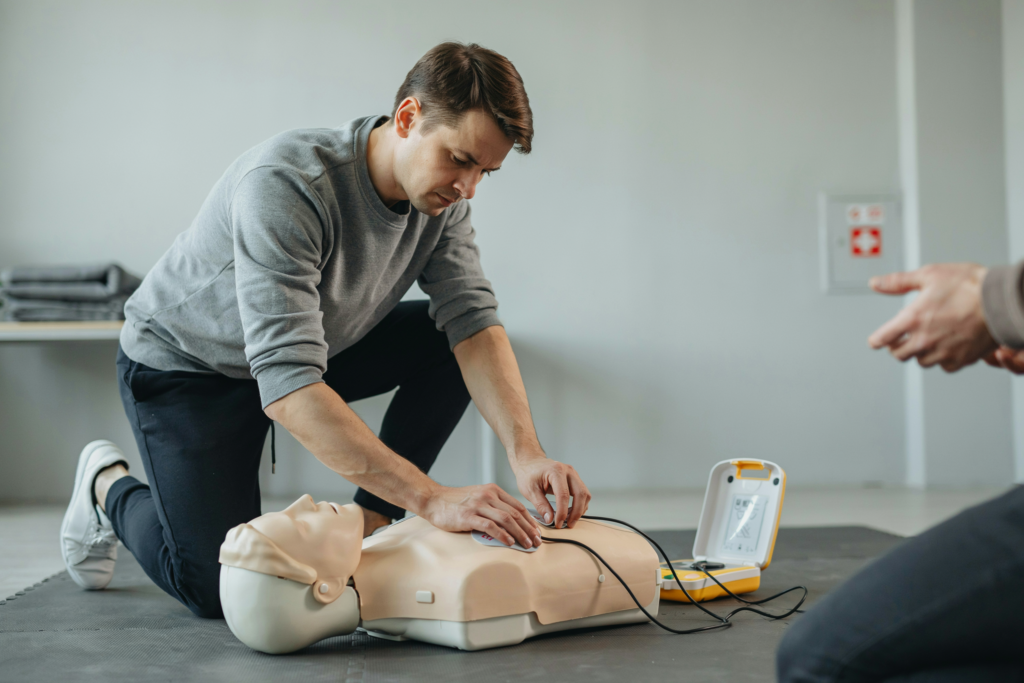
This is the part that cannot move online, and for good reason. The in-person session is where the real learning happens. Your assessor will take you through:
- CPR on manikins — correct compression technique, rate (100–120 per minute), depth (5–6cm), and full chest recoil between compressions.
- AED operation — device familiarisation, correct pad placement, and how to respond to voice prompts.
- Bandaging and wound management — pressure bandages, dressings, and improvised wound care.
- Recovery position and patient monitoring — how to position an unconscious but breathing patient and keep them stable until emergency services arrive.
- Choking response — back blows and abdominal thrusts for both adults and infants.
Blended learning actually makes the overall course shorter, not longer. Because you’ve already worked through the theory before you arrive, the face-to-face session can focus entirely on skills. You’re not sitting in a classroom watching a trainer read from slides. You’re on the floor, practising.
⚠️ Before you book anywhere: Not every provider offering a first aid certificate online is a registered RTO. An unregistered provider cannot issue a nationally recognised qualification regardless of what their website says. Always verify on training.gov.au first.

What the Law Actually Says About Online First Aid Certificates
The blended model makes practical sense, but it’s also a legal requirement, not just a preference. There’s a growing number of websites selling what look like first aid certificates clean landing pages, fully online completion, instant download. Those certificates aren’t worth the PDF they’re printed on.
ASQA and the Health Training Package Requirements
ASQA is the national regulator for vocational education and training. Its standards are explicit: assessment must be conducted by a qualified assessor who directly observes the candidate’s performance of each practical skill. Providers outside the RTO framework cannot issue a nationally recognised certificate regardless of how professional their website looks. Without RTO registration, the certificate has no legal standing. Verify any RTO’s registration at training.gov.au before you book.
What Happens If You Use an Online-Only Certificate at Work
For HR managers and school administrators: an invalid certificate creates exactly the same liability exposure as no certificate at all. If a WorkSafe Queensland auditor asks to sight your first aid compliance records and your designated first aider holds a certificate from an unregistered provider, that certificate will be rejected. Lapsed and invalid certificates are treated identically in an audit scenario.
Consider a facilities manager at a Brisbane construction company who discovered this the hard way. During a WorkSafe Queensland site audit, three designated first aiders were found to be holding certificates from an online-only provider that wasn’t registered as an RTO. All three certificates were rejected, and each staff member had to complete accredited face-to-face training before returning to their roles.
For childcare workers and centre directors: ACECQA is equally firm. Certificates issued without a verified practical component will not satisfy National Quality Framework first aid ratio requirements.
✅ How to check if your first aid certificate is legally valid: Your Statement of Attainment must include your RTO's name, their ASQA registration number, and the exact unit code (e.g. HLTAID011). If any of those three elements are missing, the certificate may not be accepted by WorkSafe Queensland, ACECQA, or AHPRA.
Why Practical Skills Cannot Be Self-Assessed: The Evidence
The legislation reflects the evidence. Hands-on practice isn’t just a regulatory preference it’s what actually determines whether someone can perform CPR effectively when it counts.
Most people, when they think about first aid training, imagine the knowledge side of it: knowing the steps, remembering DRSABCD. That can genuinely be learned online. But knowing the steps and being able to execute them under pressure on a real person are two very different things, and the gap between them is exactly what the in-person component exists to close.
What Research Says About CPR Skill Retention
The ARC and ANZCOR are explicit in their guidelines: resuscitation skills require regular face-to-face practice to maintain competency. Research published in the Resuscitation journal has found that CPR skill quality degrades measurably within months of training without hands-on refresher practice. Compression depth, rate accuracy, and correct hand positioning all decline over time, and they decline faster when the initial training didn’t include adequate physical practice.
That’s the exact reason the HLTAID009 CPR component carries a recommended annual renewal, even though the full HLTAID011 is valid for three years. The physical skill fades. The theory doesn’t fade at the same rate.
Why Compression Quality Cannot Be Verified Through a Screen
Correct chest compression depth is 5 to 6 centimetres. That’s not a wide margin. Too shallow and you’re not circulating blood effectively. Too deep and you risk injury. The only way to know whether your compressions are landing in that range is to have a qualified assessor watch you, or to use a manikin with a feedback indicator.
Full chest recoil between compressions is something almost everyone gets wrong the first time, and almost no one self-corrects without physical coaching. AED familiarisation requires handling the actual device. Choking response requires physical practice on a partner or manikin. These are motor skills built through repetition, not through watching.
What to Expect on the Day
A lot of people walk into their first first aid course carrying some version of the same anxiety: a formal exam environment, a clipboard-wielding assessor grading every move, and the real possibility of embarrassing themselves in front of strangers. That’s not what it’s like.
Your trainer works through each skill with every participant. No one gets left behind, and no one is expected to walk in knowing anything. The environment is friendly and practical, and the trainer’s job is to get everyone to competency, not to catch people out.
The session typically flows through:
- Brief welcome and overview of what the session will cover.
- CPR skills — manikin practice, compression technique, rate and depth coaching, AED familiarisation and pad placement.
- Airway management, recovery position, choking response for adults and infants.
- Wound management, bandaging, bleeding control, dressing application.
- Scenario practice — working through realistic emergency situations to consolidate skills.
- Formal skills assessment — your assessor observes each required skill and signs off competency.
- Statement of Attainment — issued promptly after successful assessment.
No prior experience is required. Weekend sessions are available, which makes a significant difference if you work during the week or need to work around family commitments.
What to Look For When Choosing a First Aid Provider in Queensland
Not all first aid training is created equal. The difference between a good experience and a frustrating one usually comes down to a few things you can check before you book.
Check Their RTO Registration Number
Before you book with any first aid provider in Queensland, go to training.gov.au and verify that the organisation is listed as a registered RTO. The provider must appear in the national register with an active registration number, and the unit code HLTAID011 must appear in their scope of registration. After you complete the course, that exact unit code must appear on your Statement of Attainment. An unregistered provider cannot issue a legally recognised certificate regardless of how good the training actually is.
Look for Flexible Scheduling
A provider who only runs weekday sessions between nine and five isn’t going to work for most of the people who actually need this certificate. Online theory combined with weekend practical sessions is the right setup for working adults. Ask about certificate turnaround time directly, and look for that commitment published clearly on their website. Some RTOs deliver the course and disappear. The better ones treat the relationship as ongoing and send renewal reminders before your certificate lapses.
Ready to Get Your First Aid Certificate?
The honest answer to why first aid can’t be fully online isn’t a bureaucratic one it’s a practical one. CPR is a physical skill. AED operation is a physical skill. Choking response, bandaging, recovery position all of it requires hands on a manikin, a real device, or a real person before anyone can sign off that you’re actually competent. A screen can teach you the theory. It can’t verify your technique.
The blended model exists because it works. You handle the knowledge side at home, at your own pace. Then you show up for the practical session already prepared, which means the face-to-face time is shorter, more focused, and more useful than a traditional full-day classroom course ever was. An online-only certificate from an unregistered provider isn’t a shortcut, it’s a liability. It won’t satisfy WorkSafe Queensland, it won’t satisfy ACECQA, and it won’t protect you if something goes wrong and someone asks to see your records.
If you’ve been putting this off because the in-person requirement felt like too much of a barrier, that barrier is smaller than it looked from the outside. The process is straightforward. And the outcome of a nationally recognised qualification that means something to your employer, your regulator, and yourself is worth a few hours on a Saturday morning.
Book Your First Aid Training Now
Fast, affordable, and nationally accredited training delivered by professionals who care
Frequently Asked Questions
Q.Why can't a first aid course be completed fully online in Australia?
First aid training cannot be completed fully online because ASQA and the Health Training Package require a qualified assessor to directly observe practical skills before a nationally recognised certificate can be issued. CPR compression technique, AED operation, choking response, and patient management all require physical demonstration. The online theory component covers knowledge only and does not satisfy the assessment requirements on its own.
Q.Is an online-only first aid certificate legally valid in Australia?
No. An online-only first aid certificate is not nationally recognised and will not be accepted by WorkSafe Queensland, ACECQA, or AHPRA. Valid certificates must be issued by an ASQA-registered RTO and must include a face-to-face practical assessment component. Verify any provider's RTO registration number on training.gov.au before booking.
Q.Which parts of a first aid course can I complete online?
The theory component of HLTAID011 can be completed online before your practical session. This covers legislation and duty of care, the DRSABCD action plan, emergency recognition, basic anatomy, and asthma and anaphylaxis awareness. The practical skills assessment including CPR on manikins, AED operation, bandaging, choking response, and recovery position must be completed in person with a qualified assessor.
Q.How do I know if a first aid provider is legitimate?
Search for the provider's name or RTO number on training.gov.au and confirm they appear as an active registered training organisation with HLTAID011 in their scope of registration. Your Statement of Attainment after completion must include the provider's RTO name, their ASQA registration number, and the exact unit code. If any of those elements are missing, the certificate may not be accepted by your employer or regulator.
Q.Does HLTAID011 need to be renewed and how often?
HLTAID011 (Provide First Aid) is valid for three years. The embedded HLTAID009 CPR component carries a recommended annual renewal to maintain skill currency in line with ARC guidelines, since CPR technique degrades measurably without regular hands-on practice. Most employers and regulators, including ACECQA and AHPRA, expect the CPR component to be refreshed each year even if the full HLTAID011 certificate hasn't yet expired.
Making first aid training more affordable for
every classroom
We believe every student deserves access to life-saving first aid knowledge. That’s why we offer specially reduced pricing for schools and educational groups. Whether you’re booking for a single class, a year group, or your entire school, our flexible packages make training more accessible and cost-effective — without compromising quality.
