

It’s 6:47am on a Tuesday. Your client—a 52-year-old accountant determined to “get back in shape”—just finished his third set of kettlebell swings when he grabs his chest and drops to his knees. Your CPR certification is current, but your last hands-on practice was 11 months ago. Do you start with chest compressions or check for breathing first? How deep should you push? What’s the compression-to-breath ratio again? In this moment, “sort of knowing” how to perform CPR correctly isn’t good enough.
This comprehensive guide takes you through each step of performing CPR correctly, based on the 2025 Australian Resuscitation Council guidelines. Whether you’re a fitness professional, childcare educator, workplace first aider, or simply someone who wants to be prepared, you’ll learn the exact technique, timing, and troubleshooting that makes CPR effective in real emergencies—not just in training rooms.
By the end of this article, you’ll have the knowledge and confidence to perform CPR correctly in the situations that matter most.
⚡ CRITICAL FACT: For every minute without CPR, survival chances drop by 7-10%. Starting compressions within 60 seconds can triple a person's chance of surviving cardiac arrest. Speed matters more than perfect technique.
How to Perform CPR: Step-by-Step Process
Before we get into the detailed mechanics, here’s the core sequence you need to memorize. These steps follow the current Australian Resuscitation Council guidelines and represent the gold standard for how to perform CPR correctly in emergency situations.
The 10-Step CPR Sequence:
- Check for danger – Ensure the scene is safe for you and the casualty
- Check for response – Tap their shoulders and ask loudly “Are you okay?”
- Send for help – Call 000 immediately, or have someone else call while you start CPR
- Open the airway – Tilt their head back and lift their chin
- Check for breathing – Look, listen, and feel for normal breathing for 10 seconds maximum
- Start chest compressions – Place both hands in the centre of their chest and push hard and fast
- Give 30 compressions – Push down 5-6cm at a rate of 100-120 per minute
- Give 2 rescue breaths – Tilt their head, pinch their nose, give 2 breaths (1 second each)
- Continue cycles – Repeat 30 compressions and 2 rescue breaths until help arrives
Use an AED if available – Apply defibrillator pads and follow voice prompts
The Critical First Moments: What to Do Before You Start CPR
Understanding how to perform CPR correctly starts with knowing what to do in those first 30 seconds, before you even touch the person.
Check for Danger (The Step Everyone Skips)
Take three seconds to scan the scene. Is there a reason they collapsed that could hurt you too? Electrical hazards, traffic, gym equipment that could roll – you need to protect yourself to help them. If the scene isn’t safe and you can’t make it safe quickly, move the person by grabbing them under their armpits and dragging backwards.
Check for Response
Tap their shoulders firmly and shout loudly: “Are you okay? Can you hear me?” If they groan, move, or open their eyes even slightly, they’re conscious – don’t start CPR. No response at all means unconscious, and you need to figure out if they’re breathing.
Send for Help
Call 000 on speakerphone before you start compressions. Put your phone on the ground next to you so you can talk while doing CPR. If there are other people around, point at someone specific and say: “You in the blue shirt – call 000 right now.” Don’t just yell “Someone call an ambulance” because everyone assumes someone else will do it.
Open the Airway and Check for Breathing
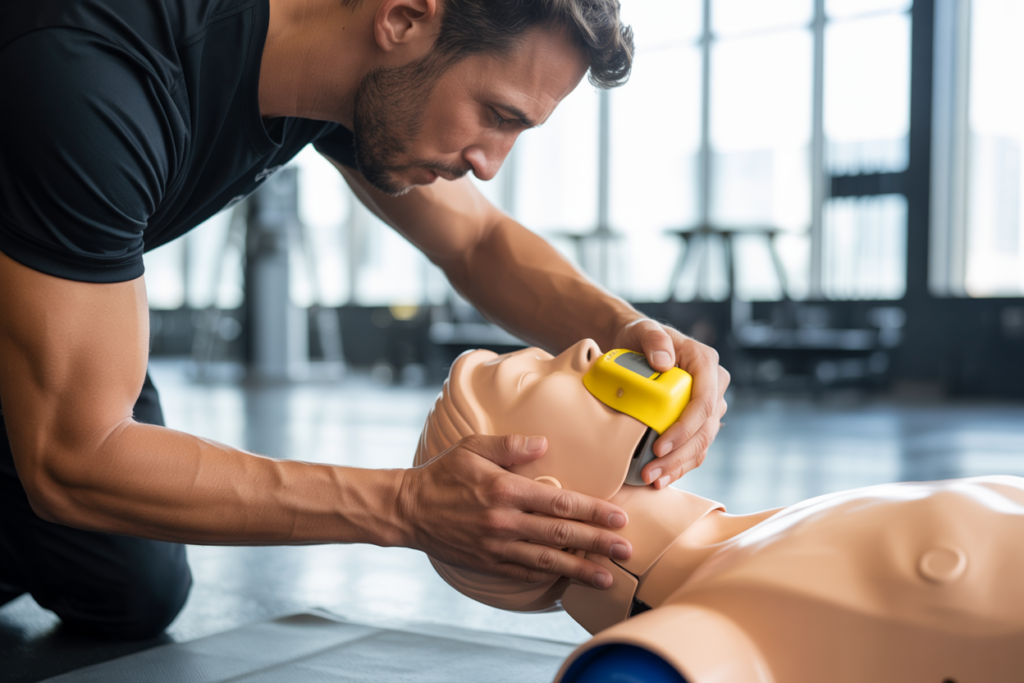
Place one hand on their forehead and two fingers under their chin. Tilt their head back to open the airway. Then check if they’re breathing – look at their chest, listen near their mouth, feel for breath. You’ve got 10 seconds maximum.
Normal breathing vs. agonal gasps: Sometimes people in cardiac arrest make gasping sounds. These are called agonal gasps and they don’t count as breathing. If the breathing is infrequent, irregular, or making weird noises, it’s NOT normal breathing and you need to start CPR.
Chest Compressions: The Technique That Actually Saves Lives
High-quality chest compressions are the single most important factor in surviving cardiac arrest. If you’re going to master one thing about how to perform CPR correctly, this is it.
| CPR Element | Target | Why It Matters |
|---|---|---|
| Compression Depth | 5-6cm | Shallow compressions don't circulate blood to the brain |
| Compression Rate | 100-120 per minute | Too slow = inadequate blood flow; too fast = heart doesn't refill |
| Hand Position | Centre of chest, lower breastbone | Wrong position won't compress the heart effectively |
| Chest Recoil | Full release between compressions | Allows blood to flow back into heart chambers |
| Interruptions | Less than 10 seconds | Every second stopped = survival chance drops |
Rescue Breaths: When and How to Give Them Safely
Chest compressions are more important than rescue breaths. If you absolutely cannot or will not give rescue breaths, doing compression-only CPR is still massively better than doing nothing.
The 30:2 Ratio
30 chest compressions followed by 2 rescue breaths. That’s one cycle. Each cycle takes about 24 seconds.
Proper Rescue Breath Technique
After your 30 compressions:
- Position yourself at their head and ensure their airway is still open
- Pinch their nose closed with your thumb and index finger
- Make a seal with your mouth – place your mouth completely over theirs
- Give the first breath – blow steadily for 1 second, watch for chest rise
- Let them exhale – take your mouth off, watch their chest fall
- Give the second breath – same technique
- Immediately resume compressions
You’re not trying to blast air into them – just a normal breath. If their chest doesn’t rise, reposition their head and try again. Don’t waste more than 10 seconds total on the two breaths.
Compression-Only CPR
You should do compression-only CPR if you’re unwilling or unable to give breaths, you don’t have a barrier device, there’s blood around their mouth, or you’re alone and getting fatigued. Just keep doing continuous chest compressions at 100-120 per minute until paramedics arrive.
Using an AED During CPR
When someone brings you an AED, this is good. It dramatically increases the person’s chance of survival. The moment someone shows up with an AED, you use it.
How to Use an AED
Step 1: Turn on the AED – it starts talking to you
Step 2: Keep doing compressions while someone else prepares the AED
Step 3: Expose the person’s chest – rip open their shirt
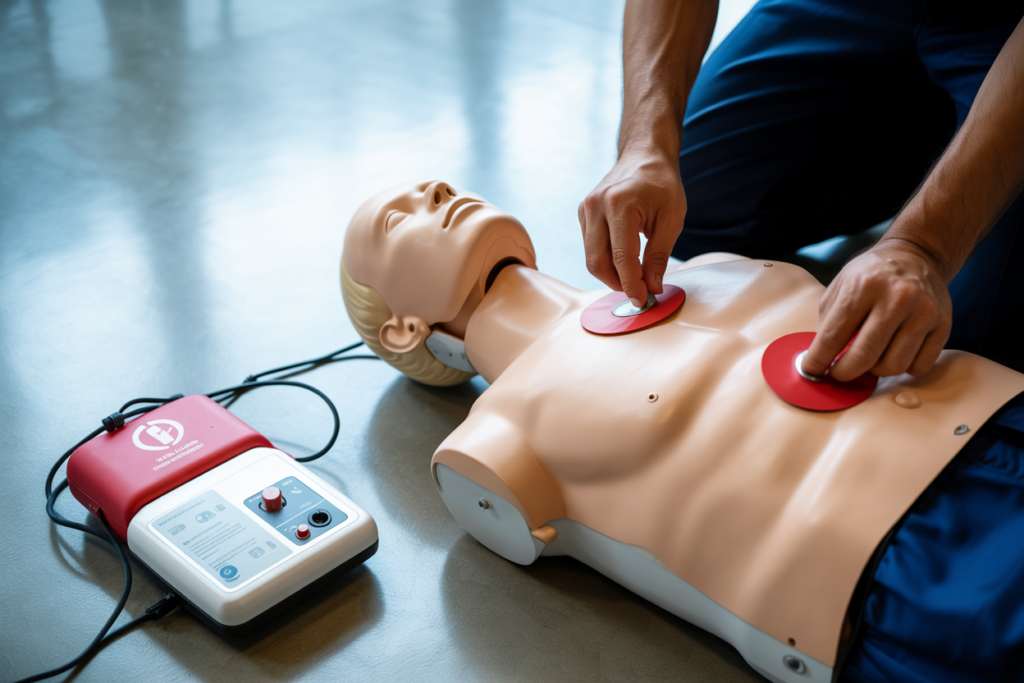
Step 4: Apply the electrode pads – one pad goes upper right chest, the other goes lower left side
Step 5: Let the AED analyze – the AED will say “Don’t touch the patient.” Stop compressions during analysis.
Step 6a: If the AED says “Shock advised” – make sure nobody is touching them, press the shock button when instructed, immediately resume compressions
Step 6b: If the AED says “No shock advised” – immediately resume compressions
The AED will reanalyze every 2 minutes. You keep doing CPR between analyses. Don’t wait to see if the shock worked – as soon as you deliver it, you start compressions again.
⚡ AED IMPACT: Using an AED within 3-5 minutes of collapse can increase survival rates from 10% to 50-60%. These devices literally restart hearts. If your gym doesn't have one, that's a serious safety gap.
CPR for Children and Infants
The technique changes based on age and size.
Age categories:
- Adults: Anyone over 8 years old
- Children: Ages 1-8 years old
- Infants: Under 1 year old
CPR for Children
Hand placement: Use one or two hands depending on the child’s size. Larger children get two hands like adults. Smaller children get one hand only.
Compression depth: At least one-third the depth of their chest, about 4-5cm.
Compression rate: Same as adults – 100-120 per minute.
Rescue breaths: Same 30:2 ratio. For smaller children, gentler breaths – you don’t need full adult-sized breath volume.
CPR for Infants
Hand placement: Use two fingers only – your index and middle finger. Place them on the breastbone, just below an imaginary line between their nipples.
Compression depth: At least one-third the depth of their chest, about 4cm.
Compression rate: Same – 100-120 per minute.
Rescue breaths: Cover both their mouth AND nose with your mouth. Give gentle puffs of air – just enough to make their chest rise slightly. Think of it like gently blowing out a candle.
If you’re alone with an unresponsive infant: Do CPR first for 2 minutes, THEN call for help. With adults, you call immediately.
Common CPR Mistakes That Kill People
Mistake #1: Hesitation and Delay
People freeze and stand there for 30, 60, 90 seconds trying to figure out what to do. Every second of delay matters. If they’re unconscious and not breathing normally, you start compressions within 10 seconds.
Mistake #2: Compressions Too Shallow
You’re pushing 2-3cm instead of 5-6cm because you’re scared of hurting them. Shallow compressions don’t circulate blood. They’re already as hurt as they can be – they’re dead. The only way they get less dead is if you push hard enough.
Mistake #3: Compressions Too Slow
You start at the right pace, then gradually slow down as you get tired. Slow compressions don’t circulate enough blood. Keep that “Stayin’ Alive” rhythm going the entire time.
Mistake #4: Not Allowing Full Chest Recoil
You’re leaning on them between compressions. This prevents blood from flowing back into the heart chambers. Think of each compression as a complete cycle – push down, come all the way up.
Mistake #5: Stopping Too Often or Too Long
Every time you stop compressions, blood flow stops. Don’t stop every 30 seconds to check if they’re breathing. Don’t take breaks. Any interruption should be under 10 seconds.
Mistake #6: Wrong Hand Position
Hands too high (on their throat), too low (on their stomach), or off to the side (on their ribs) won’t compress the heart effectively. Centre of chest, on the breastbone.
Mistake #7: Bent Elbows
You’re using arm muscles instead of body weight. You’ll be exhausted quickly and your compressions will get weaker. Lock your elbows and use your body weight.
Mistake #8: Giving Up Too Soon
You’ve been doing CPR for 8 minutes and they’re not responding, so you stop. Most successful resuscitations don’t happen in the first few minutes. Keep going until paramedics arrive or you’re physically unable to continue.
What Happens After CPR: Recovery Position
If the person starts breathing normally before paramedics arrive, your job isn’t finished. Roll them into the recovery position.
How to put someone in recovery position:
- Kneel beside them at chest level
- Straighten their legs flat on the ground
- Place their near arm at a right angle
- Bring their far arm across their chest to their near cheek
- Bend their far leg – pull the knee up
- Roll them toward you by pulling on their far knee
- Adjust their top leg to 90 degrees for stability
- Tilt their head back to keep the airway open
This position protects their airway in case they vomit and keeps them stable until paramedics arrive. Keep monitoring their breathing every 30-60 seconds. If breathing stops again, roll them onto their back and resume CPR.
🔄 RECOVERY POSITION PURPOSE: People who've been in cardiac arrest can vomit without warning. If they're on their back when this happens, they can choke on their own vomit. The recovery position lets fluids drain safely from their mouth while keeping their airway open.
Getting Certified: What You Need to Know
Reading this guide is great, but it doesn’t count for insurance, employment, or legal protection. You need actual certification from a registered training organization.
What CPR certification means: When you complete a CPR course, you receive HLTAID011 – Provide First Aid. This is the nationally recognized qualification that covers CPR, AED use, and basic first aid skills.
How long certification lasts: CPR expires every 12 months. First Aid expires every 3 years. You need to recertify the CPR portion annually.
Types of courses:
- In-person courses: Comprehensive instruction with extensive hands-on practice
- Blended learning: Online theory plus in-person practical
- Express CPR-only: Just CPR recertification if your first aid cert is still current
Avoid online-only courses with no hands-on component. They’re not recognized by most employers or insurance companies. You cannot learn effective CPR from watching videos alone.
What to look for in a course:
- Registered with ASQA (Australian Skills Quality Authority)
- HLTAID011 certification provided
- Extensive hands-on practice time
- Experienced instructors with real-world experience
- Practice with adult, child, and infant mannequins
- AED training included
Conclusion: From Knowledge to Action
You’ve just learned how to perform CPR correctly. You know the technique, the common mistakes, and the real-world scenarios. But here’s the reality: none of this matters unless you actually do something with it.
Knowledge doesn’t save lives. Action does.
For fitness professionals, you’re at higher risk of encountering cardiac arrest than the general public. You push people to their physical limits. You train clients with undiagnosed heart conditions. This will probably happen to you eventually.
The question isn’t “Will I need CPR?” It’s “When I need CPR, will I be ready?”
Here’s what you do next:
If you’re not currently certified, book a comprehensive CPR course this week. Not “sometime this month.” This week. Your client’s life might depend on what you learn in that course.
If your certification is current but you haven’t practiced in months, refresh your skills. Knowledge decays fast. Refresh it before you need it.
The next cardiac arrest you witness will be terrifying. Your hands will shake, your mind will race, you’ll doubt yourself. But if you’ve practiced the skills, your hands will remember what to do even when your brain is panicking.
And maybe – just maybe – because you took the time to learn how to perform CPR correctly and actually get certified, someone gets to go home to their family instead of dying on a gym floor.
Ready to get certified? Book your CPR course today and gain the skills that could save a life tomorrow.
Book Your First Aid Training Now
Fast, affordable, and nationally accredited training delivered by professionals who care
Frequently Asked Questions About CPR
Q.Can I hurt someone by doing CPR if they don't actually need it?
Yes, but it's unlikely and the alternative is worse. If someone is conscious and breathing normally, they'll push you away or tell you to stop within seconds. If they're unconscious and you start CPR but they didn't actually need it, they'll wake up within 30-60 seconds and you'll stop. You might bruise their chest, but you won't cause serious injury. The risk of NOT doing CPR on someone who needs it is death, while the risk of doing CPR on someone who doesn't need it is minor bruising.
Q.What if I crack their ribs during CPR?
You probably will, and that's completely normal and acceptable. Rib fractures happen in about 30% of CPR cases, especially in older adults, because you need to push 5-6cm deep to circulate blood effectively. Broken ribs heal in 6-8 weeks, but brain death from inadequate CPR doesn't heal ever. Push hard enough to be effective even if it means breaking ribs - survival is more important than avoiding fractures.
Q.How long should I continue CPR if they're not responding?
Continue until paramedics arrive and take over, the person starts breathing normally on their own, or you're physically unable to continue due to complete exhaustion. Don't give up after 5 or 10 minutes just because they're not responding - most successful resuscitations involve 15-30 minutes of total CPR before the person's heart restarts. Your job is to keep blood flowing to their brain until advanced medical care arrives, not to restart their heart yourself.
Q.What's the difference between CPR and first aid certification?
CPR certification (HLTAID009) covers only cardiopulmonary resuscitation and AED use, while First Aid certification (HLTAID011) includes CPR plus other emergency skills like wound care, burns, fractures, asthma attacks, and allergic reactions. Most employers and insurance companies require HLTAID011 (full first aid), not just CPR. The CPR component expires annually while the full first aid component expires every 3 years, so you need annual recertification.
Q.How often do I need to recertify my CPR?
CPR certification expires every 12 months, while the broader First Aid certification expires every 3 years. For fitness professionals and anyone who needs CPR for work, you must renew the CPR component annually. It's smart to book your recertification around month 10-11 rather than waiting until day 365, so you don't have any lapse in coverage that could affect your insurance or employment status.
Making first aid training more affordable for
every classroom
We believe every student deserves access to life-saving first aid knowledge. That’s why we offer specially reduced pricing for schools and educational groups. Whether you’re booking for a single class, a year group, or your entire school, our flexible packages make training more accessible and cost-effective — without compromising quality.
