
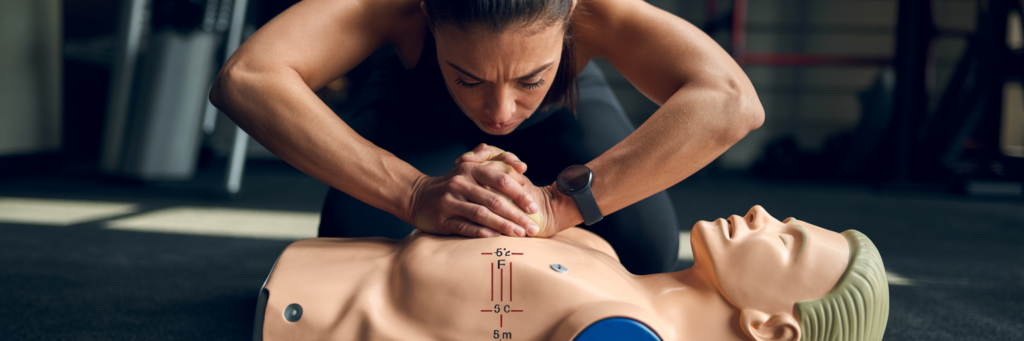
Your client collapses during a HIIT session. Heart attack. You drop to your knees, hands hovering over their chest—and your mind goes blank. Was it 30 compressions and 2 breaths? Or 15 and 1? How deep do I push?
Here’s what most Brisbane personal trainers don’t realize: the CPR steps you learned 12 months ago have changed. The Australian Resuscitation Council updated five critical protocols in 2025, and if you’re still following the old steps, you could be putting your clients—and your career—at risk.
This guide breaks down the exact CPR steps for 2025, including the five major protocol changes that impact how you respond to cardiac emergencies. Whether you’re renewing your HLTAID011 certification or need a practical refresher, here’s everything you need to perform CPR confidently in 2025.
⚠️ Quick Reality Check: If your CPR certification expired even one day ago, your Professional Indemnity insurance is probably void right now. Every training session you're running without current certification puts your entire business at risk.
What Are the CPR Steps for 2025?
The 8 CPR steps for 2025 are:
- Check for danger – Make sure the scene is safe for you and the collapsed person before you do anything else
- Check for response – Tap their shoulders firmly and shout “Are you okay?” or “Can you hear me?”
- Call 000 – Get someone specific to call emergency services (or do it yourself if you’re alone)
- Open the airway – Tilt their head back and lift their chin to open the airway passage
- Check for breathing – Look, listen, and feel for normal breathing (take no more than 10 seconds)
- Start chest compressions – Push hard and fast—30 compressions at 100-120 beats per minute, pressing down 5-6cm deep
- Give rescue breaths – Deliver 2 breaths after every 30 compressions (that’s the 30:2 ratio)
Continue until help arrives – Keep repeating the compression-breath cycles without stopping until paramedics take over
Understanding the 2025 CPR Protocol Changes
Why the Australian Resuscitation Council Updated CPR Guidelines
The Australian Resuscitation Council spent the last two years analyzing cardiac arrest survival data from 2023-2024. The survival rates for exercise-induced cardiac events improved significantly when responders used the updated protocols.
These changes align Australia with ILCOR (the International Liaison Committee on Resuscitation), which means Brisbane personal trainers are now following the same evidence-based protocols as emergency responders worldwide. Most importantly, these updates specifically address cardiac events that happen during high-intensity training scenarios.
What These Changes Mean for Personal Trainers
Your insurance policy probably requires you to follow current protocols. If you’re still using old CPR steps and something happens, your Professional Indemnity insurer could argue you weren’t following current guidelines.
Your HLTAID011 certification needs to reflect 2025 protocols. Fitness Australia and Physical Activity Australia both require trainers to hold certifications that teach current protocols—not outdated ones.
The 5 Critical CPR Changes for 2025
Change #1 – Updated Compression-Only CPR Guidelines
This is probably the biggest shift, and honestly, it removes a huge barrier for trainers who panic about doing rescue breaths wrong.
Here’s what changed: Hands-only CPR is now officially recognized as equally effective during the first 6-8 minutes of cardiac arrest. That means if you’re doing continuous chest compressions without rescue breaths, you’re still giving your client a legitimate chance at survival while paramedics are en route.
The old guidelines made it sound like you HAD to do rescue breaths or you were doing it wrong. The 2025 update says if you’re uncomfortable with mouth-to-mouth, if you don’t have a face shield, or if you’re worried about doing it incorrectly—just keep pushing on the chest.
When to use compression-only vs traditional CPR:
- Compression-only: Unknown person, no barrier device, you’re not confident with breaths, drowning wasn’t involved
- Traditional CPR (with breaths): Children, drowning victims, drug overdoses, or when you’re trained and comfortable doing it
Change #2 – New Compression Depth Specificity
The 2025 guidelines give you actual numbers: 5-6cm compression depth for adults. Not “kinda deep” or “until it feels right”—we’re talking about compressing the chest approximately one-third of its depth.
Over-compression can fracture ribs. Under-compression doesn’t circulate blood effectively. When you’re pressing on your client’s chest, you should be pushing down about as far as a smartphone is thick (stacked two iPhones tall). Your arms should be straight, using your body weight.
Change #3 – Modified Airway Management Protocols
The head tilt-chin lift is still standard, but the 2025 guidelines added important cautions for fitness scenarios.
If you suspect a spinal injury—like if your client collapsed after heavy deadlifts or took a fall—use the jaw-thrust technique instead of tilting the head back. You’re still opening the airway, but you’re not moving the neck.
If you’re alone and not confident with airway management, skip it and go straight to compressions. Blood circulation matters more than a perfectly opened airway in the first few minutes.
Change #4 – Updated AED Integration Timing
AEDs now have specific timing guidelines: Don’t stop CPR compressions for more than 10 seconds to apply the AED. If someone else can grab it and set it up while you keep compressions going, even better.
If you’re training clients at outdoor locations, know where the nearest AED is before emergencies happen.
Change #5 – Enhanced Breathing Check Protocol
The breathing check is still 10 seconds maximum (look, listen, feel), but the 2025 guidelines added specific indicators for what you’re actually checking for. Because here’s the problem: agonal gasping looks like breathing but it’s not.
Agonal gasping is when someone’s taking these irregular, gasping breaths after cardiac arrest. It sounds like they’re breathing, especially if you’re freaking out and your adrenaline is spiking. But they’re not getting oxygen, and they need CPR immediately.
💡 How to tell the difference: Normal breathing is regular and quiet. Agonal gasping sounds labored, irregular, maybe gasping or gurgling. If you're not sure, treat it like they're not breathing and start compressions.
Step-by-Step 2025 CPR Protocol for Personal Trainers
The DRSABCD Action Plan
DRSABCD stands for Danger, Response, Send for help, Airway, Breathing, CPR, Defibrillation. When your client hits the ground, you need this sequence to be automatic.
Step 1 – Danger: Assessing Scene Safety
Before you touch your collapsed client, make sure you’re not about to become victim number two. Are there loose weights around them? Is workout equipment still moving? You might have cyclists flying past on paths, crowds of people, or incoming waves at beach bootcamps.
Your phone counts as scene safety. Put it somewhere you can grab it fast. If you’re alone, you’ll need it to call 000 while doing compressions.
Step 2 – Response: Checking for Consciousness
Tap their shoulders firmly—not gently, FIRMLY—and shout near their ear: “Can you hear me?” or “Are you okay?”
If they respond (even just a groan or movement), they don’t need CPR. If there’s no response—nothing, not even a twitch—move immediately to the next step.
Step 3 – Send for Help: Calling 000 Effectively
If someone else is nearby: Point directly at a specific person and say “YOU in the blue shirt—call 000 now and tell them someone’s collapsed. Come back and tell me when you’ve called.” Don’t just yell “someone call 000” into the crowd—nobody will do it.
If you’re alone: Put your phone on speaker, call 000, tell them the situation and exact location, then put the phone down and start CPR.
Step 4 – Airway: Opening the Airway Correctly
Place one hand on their forehead, two fingers under their chin, and gently tilt the head back while lifting the chin. This moves the tongue away from the back of the throat so air can get through.
Exception: If you suspect neck or spinal injury, use the jaw-thrust technique instead.
Step 5 – Breathing: Checking for Normal Breathing
Get close to their face. Look at their chest to see if it’s rising. Listen for breath sounds. Feel for air on your cheek. Do this for no more than 10 seconds.
If they’re not responding to you, treat them like they’re not breathing properly and start CPR.
Step 6 – CPR: Performing Compressions and Breaths
Hand position: Place the heel of one hand in the center of their chest (right between the nipples). Put your other hand on top and interlock your fingers. Keep your arms straight and position your shoulders directly over your hands.
Compression technique:
- Push down 5-6cm (about one-third of chest depth)
- Push at a rate of 100-120 compressions per minute (think “Stayin’ Alive” by the Bee Gees)
- Let the chest fully recoil between compressions
- Count out loud: “1, 2, 3, 4…” up to 30
After 30 compressions, give 2 rescue breaths:
- Tilt head, lift chin to keep airway open
- Pinch their nose closed
- Make a seal over their mouth with yours
- Blow steadily for about 1 second (chest should rise)
- Give a second breath
- Immediately return to compressions
If you’re not doing rescue breaths: Just keep the compressions going without stopping at 100-120 per minute until help arrives or an AED is ready.
Reality check: CPR is exhausting. If someone else is available, swap out every 2 minutes to maintain quality compressions.
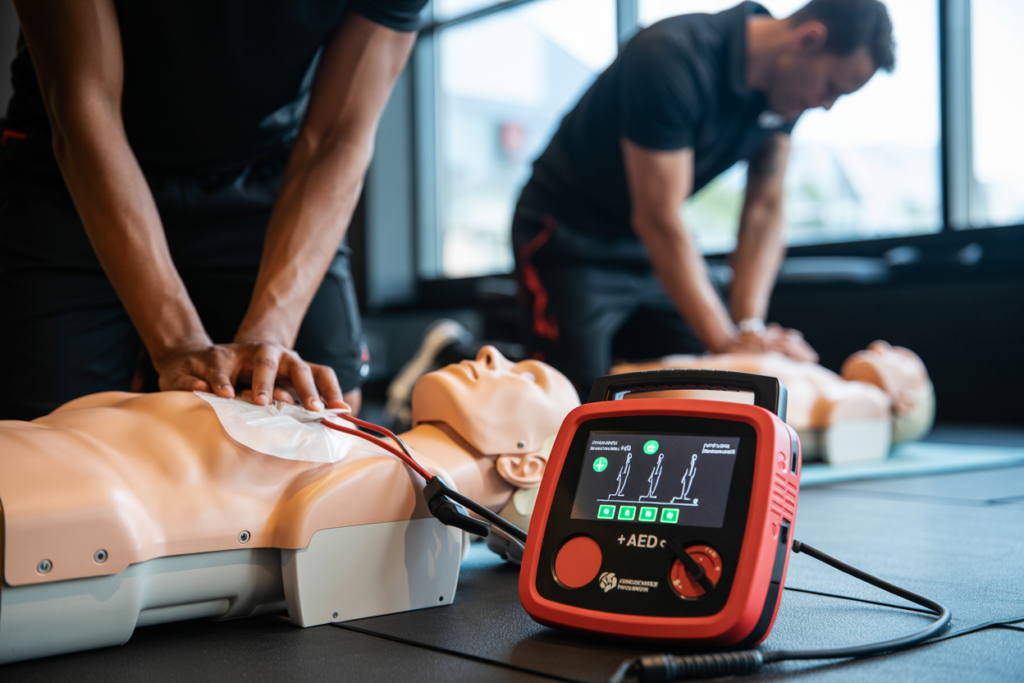
Step 7 – Defibrillation: Using an AED
If an AED is available, someone should grab it while you keep compressions going. Don’t stop CPR until the AED pads are on and the machine is ready to analyze.
How to use an AED:
- Turn it on (it will give you voice instructions)
- Expose the chest completely
- Stick the pads on bare skin exactly where the diagram shows
- Make sure nobody is touching them
- Let the machine analyze their heart rhythm
- If it says “shock advised,” make sure everyone’s clear and press the shock button
- Immediately resume CPR
The AED will tell you what to do. Just follow the voice prompts and keep doing CPR between shocks.
Common CPR Mistakes Personal Trainers Make
| Mistake | What Trainers Do Wrong | The Correct Action |
|---|---|---|
| #1: Hesitating Too Long | You freeze after checking for response, running through every possible scenario in your head while your client isn't breathing | Start CPR immediately if someone is unresponsive and not breathing normally. Every second you hesitate is a second their brain isn't getting oxygen |
| #2: Stopping Compressions Too Often | You slow down to catch your breath, stop to check if they're breathing, or pause to readjust hand position | Keep compressions continuous with minimal interruptions. Each time you stop, blood flow to the brain drops to zero within seconds |
| #3: Not Pushing Hard Enough | You're worried about hurting them, so you don't compress the full 5-6cm depth needed | Push down 5-6cm deep even if it might break ribs. CPR breaks ribs in 30% of cases—broken ribs heal, dead doesn't heal. Compression depth matters more than avoiding injuries |
| #4: Wrong Compression Rate | You compress too slowly (under 100/min) or too fast (over 120/min), losing effectiveness | Maintain 100-120 compressions per minute. Think "Stayin' Alive" by the Bee Gees (103 bpm) to keep the right rhythm |
| #5: Giving Up Too Soon | After 3-4 minutes your arms are burning and you think "this isn't working" or wonder where the paramedics are | Keep going until: (1) Paramedics arrive and take over, (2) The person wakes up and starts breathing normally, or (3) You're physically unable to continue |

CPR Training and Certification Requirements
What Certification Do You Actually Need?
You need HLTAID011 – Provide First Aid. This is the nationally recognized certification that covers CPR. This is what Fitness Australia requires, what Physical Activity Australia requires, and what your Professional Indemnity insurance policy requires.
Don’t get fooled by workplace-specific CPR training. Some employers offer basic CPR training that’s only valid within that specific workplace. That won’t satisfy your registration requirements or your insurance policy.
How Often Do You Need to Recertify?
CPR certification expires every 12 months. That’s right—every single year you need to renew it. First Aid certification lasts 3 years, but the CPR component within it still needs annual renewal.
This catches a lot of trainers off guard. They do the full first aid course thinking they’re good for 3 years, then 12 months later their insurance company asks for current CPR certification and they realize it’s expired.
Set a calendar reminder for 11 months after your certification date. Don’t wait until the week before it expires.
If Your Certification Has Already Expired
You’re training clients illegally right now. Your Professional Indemnity insurance is probably void. If Fitness Australia audits your registration, they’ll suspend it.
Every session you train without current certification is a massive risk to your business and your clients.
Your CPR Certification Next Steps
You’ve just read about CPR steps, protocol changes, and emergency scenarios. Here’s what actually matters: what are you going to do with this information?
Because reading about CPR doesn’t save lives. Knowing how to do it and being certified to do it—that’s what saves lives.
If Your CPR Certification Is Current
You’re ahead of most trainers just by having current certification. But “current” doesn’t mean “competent.”
When did you last practice CPR on an actual mannequin? If the answer is “12 months ago when I did my certification course,” your skills have degraded. Research shows CPR skills decay by up to 80% within 6 months without practice.
If Your CPR Certification Expires Within 60 Days
Don’t wait. Book your recertification course right now—not next week, not after you “check your schedule.” Right now.
Weekend courses fill up fast. If you wait until your cert is 2 weeks from expiring, the only available courses might be during your prime training hours.
Create Your Emergency Response Plan
Having CPR certification is step one. Having a plan for how you’d actually use it in your specific training scenarios—that’s step two.
For each location where you train clients, document:
- Exact address you’d give to a 000 operator
- Nearest AED location and how to access it
- Who calls 000, who gets the AED, who manages the scene
- Client emergency contacts (updated every 6 months)
Write this down. Put it in your phone under each location name. Because when an emergency happens, you won’t have time to figure this stuff out on the spot.
Practice Doesn’t Make Perfect—It Makes Automatic
The 2025 CPR protocol changes aren’t hard to learn. They’re hard to remember under pressure when your adrenaline is spiking and your client is unconscious on the ground in front of you.
Because when it’s real, you won’t rise to the occasion—you’ll default to your level of training.
Book Your First Aid Training Now
Fast, affordable, and nationally accredited training delivered by professionals who care
Frequently Asked Questions About CPR for Personal Trainers
Q.Can I be sued for performing CPR on a client?
No, you're protected under Queensland's Good Samaritan laws if you act in good faith and follow your training. If your client collapses and you perform CPR using the skills from your HLTAID011 certification, you're legally protected even if the outcome isn't good. The law recognizes that attempting to save someone's life—even imperfectly—is better than doing nothing.
Q.What if I break their ribs during CPR?
Broken ribs are an accepted consequence of effective CPR and you're not liable for injuries that occur from proper technique. The Australian Resuscitation Council's position is clear: if you're compressing to the correct depth (5-6cm), rib fractures happen in about 30% of cases, especially with older clients. Broken ribs heal, but dead doesn't—compression depth matters more than avoiding injuries.
Q.How do I know if someone needs CPR or if they just fainted?
If they're unresponsive (not responding to firm shoulder taps and loud shouting) and not breathing normally, they need CPR immediately. Someone who just fainted will respond when you tap their shoulder and shout at them—they might be groggy or confused, but they'll respond. If there's no response at all and their breathing is absent or just agonal gasping (irregular, labored breaths), start CPR right away.
Q.What's the difference between HLTAID009 and HLTAID011?
HLTAID009 is CPR-only certification (Provide CPR), while HLTAID011 is comprehensive first aid that includes CPR plus treatment for bleeding, burns, fractures, and other medical emergencies. Most Brisbane personal trainers should get HLTAID011 because it covers you for way more scenarios than just cardiac arrest, and it's what most insurance policies and Fitness Australia registration actually require. Both certifications require annual CPR renewal, but HLTAID011's broader first aid component lasts 3 years.
Making first aid training more affordable for
every classroom
We believe every student deserves access to life-saving first aid knowledge. That’s why we offer specially reduced pricing for schools and educational groups. Whether you’re booking for a single class, a year group, or your entire school, our flexible packages make training more accessible and cost-effective — without compromising quality.
