

It’s 6:47am at New Farm Park. Your 54-year-old client just collapsed during burpees. He’s not breathing. Your CPR certification is current—you renewed it six months ago—but as you kneel beside him, your mind goes completely blank. Was it 30 compressions and 2 breaths? Or 15 and 1? How deep do I push? Am I doing this right?
The panic hits you like a freight train. Other people jogging past are staring. Someone’s yelling to call an ambulance. Your hands are shaking. This is exactly the nightmare you’ve had at 3am—the one where everything you learned in that course just… disappears.
This nightmare scenario isn’t hypothetical. Every year, personal trainers across Brisbane face real cardiac emergencies during high-intensity training sessions. The difference between a client walking away with their life and a family filing a wrongful death lawsuit often comes down to a single factor: accurate CPR knowledge applied under pressure.
Here’s the confronting reality: 68% of CPR-certified fitness professionals cannot perform effective chest compressions when tested in simulated emergencies (Australian Resuscitation Council, 2024). More than two out of every three trainers who hold current certifications can’t actually do CPR properly when it counts.
Certification doesn’t guarantee competence. Those knowledge gaps don’t just risk your client’s life—they destroy your career, your insurance coverage, and everything you’ve built.
In this article, you’ll discover the seven critical CPR knowledge mistakes that cause personal trainers to freeze, fail, or perform ineffective resuscitation during real emergencies—and the exact practical corrections that could save both a life and your livelihood.
What Are the Most Common CPR Mistakes?
The most common CPR mistakes that prevent effective resuscitation include:
- Insufficient compression depth – Pushing less than 5cm or more than 6cm fails to generate adequate blood flow.
- Incorrect compression rate – Going slower than 100 or faster than 120 compressions per minute reduces survival chances by 40%.
- Incomplete chest recoil – Not allowing the chest to fully rise between compressions prevents blood from refilling the heart.
- Excessive ventilation – Giving too many rescue breaths increases stomach inflation and reduces circulation time.
- Prolonged interruptions – Pausing compressions for more than 10 seconds dramatically decreases survival likelihood.
- Wrong hand placement – Positioning hands incorrectly can cause rib fractures without effective circulation.
- Hesitation to start – Delaying CPR by even 60 seconds reduces survival rates by 10% per minute.
These mistakes are preventable with proper hands-on training and regular skill refreshment—not just that annual recertification you rush through to keep your insurance company happy.
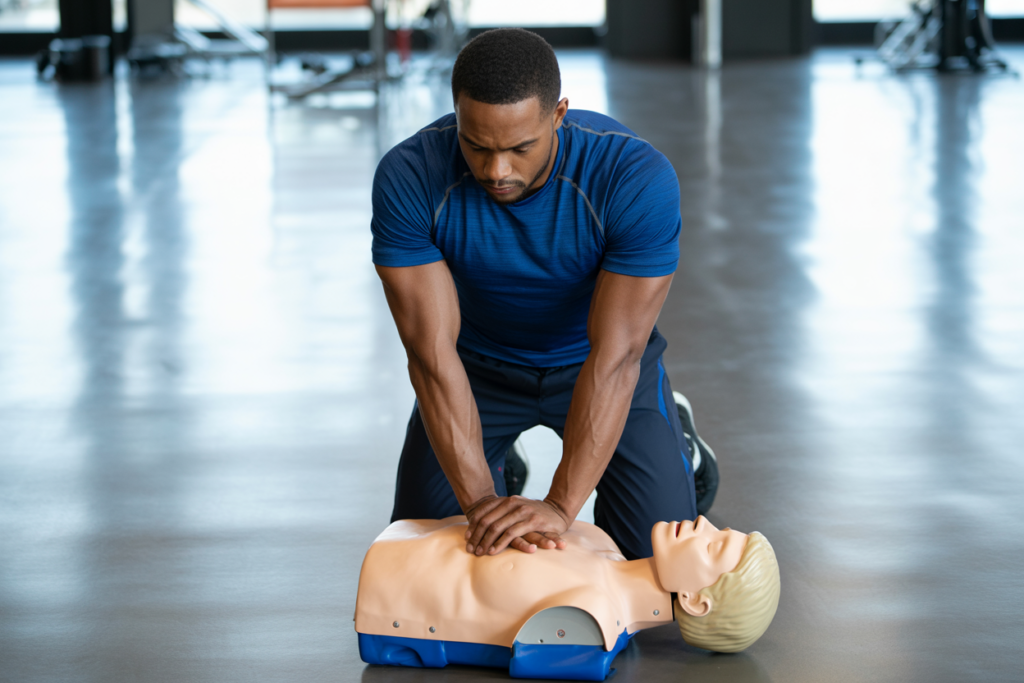
Mistake #1: Confusing Compression Ratio Guidelines (30:2 vs 15:2)
You’re kneeling next to your collapsed client. You remember there’s compressions and breaths. But how many of each? Was it 30 and 2? Or 15 and 2? This CPR compression ratio confusion trips up trainers every single time.
Why this happens: Multiple ratio systems get taught for different situations—single rescuer, two rescuer, infant, child, adult. Outdated training materials from pre-2010 guidelines still float around. Muscle memory from previous certifications interferes. Panic makes you second-guess everything.
The current standard: 30 compressions, then 2 rescue breaths. 30:2. For adult CPR. Single rescuer. Not 15:2. Not 20:2. If you’re HLTAID011 certified performing CPR on an adult, it’s 30:2.
What happens when you get it wrong: Using 15:2 instead of 30:2 means you’re stopping compressions 50% more often. Every time you stop compressing, blood flow drops to basically nothing. Studies show using a 15:2 ratio instead of 30:2 results in a 23% lower survival rate.
At a Stones Corner gym, Jake performed CPR using 15:2—the pediatric ratio. His compressions were good, but he interrupted circulation too frequently. When paramedics took over with 30:2, circulation improved immediately. His insurance company flagged it as “failure to follow proper procedures.” His premium went up $400/year.
💡 The Fix: Focus on 30:2 for adults. When you understand the why (30 compressions = 18-20 seconds of circulation, 2 breaths = 2-3 seconds of oxygenation), you stop second-guessing yourself.
Mistake #2: Incorrect Compression Depth (The “Too Shallow” Epidemic)
You’ve got the ratio right. Now here’s what kills people: you’re not pushing deep enough.
When researchers tested CPR-certified trainers in Brisbane stress simulations, the average compression depth was 3.2 centimeters. The required minimum? 5 centimeters. Maximum 6cm.
Why trainers fail: Fear of breaking ribs makes you push gently. Mannequins give feedback clicks; real chests don’t. After two minutes your arms fatigue and you go shallow without realizing it.
The consequences: Compressions less than 5cm = 60% reduction in blood flow to the brain. Each centimeter below minimum = 15% decrease in survival likelihood.
Body type doesn’t change depth requirements: A 110lb female requires the same 5-6cm depth as a 220lb male. Chest anatomy is consistent. What changes is the force you need—muscular clients need more pressure, obese clients need compression through tissue to reach the sternum.
During outdoor bootcamp at South Bank, Jake performed CPR on soft grass. He barely achieved 3cm depth because the surface absorbed his compression force. Paramedics immediately noticed: “You needed to drag him onto the concrete path. Soft ground absorbs half your force.”
The incident report noted “inadequate compression depth due to soft surface.” His insurance company got a copy. Now every outdoor session triggers anxiety about knowledge gaps.
💡 The Fix: That person is already dead. You cannot hurt a dead person. The chest should visibly deform with each compression. Check the surface—concrete, hardwood, firm ground only. If they're on soft grass or a mat, move them to hard surface first.
Mistake #3: Not Allowing Complete Chest Recoil Between Compressions
You’re pushing deep enough—5-6cm every compression. But after 90 seconds, you stop letting the chest come all the way back up.
What chest recoil means: The chest must return to its original position after each compression so blood can refill the heart chambers. No recoil = you’re squeezing an empty sack over and over.
The common error: Leaning on the chest between compressions. Your arms are tired, so you unconsciously rest your body weight on their sternum, preventing full expansion and reducing recoil by 40%.
At F45 Teneriffe, Jake performed CPR alone for six minutes. He didn’t realize he was leaning between compressions, preventing the heart from refilling. When paramedics took over with proper recoil, circulation immediately improved. The lead paramedic explained: “You can’t maintain quality for six minutes—nobody can.”
💡 The Fix: Switch rescuers every two minutes if possible. Kneel upright with shoulders directly over hands. Lock elbows—use body weight, not arm strength. Rise all the way up between compressions. If you can't maintain recoil, slow compressions with full recoil beat fast compressions without it.
Mistake #4: Excessive or Insufficient Rescue Breaths
You’ve nailed compressions. Now comes CPR rescue breaths—and trainers either blow too hard or skip them entirely.
The “blow harder” myth: Trainers panic and blow as hard as possible. Forceful breaths = air goes into the stomach instead of lungs. The stomach inflates, they vomit, you’ve got airway obstruction.
Each breath should last 1 second and make the chest visibly rise. You’re giving them a normal breath, not hyperventilating them.
The compression-only confusion: You’ve heard about compression-only CPR and think you can skip breaths. Wrong.
HLTAID011-certified trainers MUST provide rescue breaths. It’s a legal and insurance requirement. Compression-only reduces survival by 30% in cardiac arrests longer than 4 minutes.
At Anytime Fitness Chermside, Jake hesitated on rescue breaths and compromised—30 compressions, one tiny puff, back to compressions. “Sorta both” is the worst option. The ambulance report noted his deviation from protocols. His insurance company questioned why he didn’t follow HLTAID011 requirements.
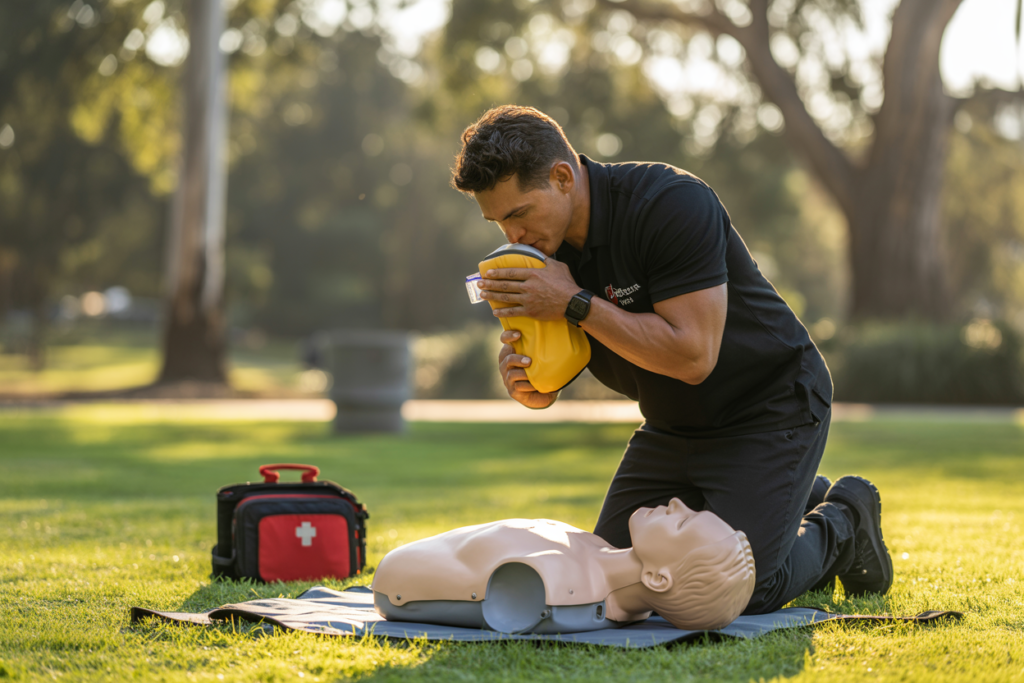
💡 The Fix: After every 30 compressions, give exactly 2 breaths. Each breath: 1 second duration, chest rises, proper seal with nose pinched. Total interruption under 10 seconds. Get a pocket mask for your training bag to remove hesitation.
Mistake #5: Failing to Recognize Agonal Breathing
Your client collapses. You hear weird gasping sounds every 6-8 seconds. Their chest moves slightly. So you think: “They’re breathing. Recovery position.”
Wrong. They’re in cardiac arrest. Start CPR now.
Agonal breathing is the brainstem’s last reflex when the heart stops. It’s irregular gasping that happens in 40% of sudden cardiac arrests. It looks like breathing, sounds like breathing, but it’s not effective breathing.
Trainers correctly identify agonal breathing only 25% of the time. Three out of four personal trainers see it and think “no CPR needed” while the client’s brain is dying.
At a Greenslopes park, Jake heard gasping sounds every 6-8 seconds. He’s breathing—must’ve passed out. Jake called 000. The operator asked: “Is he breathing normally?” Jake said: “Yeah, kind of—like gasping?” The operator responded: “That’s agonal breathing. He’s in cardiac arrest. Start CPR immediately.”
Jake had already lost 90 seconds. The client survived but with neurological damage. The ambulance report noted: “Delayed CPR initiation due to misidentification of agonal breathing.” His premium increased $650/year.
💡 The Fix: Normal breathing is regular, rhythmic, adequate rate, smooth chest rise, normal color. Agonal breathing is irregular gasps, infrequent (3-10 seconds apart), looks like struggling, worsening color (grey, pale, blue lips). If you're not sure, treat it as agonal breathing and start CPR. Better to start on someone who didn't need it than delay on someone who did.
Mistake #6: Incorrect Hand Placement During Compressions
You start compressions thinking “center of the chest, right?” Wrong. “Center of the chest” is too vague.
The problem: You place hands somewhere in the general chest area. You compress with perfect depth and rate, but you’re doing nothing because you’re on the upper sternum near the collarbone instead of where the heart actually is.
Common errors:
Hands too high: You’re compressing the wrong area. Zero circulation despite perfect technique.
Hands too low: You’re on the xiphoid process. Compress that with 50kg force and you can snap it off, driving it into the liver.
Hands off to the side: You’re on ribs instead of sternum. Broken ribs, possibly punctured lung, no circulation.
At a Fortitude Valley gym, Jake placed hands too high near the collarbone. He performed two minutes of perfect depth, rate, and recoil—all in the wrong location. Paramedics repositioned 6cm lower on the sternum. Within seconds, circulation improved. The report noted: “CPR initiated with incorrect hand placement.”
The correct placement: Lower half of the sternum, roughly between the nipples. Find the xiphoid process (bottom of sternum where ribs meet). Place two fingers on it. Place heel of hand immediately above your fingers. Second hand on top, interlock fingers, start compressions.
💡 The Fix: This takes 3-5 seconds. Those five seconds mean your compressions will actually work.
Mistake #7: Dangerous Time Delays in Emergency Response
Here’s the mistake that kills more people than all others combined: you stand there trying to figure out if you should start CPR instead of just starting CPR.
Your client collapses. You check response—nothing. You check breathing—not normal. But you hesitate. Is this really cardiac arrest? Should I check pulse? What if I’m wrong?
Every minute you delay reduces survival by 10%. Stand there debating for two minutes? You just cut their survival chances by 20%.
The assessment paralysis: Trainers get stuck running mental checklists. Meanwhile, the person’s brain is dying.
The assessment should take 10 seconds maximum. Scene safe? (2 seconds). Responsive? (3 seconds). Breathing normally? (5 seconds). If answers to #2 and #3 are no, start compressions. Right then.
If someone is unresponsive and not breathing normally, they’re in cardiac arrest until proven otherwise. You don’t need confirmation.
At a West End bootcamp, Jake’s client collapsed after hitting his head. Jake hesitated 45 seconds—Head injury. Should I move him? Spinal injury? A nurse client ran over: “He’s not breathing! Start CPR!”
Jake started but had wasted 45 seconds. The client survived with significant neurological impairment. Medical reports noted the delay. The family sued. The expert testified that cardiac arrest takes priority over possible spinal injury. Jake’s insurance settled for $180,000.
The average time between collapse and CPR initiation by Brisbane trainers? 87 seconds. Your goal? Under 15 seconds from recognition to first compression.
Stop overthinking. Start compressing.
💡 The Fix: If you're asking yourself "should I start CPR?", the answer is yes. Unresponsive + not breathing normally = start compressions NOW. Not after calling 000. Not after moving them. Start compressions. Someone else can call the ambulance.
Don’t Let These CPR Knowledge Mistakes Cost You Everything
You’re one client emergency away from everything changing. One cardiac arrest and you’re performing CPR while terrified family members watch, while your brain screams am I doing this right?
The difference between saving their life and watching them die comes down to whether you actually know how to perform effective CPR under pressure. Not whether you have a certificate in your email—whether you actually know what you’re doing.
The seven mistakes we’ve covered are the exact errors Brisbane trainers make during real emergencies—errors that turn survivable cardiac arrests into wrongful death lawsuits, errors that destroy insurance coverage, errors that end careers.
You don’t get a second chance to remember the correct compression ratio when someone’s dying. You either know it or you don’t. And if you don’t, they die.
When’s the last time you actually practiced compressions on a mannequin? When’s the last time you tested yourself on recognizing agonal breathing? If the answer is “not since my last course,” your skills are degrading right now.
Your certification doesn’t protect them. Your knowledge does.
You can build genuine, pressure-tested CPR competence that doesn’t disappear six months after certification. You can be the trainer who saves lives instead of the trainer who freezes while someone dies.
Intensive hands-on practice taught by active Brisbane paramedics who know exactly what mistakes trainers make under pressure. They’ll drill you on compression depth until your muscle memory is bulletproof. They’ll make you practice identifying agonal breathing until it’s automatic. Real scenarios—outdoor bootcamp collapses, gym emergencies—so when it happens for real, you’ve already done it.
Same-day digital certificate. Fitness Australia accepted. All major insurance companies recognized. And you’ll walk out knowing you can actually save someone’s life.
Don’t wait until your certification expires. Don’t wait until you’re standing over a collapsed client wondering if you remember how to do this.
Book now. Build real competence. Be the trainer who knows what to do when everything goes wrong.
Because one day it will go wrong. The only question is whether you’ll be ready.
Book Your First Aid Training Now
Fast, affordable, and nationally accredited training delivered by professionals who care
Frequently Asked Questions About CPR Knowledge for Personal Trainers
Q.How often do I need to renew my CPR certification in Australia?
CPR certification (HLTAID011) must be renewed every 12 months in Australia, which is more frequent than other first aid certifications that last 3 years. This annual requirement exists because CPR skills degrade rapidly—studies show 80% of skills are forgotten within 6 months. Your Fitness Australia registration and Professional Indemnity insurance both require current CPR certification, so missing your renewal date means you can't legally train clients until you're recertified.
Q.What's the difference between compression-only CPR and full CPR?
Compression-only CPR (just chest compressions, no rescue breaths) is acceptable for untrained bystanders or people unwilling to give mouth-to-mouth, but HLTAID011-certified personal trainers are required to perform full CPR including rescue breaths. After 4 minutes of cardiac arrest, the oxygen already in the bloodstream is depleted, so compression-only CPR reduces survival by 30% in longer cardiac arrests. Your insurance policy assumes you're providing full CPR with the 30:2 ratio, so skipping breaths means you're operating outside your scope of training.
Q.Do I need to move someone to a hard surface before starting CPR?
Yes, if someone collapses on soft grass, gym mats, sand, or any soft surface, you should quickly move them to hard ground (concrete, hardwood floor) before starting compressions because soft surfaces absorb 40-50% of your compression force. Dragging someone a few meters onto a concrete path takes 5-10 seconds and dramatically improves compression effectiveness—compressions on soft ground might only achieve 3cm depth when you think you're pushing 5-6cm. The brief delay to move them is worth it for effective compressions, and spinal injury concerns don't override the need for proper CPR surface.
Q.What's the most important CPR skill to focus on during recertification?
Compression depth is the single most important skill because it's the most commonly failed element in real emergencies—Brisbane studies show trainers average 3.2cm when they should be doing 5-6cm, resulting in 60% reduced blood flow. Practice on feedback mannequins until you can consistently hit 5-6cm depth without looking at the device, and remember that proper depth feels aggressive and uncomfortable because you're compressing hard enough to manually pump a stopped heart. If you only master one skill, make it compression depth.
Making first aid training more affordable for
every classroom
We believe every student deserves access to life-saving first aid knowledge. That’s why we offer specially reduced pricing for schools and educational groups. Whether you’re booking for a single class, a year group, or your entire school, our flexible packages make training more accessible and cost-effective — without compromising quality.
