

A sparky rocks up to a Brisbane site on a Monday morning, ute loaded, ready to get into it. Site supervisor asks to see the low voltage rescue kit before he signs in. He points at a tub of gear in the back of the ute. Not good enough. He’s turned around at the gate before he’s even clocked on for the day.
That’s the reality behind low voltage rescue kit requirements on QLD sites right now. Having “some kit in the ute” isn’t the same thing as having a kit that actually stacks up against what’s expected under the Electrical Safety Act 2002 (Qld) and the training standards behind UETDRRF018.
Site inductions are getting stricter by the year. Insurers and principal contractors are checking the actual gear item by item now, not just taking your word for it that you’ve got what you need. So below, we’re going through exactly what has to be in a compliant kit, the standards each piece is tied to, and how to keep both the kit and the paperwork audit-ready for whoever’s checking at the gate.
What Is Required In A Low Voltage Rescue Kit?
A compliant low voltage rescue kit needs the following items, at minimum:
- Insulated rescue hook or crook, rated to the relevant voltage
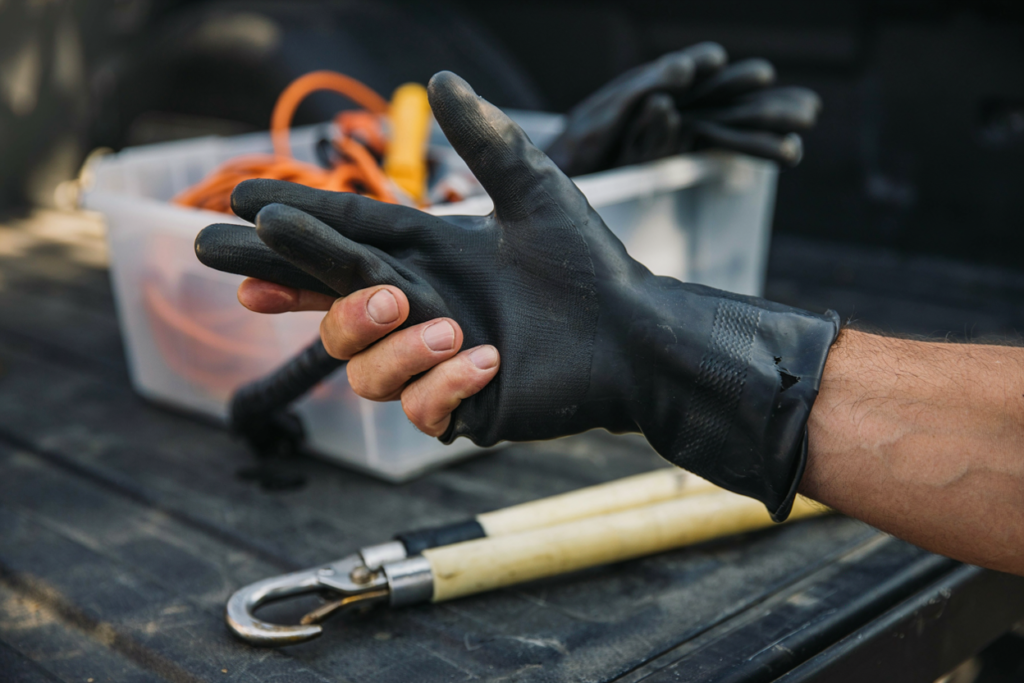
- Insulated gloves, dielectric rated and marked "Rescue Use Only"
- Insulated mat
- Non-contact voltage detector
- Fire blanket
- CPR and first aid equipment, including a face shield and basic first aid supplies
- Equipment inspection log
Contents are guided by AS/NZS 4836, though no single Australian Standard governs rescue kits as a whole. Minimum requirements are usually set by the principal contractor, the utility, or the insurer on a given site, and reinforced through UETDRRF018 training. Every item needs a visual check before each use, and insulated gear gets tested every six months by a certified party. Skip either of those and the kit’s compliance status is basically worthless on paper.
⚠️ Not optional: A low voltage rescue kit sits inside your duty of care under the Electrical Safety Act 2002 (Qld). It's a legislated control measure, not a nice-to-have.
Why Low Voltage Rescue Kits Are a Legal Requirement, Not Just Best Practice
Some blokes on site treat the rescue kit like it’s an optional extra, something you grab if you’ve got room in the ute. It’s not optional. It’s a legislated control measure, in the same category as your PPE, your lockout tags, your test equipment. Leave it behind and you’re not just under-prepared, you’re non-compliant.
The Electrical Safety Act 2002 (Qld) and your obligations
The Electrical Safety Act 2002 (Qld) puts a duty of care on anyone working on or near low voltage electrical installations. That duty doesn’t stop at “know what to do if someone contacts a live panel.” It extends to having the physical gear on hand to actually perform a rescue safely, without the rescuer becoming the second casualty.
A low voltage rescue kit sits inside that duty of care. It’s not a nice-to-have that shows you’re a switched-on operator. It’s part of how the Act expects you to manage the risk in the first place.
What AS/NZS 4836 actually governs (and what it doesn’t)
Here’s where a lot of confusion comes from. AS/NZS 4836 covers safe work practices around low voltage electrical work, and it’s the Standard most low voltage rescue kit requirements get traced back to. But it doesn’t hand you an itemised list of exactly what has to be in the kit.
That’s the gap. AS/NZS 4836 sets the safe work practice expectations, and then utilities, principal contractors, and insurers fill in the specifics for their own sites. That’s exactly why one site’s kit requirements can look slightly different to another’s, and why a kit that passed at one job might get questioned at the next gate.
If you want to read the Standard itself, it’s listed through Standards Australia and SAI Global.
The numbers behind why this matters
This isn’t red tape for the sake of it. Safe Work Australia data shows 44 electrician deaths from traumatic injury over a 10 year period, with 23 of those from electrocution. That’s not an abstract compliance stat, that’s real blokes who didn’t come home.
📉 The reality: Over 10 years, more than half of electrician deaths from traumatic injury in Australia came from electrocution. A rescue kit that's actually compliant, with someone who actually knows how to use it, is one of the few things standing between a bad moment and a fatal one.
The Full Low Voltage Rescue Kit Requirements List
Right, here’s the part most blokes actually came for. What has to physically be sitting in the kit, and what standard each piece is tied back to.
Kit item | Key requirement | Check interval |
Insulated rescue hook or crook | Voltage-rated, adequate reach | Visual, before each use |
Insulated gloves | Dielectric rated, marked “Rescue Use Only” | Visual before use, certified test six-monthly |
Insulated mat | Correct dielectric strength for the work | Visual before use, certified test six-monthly |
Non-contact voltage detector | Confirms de-energization, must be functioning | Visual, before each use |
Fire blanket | Present and accessible | Visual, before each use |
CPR/first aid gear | Face shield, basic first aid supplies | Visual, before each use |
Equipment inspection log | Records checks and test dates | Updated at every check |
Insulated rescue hook or crook
This is the tool that lets you pull a mate clear of a live panel without becoming the second person down. It has to be rated to the relevant voltage for the work being done, and it needs enough reach that you’re not standing closer to the panel than you have to be.
- Voltage rating matched to the site's LV exposure, not just "insulated" in a general sense
- Length and reach sufficient to keep the rescuer clear of the danger zone
- Visual check for cracks, moisture damage, or contamination before every use
Insulated gloves (dielectric rating)
Gloves are one of the most checked items on a kit inspection, and one of the most commonly non-compliant.
- Dielectric rating appropriate to the voltage class of the work
- Clearly marked "Rescue Use Only". Gloves used for general electrical work don't count as rescue-rated, even if they look the same
- Tested every six months by a certified party, not just eyeballed
Insulated mat
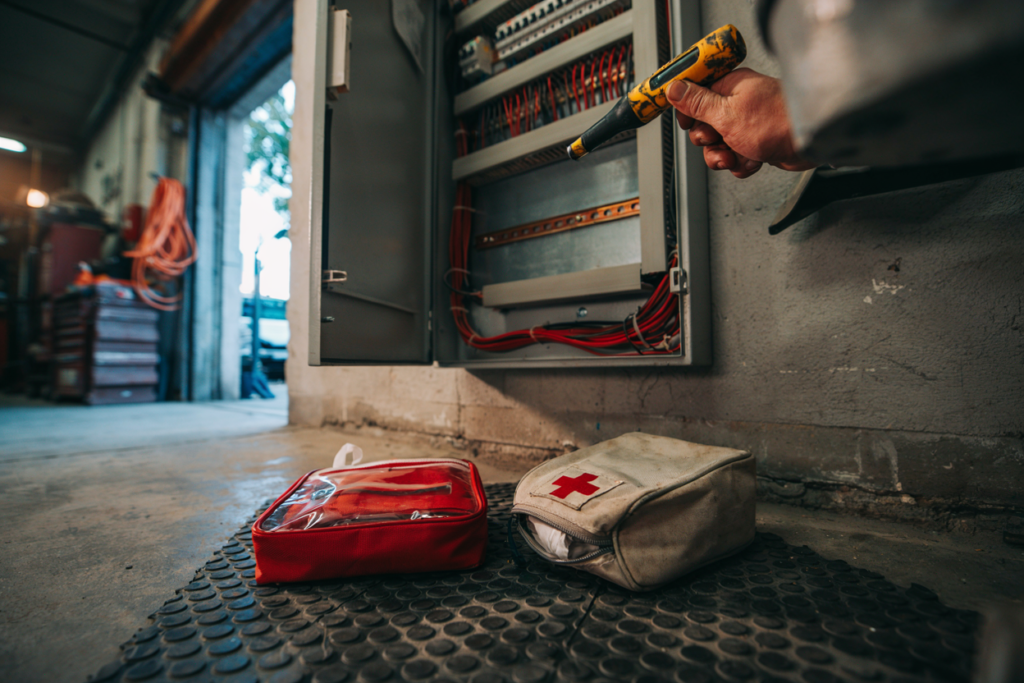
The mat gives the rescuer a safe standing platform, insulated from the ground, while performing the rescue. Dielectric strength has to match the work being done, and placement matters just as much as the mat itself. A mat that’s folded up under a seat isn’t doing anyone any good in the moment it’s actually needed.
Non-contact voltage detector
Before anyone touches anything, this confirms the panel is actually de-energised. It’s the difference between a controlled rescue and a second casualty. Every kit needs one, and it needs to be functioning, not just present.
Fire blanket and CPR/first aid provisions
Electrical incidents don’t stop at the shock itself. Cardiac arrest is a real possibility once the person is clear of the panel, which is where CPR skills and basic first aid gear come into play. A fire blanket, a face shield, and basic first aid supplies round out this part of the kit.
This is also where the crossover with first aid training becomes obvious. A rescue hook gets someone clear of danger. What happens in the next sixty seconds, whether someone can actually perform CPR properly, is a separate skill set entirely, one worth having current alongside your LV rescue training.
Equipment inspection log
This one gets overlooked constantly, and it’s the one that actually holds up your compliance story at the gate. A log documenting when each item was checked, when insulated gear was last tested, and by whom. No log, no proof. And on a lot of sites now, no proof means no start.
Having the right gear is only half the requirement. It also has to stay compliant over time.
🔍 The two-check rule: Complete a visual inspection before every use, plus a certified test every six months on all insulated items. Miss either one and the kit is non-compliant, even if it looks fine.
Inspection, Testing & Currency Requirements
Daily visual checks vs six-monthly certified testing
Two different types of checking happen here, and mixing them up is where a lot of kits fall over on audit.
Check type | Frequency | Who does it | What it covers |
Visual check | Before each use | The worker using the kit | Cracks, moisture, contamination, obvious damage |
Certified test | Every six months | Qualified tester | Dielectric integrity of insulated items |
A visual check doesn’t take long and it’s on the individual worker to actually do it, not skip it because the crew’s running late. The six-monthly certified test is the one that actually proves the insulated gear still does what it’s rated to do. Skip that one and even gear that looks fine can be sitting there non-compliant.
What happens if your kit fails inspection or lapses
This is the scenario that actually costs money and time. A kit that fails inspection, or one where the testing log has lapsed past six months, is treated the same as no kit at all on plenty of sites. That means the worker gets turned away at the gate, the day’s labour is lost, and depending on the job, a contract milestone can slip too.
It’s the exact same site-access fear that shows up around lapsed LV rescue training itself. A kit is only as good as its most recent inspection date.
Keeping your own gear compliant is one half of this. The other half is making sure you’re actually current on your UETDRRF018 training so you know what to do with that kit when it matters.
A kit that passes inspection still isn’t enough on its own.
Kit Requirements vs Training Requirements: Why You Need Both
A compliant kit with an untrained crew still fails an audit
Here’s the bit that catches some businesses out. You can have every single item in the kit, all tested, all logged, all sitting pretty in the ute, and still fail a site audit because nobody on the crew actually holds current low voltage rescue training.
A kit doesn’t rescue anyone on its own. It’s a tool. Someone still has to know how to use the insulated hook without panicking, confirm de-energisation with the voltage detector, and manage the situation from there through to CPR if it comes to that. A principal contractor checking compliance isn’t just ticking off gear on a list, they’re checking that the people on site are actually equipped to use it.
If you’re unsure how often your LV rescue training needs renewing, that’s a separate can of worms to the kit itself.
A compliant kit still needs a trained crew. Get your UETDRRF018 certificate and stay site-ready.
Who needs to hold current LV rescue training on site
It’s not just the person doing the live panel work who needs to be covered. Anyone working on or near low voltage installations where a rescue could conceivably be needed should hold current training, not just the most senior electrician on the crew. If the trained bloke is the one who ends up needing rescuing, and nobody else on site knows what to do, the kit sitting in the ute doesn’t count for much.
For a business owner or compliance officer booking training for a crew, this is the part worth getting right before the audit, not during it. One lapsed certificate in a five-man crew is still a compliance gap for the whole job.
None of this is complicated once you break it down. A compliant kit is a specific, checkable list of gear, each item tied back to a reason it’s there, not a vague pile of safety equipment that looks the part from a distance. The hook, the gloves, the mat, the detector, the fire blanket, the first aid gear, the log. Every piece earns its place.
What trips people up isn’t usually the gear itself. It’s the assumption that once you’ve bought it, you’re done. A kit that sat in the back of the ute for the last eighteen months without a single certified test isn’t doing what it’s meant to do, even if every item is technically present. Compliance isn’t a one-off purchase, it’s an ongoing habit, and the businesses that treat it that way are the ones who never get caught out at a gate.
The same goes for the people using the kit. Gear without training is just weight in the ute. A worker who’s never actually practiced pulling someone clear of a live panel, confirming de-energisation, or running CPR under pressure is going to hesitate at exactly the moment hesitation costs the most. That’s not a knock on anyone’s competence as a tradesperson, it’s just a different skill set to the electrical work itself, and it needs its own attention.
There’s a version of this where a business owner reads all of this and thinks it sounds like more admin piled on top of an already busy operation. Fair reaction. But the alternative is worse: a worker turned away at a gate on a day that mattered, or a genuine emergency where the gear or the know-how simply wasn’t there. Neither of those costs less than getting the kit and the training sorted properly up front.
Sites are only going to get stricter about this, not looser. Insurers want the paperwork. Principal contractors want the log. Workers want to actually know what to do if it’s their mate on the panel and not someone else’s problem to fix. All three of those things point the same direction, toward a kit that’s genuinely compliant and a crew that’s genuinely trained, not just a box ticked on a form somewhere.
Get the kit right, keep the testing current, and back it with training that actually holds up under pressure. That’s the whole ask here. It’s not glamorous work, checking gloves for cracks or logging a six-monthly test, but it’s the difference between a kit that looks compliant and one that actually is, and on the day it matters, that difference is everything.
Book Your First Aid Training Now
Fast, affordable, and nationally accredited training delivered by professionals who care
Frequently Asked Questions
Q.How often does a low voltage rescue kit need to be inspected?
A visual check should happen before each use, completed by the worker who's about to use the kit. In addition, insulated items such as gloves and mats need certified testing every six months to confirm they still meet their dielectric rating. Skipping either inspection places the kit's compliance at risk, even if everything appears to be in good condition.
Q.Is a low voltage rescue kit legally required?
Yes. A low voltage rescue kit forms part of the duty of care under the Electrical Safety Act 2002 (Qld) for anyone working on or near live low voltage installations. It's considered a control measure rather than an optional extra, which is why most worksites, insurers, and principal contractors require one before allowing site access.
Q.What standard applies to low voltage rescue kits?
AS/NZS 4836 outlines safe work practices for low voltage electrical work and forms the basis of most low voltage rescue kit requirements. While it doesn't prescribe an exact list of kit contents, many utilities, principal contractors, and insurers apply additional minimum requirements for their own sites.
Q.Does a low voltage rescue kit expire?
Not exactly. The kit itself doesn't have a fixed expiry date, but many of its components do. Insulated gloves and mats require certified retesting every six months, and once those testing intervals lapse, the kit is generally considered non-compliant even if the equipment shows no obvious signs of wear or damage.
Making first aid training more affordable for
every classroom
We believe every student deserves access to life-saving first aid knowledge. That’s why we offer specially reduced pricing for schools and educational groups. Whether you’re booking for a single class, a year group, or your entire school, our flexible packages make training more accessible and cost-effective — without compromising quality.
