

Your mate’s hand is stuck to a live LV panel and he can’t let go. You’ve got seconds, not minutes, to get this right, and there’s no time to be googling around for answers when it’s actually happening. If you’re standing next to that panel right now reading this on your phone, skip down to the 5 steps below. If you’re reading this before it ever happens, good, that’s exactly when you should be learning it.
Low voltage rescue procedure steps come down to five moves done in the right order: assess, call, isolate, confirm, rescue. Get the order wrong and you risk becoming casualty number two, not the rescuer.
This isn’t a checklist we made up ourselves. It mirrors ANZCOR guidelines and lines up with what’s taught in UETDRRF018, the nationally recognized unit that covers this exact scenario for electrical workers on site.
Below, we’ll break down each of the 5 steps, why “low voltage” doesn’t mean low risk, and why reading this article is not the same as being trained to do it under pressure.
Why Low Voltage Doesn’t Mean Low Risk
Here’s the thing that trips up a lot of sparkies, even experienced ones. The word “low” in low voltage makes it sound safe, like it’s the baby version of the real danger. It’s not. Low voltage can still stop a heart, and treating it like a lesser risk is exactly how people get hurt.
What “Low Voltage” Actually Means Under AS/NZS 3000
Under AS/NZS 3000, low voltage covers anything between 50V and 1000V AC. That’s a massive range, and it includes the standard supply running through pretty much every switchboard, panel, and power point on a normal construction site or commercial fit-out. So when we say “low voltage,” we’re not talking about some watered-down, barely-there current. We’re talking about the exact same voltage that’s running through the walls of your own house.
Classification | Voltage Range | Common Examples |
Extra Low Voltage (ELV) | Up to 50V AC | Some control circuits, low-voltage lighting |
Low Voltage (LV) | 50V–1000V AC | Standard site supply, switchboards, most panels |
High Voltage (HV) | Above 1000V AC | Substations, transmission infrastructure |
Why a Standard 230V Site Supply Can Still Cause Cardiac Arrest
A standard 230V supply, which is what you’ll find on the vast majority of sites, sits comfortably inside that low voltage band. And 230V is more than enough to send a current through the human body and put the heart into ventricular fibrillation, which is where the heart muscle stops pumping properly and just quivers instead. ANZCOR guidelines recognise this as a genuine cardiac arrest risk from LV contact, not some rare fluke outcome.
So no, “low voltage” doesn’t mean low risk. It means the risk is common, because low voltage is what’s actually sitting in the walls and panels you’re working near every single day. High voltage incidents are rarer because most tradies aren’t anywhere near HV infrastructure. Low voltage incidents happen more because everyone is around LV all the time.
If you want the full picture of what UETDRRF018 covers and how it prepares you to handle exactly this scenario, we’ve got a dedicated page that breaks it down.
🚨 Safety Alert: Speed matters, but order matters more. Rushing straight to the casualty before isolating the supply is how a rescuer becomes a second casualty.
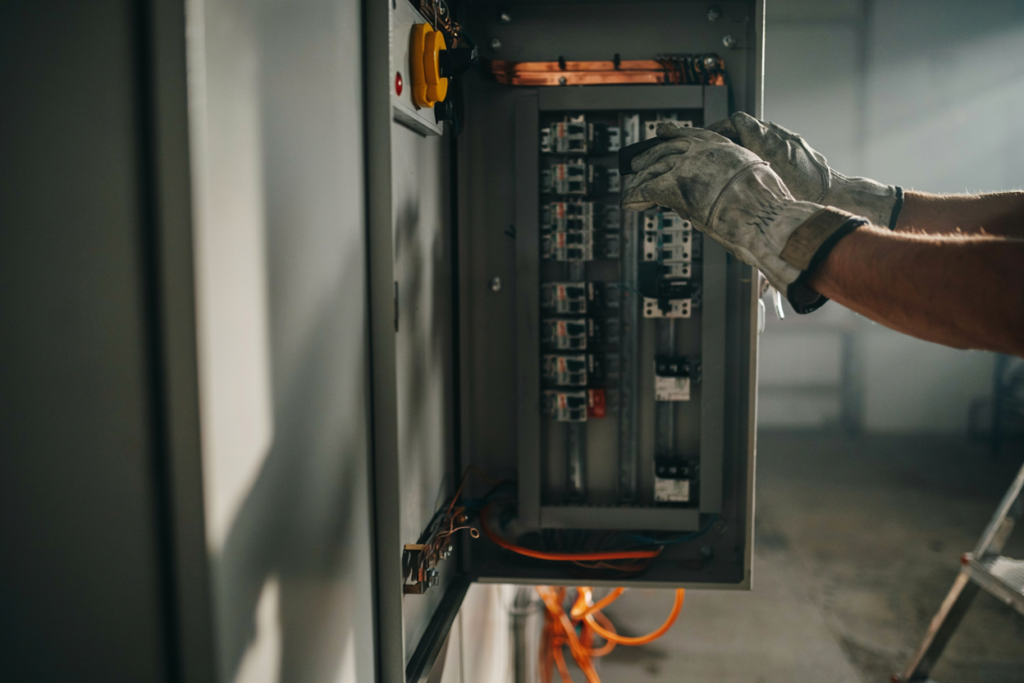
The 5-Step Low Voltage Rescue Procedure
Why this matters: when someone’s in contact with a live panel, your brain wants to run straight at them. That instinct is the thing that gets a second person hurt. These 5 steps exist to slow you down just enough to keep you safe while you help.
Here’s the sequence, laid out in full before we break down each one:
- Assess the scene
- Call for help
- Isolate the supply
- Confirm isolation before contact
- Rescue and respond
Step 1: Assess the Scene
Before you do anything else, look. Don’t touch, don’t grab, don’t reach. You’re checking for downed conductors, arcing, smoke, or anything else that tells you the hazard is bigger than just the one panel. “Look, don’t touch” is the mindset here, and it applies even when someone you know is the one in trouble. Your instinct to grab them is exactly what you have to fight in this first moment.
Step 2: Call for Help First
Dial 000, or point directly at a bystander and tell them to do it. This isn’t something you do after you’ve sorted the panel out. It happens in parallel, at the same time as everything else. If there’s someone else on site, get them on the phone the second you’ve assessed the scene, while you move on to isolating the supply.
Step 3: Isolate the Supply
Get to the switchboard and de-energise the correct isolation point. This is where a lot of people rush and get it wrong. You need to verify you’re isolating the actual point of supply to that panel, not just flicking the nearest switch and hoping. Never assume. Confirm it.
Step 4: Confirm Isolation Before Contact
This is the step that gets skipped under pressure more than any other, and it’s the one that matters most. Test with an approved voltage tester before you touch anything. “Test before touch” isn’t a suggestion, it’s the whole point of this step existing. Isolating the supply doesn’t help you if you’ve isolated the wrong thing, and the only way to know for sure is to test it.
Step 5: Rescue and Respond
Once isolation is confirmed, use insulated equipment only, things like a rescue crook or 1000V-rated gloves to AS/NZS IEC 60903. Clear the casualty from the hazard, then assess their breathing and consciousness. Begin CPR if required.
We’re keeping this at the sequence level here, not the hands-on technique, because that’s genuinely something you need to be shown and practiced, not read off a page. More on that below.
🤚 Reality Check: Not frozen, locked. Someone stuck to a live panel isn't hesitating. Their muscles are physically clamped and won't respond to their own commands.
Why “Can’t Let Go” Makes Hesitation Deadly
This is the part that catches people off guard, because it explains something that looks confusing from the outside. Someone’s in contact with a live panel and they’re not pulling away. To anyone watching, it looks like they’re frozen, or worse, like they’re choosing to stay there. They’re not. Their body has stopped taking orders from them.
The Involuntary Muscle Contraction Response, Explained in Plain Terms
When current passes through the muscles in the hand and forearm, it can cause those muscles to contract involuntarily. The grip muscles are stronger than the release muscles, so the hand clamps down and stays clamped. The person isn’t choosing to hold on. Their own muscles are locking them there, and there’s nothing they can do about it from where they’re standing. This is the “can’t let go” phenomenon, and it’s exactly why isolating the supply has to come before anyone touches that casualty.
The Current-Path Principle: Why Rushing in Bare-Handed Creates a Second Casualty
If you grab your mate while he’s still live, the current doesn’t stop at him. It looks for a path, and your body becomes part of that path the moment you make contact. Now there’s two people locked onto that panel instead of one, and nobody left standing to isolate the supply or call for help. That’s the current-path principle, and it’s the reason every one of those 5 steps exists in the order it does.
This is Jake’s nightmare scenario, a mate down near a live panel with nobody on site who actually knows what to do. It’s not a rare story in the trade. Most experienced sparkies know of an incident, or know someone who knows of one. The steps above exist because hesitation and rushing in both get people hurt, just in different ways.
Is This the Course You Actually Need? (UETDRRF018 Explained)
A fair few sparkies land on this page not entirely sure if this is even the ticket they’ve been told to get. That confusion is common, and it’s worth clearing up properly before you book anything.
What UETDRRF018 Covers vs. General Electrical Safety Inductions
UETDRRF018 is specifically about performing a rescue from a live low voltage panel or apparatus. That’s it, that’s the scope. It’s not the same as a general electrical safety induction, which covers broader site safety awareness but doesn’t get into the specific rescue sequence, the isolation procedure, or the hands-on technique for getting someone clear of a live panel safely. If you’ve only done a general induction, you haven’t covered this.
Who Mandates It: QBCC, WorkSafe Queensland, Head Contractor Site Requirements
This ticket usually comes up because someone with authority has told you it’s required. That might be QBCC, it might be WorkSafe Queensland, or it might just be a head contractor’s WHS officer applying their own site requirements before you’re allowed to start work. Whoever it came from, if you’ve been told you need it, this is likely the course they mean.
UETDRRF018 (Low Voltage Rescue) | General Electrical Safety Induction | |
Focus | Rescue from live LV panel/apparatus | Broad site safety awareness |
Covers isolation procedure | Yes | No |
Covers rescue technique | Yes | No |
Site-mandated for LV work | Often, specifically | Not a substitute |
If this sounds like your situation, we’ve got a dedicated UETDRRF018 page that walks through everything the course covers and the next available dates.
Conclusion
Reading through five steps on a screen and actually running through them with your hands, under time pressure, with an instructor watching to make sure you get it right, are two completely different things. You can read this article ten times over and still freeze the first time you’re standing in front of a real panel with a mate on the ground. That’s not a criticism, it’s just how skills work. Muscle memory doesn’t come from scrolling.
The steps themselves aren’t complicated. Assess, call, isolate, confirm, rescue. Anyone can memorise that order in under a minute. But knowing the order and knowing how to isolate the correct point on an unfamiliar switchboard, under pressure, with someone’s life depending on getting it right the first time, are worlds apart. That gap is exactly what proper training is meant to close.
There’s a reason this ticket keeps coming up on job sites, and it’s not because someone in an office decided to add another box to tick. It’s because low voltage incidents happen more often than people expect, precisely because low voltage is everywhere. Every switchboard, every panel, every standard site supply sits inside that range. The risk isn’t rare, it’s just underestimated.
Most tradies who’ve been in the game long enough know a story, whether it happened to them, a mate, or someone a mate worked with. Nobody wants to be the person standing there when it happens with no idea what to do next. And nobody wants to be the reason a second person ends up hurt because they rushed in without isolating first.
Getting ticketed for this isn’t about satisfying a supervisor’s clipboard, even though that’s often the reason someone ends up searching for it in the first place. It’s about being the person on site who actually knows what to do in the ninety seconds that matter most. That’s a different kind of value than a card in your wallet, even if the card is what gets you back on site.
If you’ve read this far, you already know why this matters. The next step is turning that knowledge into something your hands know how to do without thinking, and that only happens in a room with a real panel, a real instructor, and real practice. Reading the steps gets you started. Training gets you ready.
Book Your First Aid Training Now
Fast, affordable, and nationally accredited training delivered by professionals who care
Frequently Asked Questions
Q.Is low voltage actually dangerous, or just a formality?
Low voltage is genuinely dangerous. Standard 230V site supply sits inside the low voltage range and is more than enough to cause cardiac arrest through ventricular fibrillation. Treating it as a lesser risk is exactly how people get hurt.
Q.What's the very first thing I should do if I see someone in contact with a live panel?
Assess the scene before you do anything else. Look for downed conductors, arcing, or smoke, and don't touch the casualty until you know the hazard is contained. Grabbing them first is the most common mistake.
Q.Should I call for help before or after I isolate the supply?
Call in parallel, not after. Dial 000 or direct a bystander to do it at the same time you're moving to isolate the supply, not once everything else is already sorted.
Q.Why can't I just pull my mate away from the panel?
Their muscles may be locked in an involuntary contraction, and if you touch them while the supply is still live, the current can pass through you too. That turns one casualty into two, with nobody left to isolate the supply or call for help.
Q.Is a general electrical safety induction the same as this course?
No. A general induction covers broad site safety awareness, but it doesn't cover the isolation procedure or the rescue technique for a live low voltage panel. If you've only done the induction, this hasn't been covered.
Q.Who actually requires this ticket?
It's commonly mandated by QBCC, WorkSafe Queensland, or a head contractor's WHS officer as a condition of working on site. If someone in authority has told you it's required, this is likely the course they mean.
Q.Can reading this article replace doing the actual course?
No. The steps are simple to memorize, but isolating an unfamiliar switchboard correctly under pressure is a hands-on skill. That only comes from practice on a real panel with an instructor, not from reading a sequence on a page.
Making first aid training more affordable for
every classroom
We believe every student deserves access to life-saving first aid knowledge. That’s why we offer specially reduced pricing for schools and educational groups. Whether you’re booking for a single class, a year group, or your entire school, our flexible packages make training more accessible and cost-effective — without compromising quality.
