

Your booking confirmation email lands in your inbox. Date, time, location, done. But nowhere on it does it tell you what to actually bring to a low voltage rescue course, and that’s the bit that actually matters when you’re standing at the front door on the day.
You’ve probably been here before probably. Turn up to a training course thinking you’ve got everything sorted, only to find out you needed your CPR card and you left it in the glovebox of the ute that’s parked back at the depot. Or you rock up in steel caps thinking that’s the safe bet, and the trainer’s asking why you’re not in something you can kneel and move around in. Small stuff, but it costs you time on a day where you’ve already taken time off the tools to be there.
That’s what this guide sorts out. No fluff, no guessing. Below we’ll run through exactly what documents you need, what to wear, what’s already supplied so you’re not overpacking, a few extras most people forget, and the common mistakes that end up delaying people on the day. Get this right and you walk in, get your ticket, and get back to work without any drama.
Quick Answer: What to Bring to a Low Voltage Rescue Course
If you’re just after the short version before you head out the door, here’s your checklist:
- Photo ID for enrolment and to match your Statement of Attainment
- Proof of your current HLTAID009 (CPR) certificate, as this is a mandatory prerequisite with no exceptions
- Comfortable, work-appropriate clothing, as you'll be kneeling and moving around during practical activities
- Enclosed, sturdy footwear (no thongs or sandals)
- Your own device (phone or tablet), if required for activities on the day
- Any site-specific PPE your employer requires. Otherwise, don't worry—required PPE will be supplied.
That’s the bones of it. Everything else, the rescue kit, the equipment, the gear that actually gets used in the practical component, First Aid Alive supplies on the day. You’re not turning up to a hardware run, you’re turning up ready to learn.
📄 Quick tip: No CPR proof, no assessment. This is the one document that actually stops you at the door if it's missing.
What Documents You Need to Bring to UETDRRF018
This is the part that trips people up the most, and honestly it’s the easiest one to get right if you just sort it the night before instead of on the drive in.
Photo ID
Bring it, no exceptions. Drivers licence, proof of age card, whatever you’ve got. This isn’t the trainer being fussy for the sake of it, it’s tied to your enrollment and it needs to match the name that ends up on your Statement of Attainment. Get the name wrong or turn up without ID and you’re creating paperwork problems for yourself down the track, the kind that follow you around when you go to prove your ticket on site.
A lot of blokes assume a photo on their phone of their licence will do the trick. Sometimes it will, but don’t bank on it. Bring the actual card if you can. It’s one less thing to explain to a trainer who’s trying to get through enrolment for a room full of people, and it means you’re not the one holding up the queue while everyone waits on you to find the photo in your camera roll.
Proof of your current HLTAID009 (CPR) certificate
UETDRRF018 has a prerequisite baked into it, and that’s a current HLTAID009 CPR certificate. Without it, you can’t be assessed, simple as that. Proof can come in a few forms, a physical card, a digital copy on your phone, or your USI record showing the unit’s been completed. The trainer needs to see something concrete, not just you saying “yeah I’ve done my CPR, trust me.”
This trips up more tradies than you’d expect, and it’s usually not because they never did the course. It’s because the certificate is sitting in an inbox they haven’t checked in months, or it’s a physical card that got left in a work shirt that’s since gone through the wash a dozen times. Get in the habit of keeping a digital copy somewhere you’ll actually find it, your phone’s photo gallery, a notes app, whatever works for you.
What to do if you can’t find your CPR certificate
Happens more than you’d think. Cards get left in old wallets, emails get buried, RTOs change names. If you can’t put your hands on it, your USI record is your best friend here, it’ll show every nationally recognized unit you’ve ever completed, including your CPR. If that doesn’t sort it, get onto whichever RTO originally issued it and ask for a reprint or confirmation.
Worth doing this check a few days out, not the morning of, because chasing down old paperwork under time pressure is exactly the kind of stress you don’t need before a course. If you genuinely can’t track it down in time, get in touch before your booking rather than after, there’s usually a way to sort it that doesn’t involve you standing at reception explaining yourself while everyone else is already seated.
You can also check the full unit requirements yourself on the training.gov.au UETDRRF018 page if you want to see exactly what’s mandated.
👕 Quick tip: Dress like you're working on the ground, not like you're heading to a meeting. Kneeling and moving is the whole purpose.

What to Wear to Your Low Voltage Rescue Course
The dress code for a low voltage rescue course isn’t complicated, but get it wrong and you’ll spend the day uncomfortable or, worse, get pulled up by the trainer before you’ve even started.
Comfortable, work-appropriate clothing
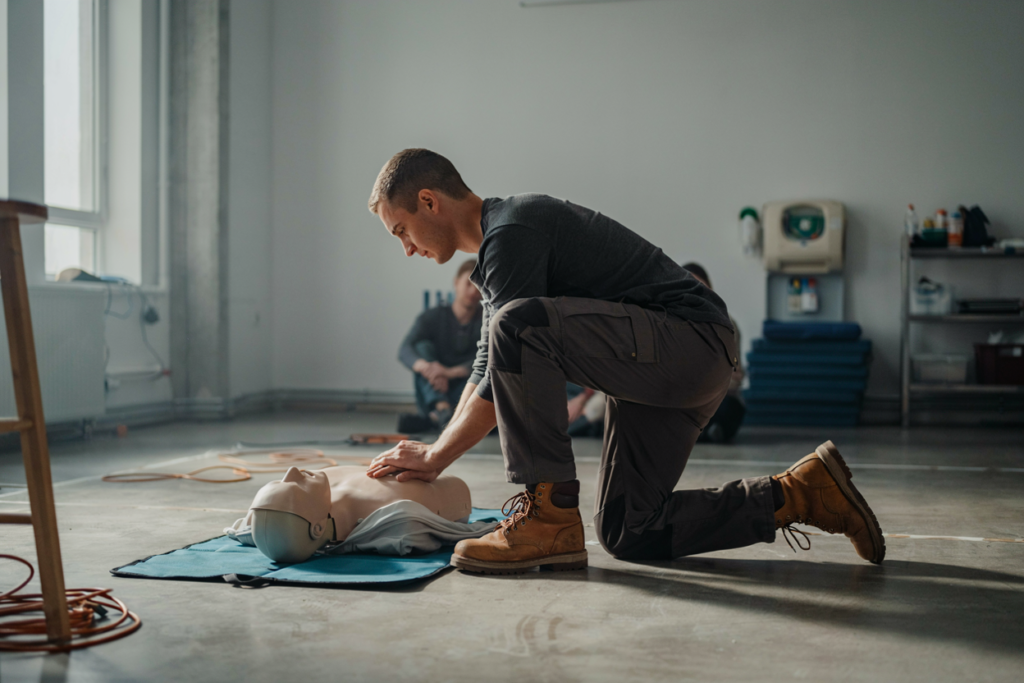
There’s a practical component to this course, and that means kneeling, bending, moving around on the floor, the same sort of positions you’d be in doing CPR or performing a rescue. Turn up in something stiff, tight, or your good work gear you don’t want to get dusty, and you’ll be regretting it before long. Think along the lines of what you’d wear on a normal work day, nothing fancy, just something you can move in.
If you’re coming straight from a job, whatever you’ve already got on will usually be fine. It’s the same reasoning as any other hands-on trade training, you’re not sitting behind a desk, you’re on the ground working through the motions with a manikin and a mock panel, so comfort wins over anything else.
Enclosed, sturdy footwear
No thongs, no sandals, no slip-on shoes with no backs on them. Enclosed and sturdy is the general rule, and if you’ve already got your work boots from the job you were on that morning, they’ll do the job fine. The point is, whatever’s on your feet needs to keep you steady and protected while you’re moving through the practical drills.
Here’s a quick way to check yourself before you head out the door:
Wear this | Skip this |
Work boots or enclosed sneakers | Thongs or slides |
Loose, movement-friendly pants | Stiff jeans or your good work pants |
A shirt you don’t mind kneeling in | Anything you’d be annoyed to get dusty |
Layers you can adjust | Heavy jackets that restrict movement |
Site-specific PPE: bring it if your employer requires it
This one’s situational. If your employer or head contractor has specific PPE requirements for you as a spark on their books, bring it along. But it’s not mandatory for the course itself, so if you rock up without it, that’s not going to hold you up. Everything you actually need for the rescue component is supplied on the day, more on that next.
🧰 Quick tip: Leave the toolbox at home. The rescue kit and manikins are all provided, so your job is just to show up and learn.
What’s Already Supplied, So You Don’t Overpack
A fair few people turn up thinking they need to bring half a toolbox with them. You don’t. This isn’t a job site, it’s a training room, and the equipment side of things is handled for you.
Rescue equipment provided on the day
Everything you’ll physically handle during the practical, the rescue kits, the CPR manikins, the gear specific to performing a low voltage rescue, is supplied. You’re not expected to source or bring any of it yourself. Your job is to show up, learn the technique, and get through the assessment.
This actually matters more than it sounds. A lot of tradies who’ve never done this specific unit before assume they’re meant to bring some of their own gear, insulated tools, their own PPE for the practical component, that sort of thing. You’re not. The whole point of a structured rescue course is that everyone’s working with the same equipment, checked and set up the same way, so the training is consistent no matter who’s in the room or what they’ve got in the back of the ute.
Assessment materials
Depending on how the course is run, assessment might be paper-based and instructor-led, or it might need your own device. Worth a quick check when you book so you’re not caught out either way, but either format, you won’t be left scrambling for materials on the day itself.
✅ Bottom line: The technical gear, the rescue equipment, and the assessment tools are all covered. Your packing list is short for a reason.
Often-Forgotten Extras Worth Bringing
Nobody fails a course because they forgot a snack. But a few small things make the day noticeably smoother, and they’re the sort of stuff that’s easy to overlook when you’re focused on the documents and the dress code.
Water and snacks
Having your own water bottle and something to snack on isn’t a bad shout. Training rooms aren’t always close to a servo or a shop, and you don’t want to be running on empty during a practical session.
A charged phone
Sounds obvious, but it’s easily overlooked when you’re rushing out the door. Your phone might be where your digital CPR proof lives, and if it’s on ten percent battery by the time you turn up, that’s not a great start. Chuck it on charge the night before along with everything else you’re prepping.
A pen
If any part of the day involves paperwork, enrolment forms, sign-in sheets, having your own pen means you’re not one of the ten people in the room hunting around for a spare. Small thing, but it’s the kind of small thing that adds up when you’re trying to get through admin quickly and get into the actual training.
A backup copy of your CPR proof
You’ve already got your CPR certificate sorted from the documents section above, but here’s the extra step, keep a backup. A screenshot on your phone as well as the physical card if you’ve got one. Cards go missing, phones die, and having two ways to prove it means one hiccup doesn’t turn into a hold-up.
What NOT to Bring / Common Mistakes That Delay the Day
This is the section that matters most if you’re the type who’s booked in last minute and just wants to get through the door without a hitch. These are the exact things that turn away tradies on the day, and every one of them is avoidable.
Expired or unverifiable CPR proof
If your HLTAID009 has lapsed, or you can’t produce anything that proves it’s current, you’re not getting assessed. This isn’t the trainer being difficult, it’s the prerequisite, and there’s no way around it on the day itself. Sort this before you turn up, not after.
Inappropriate footwear
Thongs, sandals, anything open-toed or unstable, and you’ll be pulled up before the practical even starts. It’s a safety call, not a style call, and it’s a completely avoidable way to lose time on a day you’ve already carved out.
Turning up without ID
No photo ID, no enrolment match, no Statement of Attainment that lines up with who you actually are. It’s a five-second check that becomes a real problem if you’ve left your wallet at home.
Unnecessary tools and equipment
You don’t need to bring your own tools, your own PPE beyond what your employer requires, or anything from your work van. Everything for the practical is supplied, and turning up with a bag full of gear you think you might need just means more stuff to carry around and keep track of.
A flat phone with your only copy of your CPR proof
If your only proof of your CPR certificate is a screenshot on a phone that’s about to die, you’ve created a problem for yourself that didn’t need to exist. This ties back to the backup point earlier, but it’s worth repeating here because it’s one of the more common ways people get caught out.
Conclusion
Getting ready for a low voltage rescue course really comes down to a handful of things sorted the night before, not scrambled together on the drive in. Your ID, your CPR proof, the right clothes, sturdy shoes. None of it is complicated on its own, it just adds up to a smoother day when you’ve actually thought about it ahead of time.
Most of the hold ups tradies run into on the day are avoidable, and that’s the frustrating part when you hear about someone getting turned away. An expired CPR certificate, thongs instead of enclosed shoes, a wallet left on the kitchen bench. Every one of these is a five minute fix if you catch it early, and a real problem if you don’t. The equipment side of things isn’t something you need to lose sleep over either, the rescue kits, the manikins, the gear you’ll actually be using in the practical, all of that gets handled for you. Your only job is showing up switched on and ready to work through the training properly.
None of what’s covered here is complicated once you actually sit down and think it through. It’s the kind of stuff that takes ten minutes to sort the night before and saves you a genuinely frustrating morning if you skip it. Most tradies who’ve done a few of these compliance courses already know the drill, but for anyone doing UETDRRF018 for the first time, it’s worth taking the checklist seriously rather than assuming you’ll figure it out on the spot.
There’s a bit of comfort in knowing the small stuff, the water bottle, the backup copy of your certificate, is what separates a stressful morning from an easy one. None of it changes whether you pass or fail, but it changes how the day feels, and that counts for something when you’ve already given up a day off the tools to be there. A bit of preparation the night before turns what could be a stressful morning into a straightforward one. Walk in with your documents sorted and the right gear on, and the rest of the day takes care of itself.
Book Your First Aid Training Now
Fast, affordable, and nationally accredited training delivered by professionals who care
Frequently Asked Questions
Q.Do I need to bring my own PPE?
No, not for the course itself. The rescue equipment and everything you need for the practical is supplied. Site-specific PPE only comes into it if your employer requires it for their own purposes. Otherwise, leave it at home.
Q.What happens if I can't find my CPR certificate?
Check your USI record first, as it will usually show your HLTAID009 qualification if it has been completed and recorded. If you still can't find it, contact the RTO that originally issued the certificate and request confirmation or a replacement. It's best to do this a few days before your course rather than on the morning of training.
Q.Do I need my own tools or equipment?
No. Rescue kits, manikins, and all equipment used during the practical assessment are supplied on the day, so there's no need to bring anything from your work van.
Q.What should I wear?
Wear comfortable, work-appropriate clothing and enclosed, sturdy footwear. You'll be kneeling and moving around on the floor during the practical, so stiff clothing or open-toed footwear will only make things harder.
Q.Can I use a digital copy of my CPR certificate?
In most cases, yes. A screenshot or digital copy is generally accepted, but it's worth keeping a backup in case your phone battery dies or the file becomes unavailable.
Q.What if I'm coming straight from a job site?
That's completely fine. Whatever you're already wearing for work will usually be suitable, provided your footwear is enclosed and you're wearing clothing you can comfortably kneel and move around in.
Q.Will I be turned away if I forget something?
It depends on what's missing. Forgetting a pen or water bottle won't stop your day, but arriving without photo ID or valid proof of your current HLTAID009 (CPR) certificate will. Make sure your required documents are sorted before you arrive.
Making first aid training more affordable for
every classroom
We believe every student deserves access to life-saving first aid knowledge. That’s why we offer specially reduced pricing for schools and educational groups. Whether you’re booking for a single class, a year group, or your entire school, our flexible packages make training more accessible and cost-effective — without compromising quality.
